
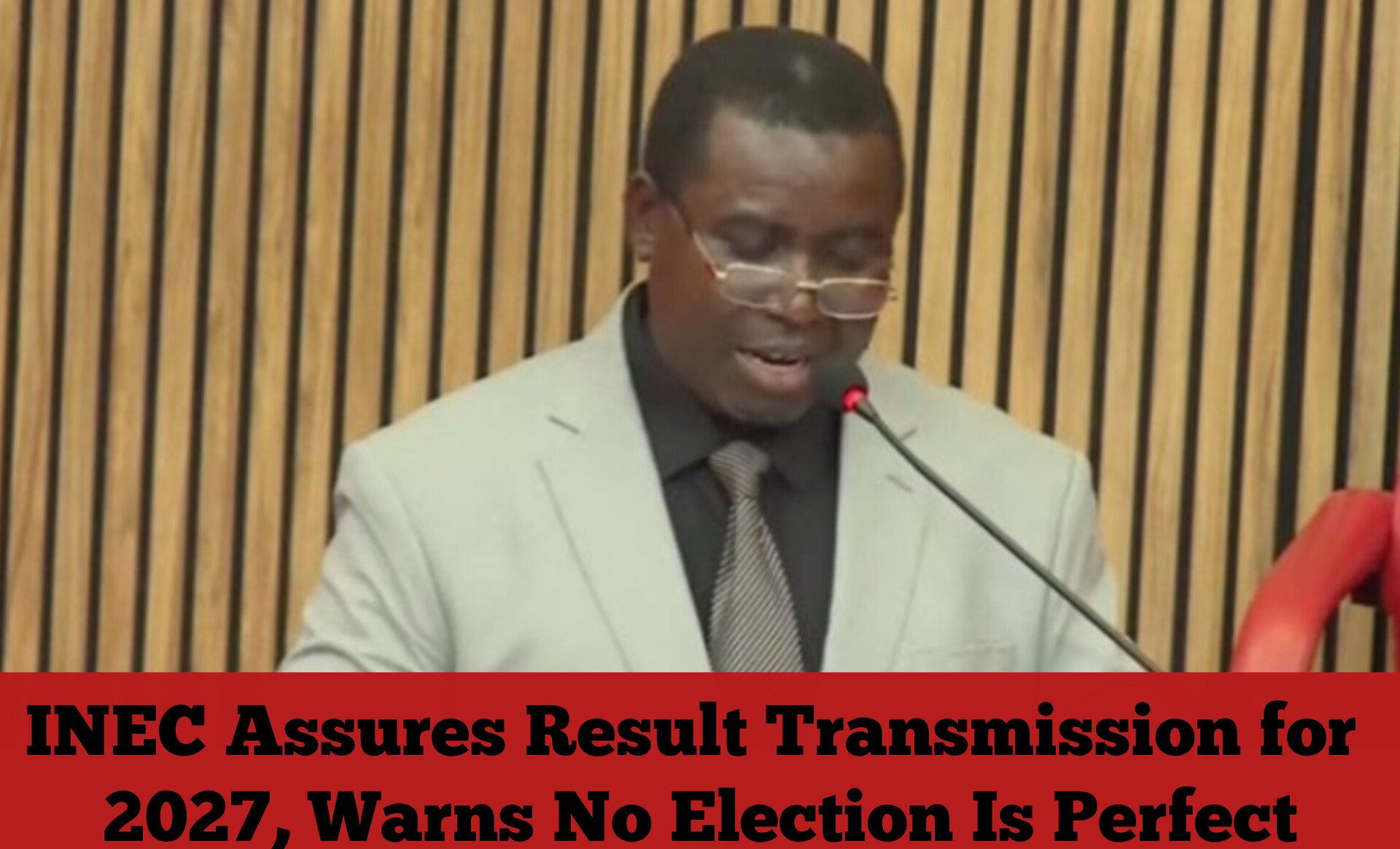
The Chairman of the Independent National Electoral Commission (INEC), Joash Amupitan, has assured Nigerians that the commission possesses the technical capacity to electronically transmit election results during the 2027 general elections, while cautioning that no election can be “100 per cent perfect.”
Amupitan gave the assurance on Sunday while speaking at a Citizens’ Town Hall programme titled “Electoral Act 2026: What it means for your votes and the 2027 elections,” aired live on major television networks.
The programme was anchored by broadcaster Seun Okinbaloye and the Executive Director of Yiaga Africa, Samson Itodo. Political stakeholders in attendance included the National Chairman of the All Progressives Congress, Nentawe Yilwatda; Labour Party Interim National Chairman Nenadi Usman; former Minister of Education Oby Ezekwesili; and Senator Ireti Kingibe, among others.
‘INEC Will Strive for Excellence, Not Perfection’
Appealing for public understanding, Amupitan said INEC would work towards delivering its best election yet but could not guarantee absolute perfection.
“What Nigerians desire is a perfect election, and INEC will strive as much as possible to give the country the best election. However, we may not be able to achieve a 100 per cent perfect election for now,” he said.
He reaffirmed the commission’s commitment to electronic results transmission, noting that the major concern remained the definition and feasibility of real-time transmission across all locations.
“As far as electronic transmission of results is concerned, we have the capacity to transmit the results, and we are going to transmit the results. The only concern was real-time,” Amupitan stated.
Describing elections as central to democratic governance, the INEC chairman stressed the importance of voter education and institutional transparency.
“Election is the lifeblood of democracy. According to Abraham Lincoln, the ballot is more powerful than the bullet. The ignorance of a voter is very inimical to the security of a nation,” he said.
He added that INEC and civil society organisations must work together to guarantee credible and transparent elections.
On debates surrounding electronic transmission of results, Amupitan disclosed that INEC pushed for mandatory transmission during deliberations on the Electoral Act 2026.
He cited the recent Federal Capital Territory Area Council elections, where difficult terrain and poor accessibility delayed results from Kabi ward in Kuje Area Council.
“The moment our officials entered that place, we could not reach them. They were not accessible by phone until we sent people to ensure their safety before the results were brought out and collated,” he explained.
Despite the delay, Amupitan maintained that transmission itself was not the core problem.
“The problem is not even the network, but the adequacy of the network available in some locations,” he said.
Linking election credibility to logistics, the INEC boss warned that operational failures could erode public confidence.
“Your election can only be as good as your logistics. Where there is logistics failure, you are beginning to fail,” he noted.
He acknowledged some logistical and human errors during the FCT poll but said corrective measures were already underway.
Amupitan expressed confidence that the 2027 general elections would be a marked improvement over previous polls, citing growing voter awareness and demand for accountability.
“The election of 2027 will be the best election Nigerians will have. People are much more aware, and there is a clear correlation between elections and development,” he said.
Meanwhile, INEC has commenced a comprehensive review of its regulations and guidelines for political parties as part of preparations for the 2027 elections.
According to a statement by the Chief Press Secretary to the INEC chairman, Adedayo Oketola, the exercise is aimed at aligning party regulations with the Electoral Act 2026, strengthening compliance, and reducing pre-election disputes.
INEC said the technical workshop would involve commissioners, directors, legal experts, and election administrators, with support from the Westminster Foundation for Democracy (WFD).
Speaking on the reforms, Amupitan said:
“For elections to inspire public confidence, the institutions that produce candidates must themselves operate transparently and within the law.”
WFD Nigeria Country Director Adebowale Olorunmola described the review as foundational.
“This isn’t just a review of a document; it is a reconstruction of the democratic foundation,” he said.
In compliance with the Electoral Act 2026, major political parties have begun digital membership registration nationwide.
The Peoples Democratic Party (PDP) announced the commencement of electronic registration across all wards, while the African Democratic Congress (ADC) launched a free online registration platform and directed existing members to revalidate their details.
The ruling APC, which concluded its e-registration exercise last month, is also expected to reopen its portal to accommodate more members following consultations among party leaders.
INEC said the early alignment of party membership registers with the Electoral Act would reduce litigation and enhance confidence in the electoral process ahead of 2027.


![[12/06, 9:04 am] rosewendy: President Donald Trump announced Wednesday the launch of a new website for his proposed $5 million U.S. residency visa, dubbed the "Trump Card." The online platform, now live at TrumpCard.gov, allows interested applicants to join a waiting list for what the former president has billed as an exclusive pathway to American residency. “Thousands have been calling and asking how they can sign up to ride a beautiful road in gaining access to the Greatest Country and Market anywhere in the World,” Trump said in a social media statement promoting the site. The high-priced residency visa — which Trump first teased in April while aboard Air Force One, holding a golden prototype card featuring his likeness — is intended as a premium alternative to the traditional U.S. green card. While the visas are not yet available for purchase or application, the new website invites visitors to submit their name, email address, and preferred visa type under the banner “The Trump Card is Coming.” Trump has pitched the program as a strategy to attract wealthy investors and entrepreneurs, claiming it could bolster the U.S. economy and potentially help address the national deficit. In February, he suggested that up to a million of these residency permits could be issued, and notably did not exclude the possibility that Russian oligarchs or other foreign elites might be eligible. The launch arrives at a contentious moment for U.S. immigration policy. The Trump administration has been intensifying deportation operations nationwide, drawing protests and legal challenges over alleged civil rights violations and aggressive enforcement tactics. Despite the controversy, Trump has continued to promote the visa program as a direct route to U.S. citizenship for those able to afford its steep price tag. [12/06, 11:32 am] rosewendy: "Trump Pitches $5 Million 'Golden Visa' for the Ultra-Rich Russian Oligarchs Welcome"](https://toscadnews.com/wp-content/uploads/2025/06/InShot_20250612_114252150.jpg)