Media experts have called for stronger professionalism, ethical standards, and strategic information management among public-sector information officers, citing the increasing complexity of the digital communication lansdscape.
The call was made in Keffi, Nasarawa state, during a three-day capacity-building workshop organised by the Nigerian Union of Journalists, NUJ, FCT Council and themed “Enhancing Public Image, Strategic Communication and Media Visibility in the Digital Era.”
Former President of the NUJ, Dr. Chris Isiguzo raised concerns over the deepening threats facing professional journalism in Nigeria, warning that unchecked misinformation, unregulated online content, and lack of legislative protection for journalists could further endanger the country’s democracy.

Dr. Isiguzo recommended investments in modern communication infrastructure, fact-checking systems, analytics-driven practices, multimedia storytelling and strict ethical adherence.
“Whatever you turn out must accommodate the fundamentals, so whoever is reading what you are publishing will say this is a professional doing the job,” he said.
Chairman of the NUJ FCT Council, Comrade Grace Ike, said capacity building for information officers was essential, as human resources remain any institution’s most valuable asset.
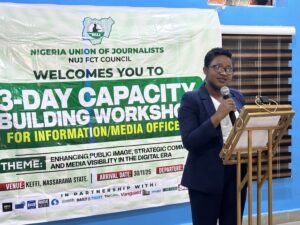
She noted that modern journalists must serve as strategists, crisis managers, digital communicators, and reputation protectors while upholding ethics, truth, and the public interest.
“Training and knowledge acquisition lead to excellence, elevate institutional credibility, improve communication, clarify governance, strengthen engagement, and foster a healthier democracy,“ she explained.
Head of Corporate Communications at the Nigerian Communications Commission (NCC), Mrs. Nnenna Ukoha, represented by Principal Manager of Public Affairs, Mr. Tunde Akpeji, explained that the training would strengthen professionalism, enhance efficiency, and equip officers with the skills needed to communicate effectively.
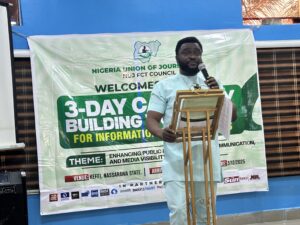
Communication scholar, Dr. Nicholas Igwenagu, emphasised that information officers are critical to shaping public perception and must balance accuracy with speed amid political pressure, limited resources and social-media-driven rumours. He underscored honesty, transparency and professionalism as the foundation of effective public communication.
Other experts, including Mr. Victor Habila Alaku, Dr. Simon Sheyigari, and the chairman of the Nigerian Institute of Public Relations, Mr Stanley Ogadigo, urged institutions to strengthen digital engagement, adopt comprehensive social media strategies, and prepare robust crisis-response systems to protect organisational reputation.
They warned that conservative attitudes toward digital platforms, online misinformation and coordinated disinformation attacks pose serious threats.
Two participants, Mr. Henry Ikechukwu from the Information department of the National Agency for Science and Engineering Infrastructure, NASENI and Ms. Ekaete Ibuot from a private media organisation, expressed satisfaction with the training, noting that the knowledge gained would enable them to deliver accurate and balanced information to the public.
Participants also developed practical crisis-communication frameworks and explored methods for monitoring public perception.