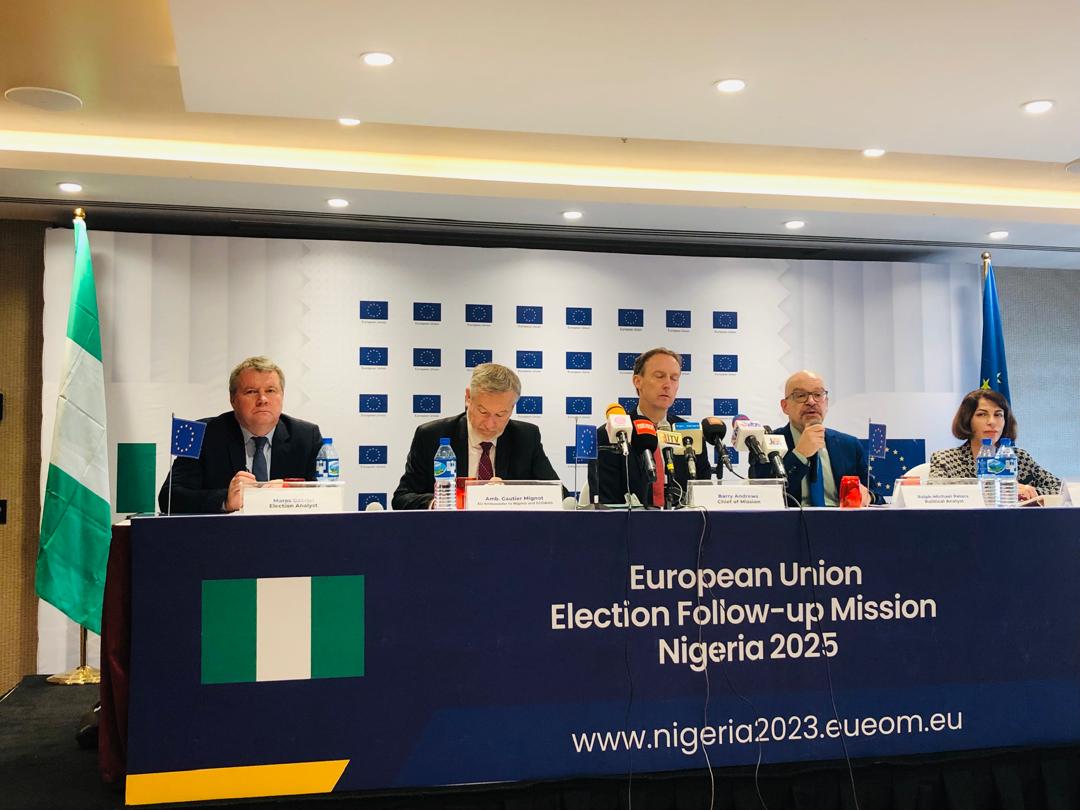
Only 1 of 23 EU Recommendations Fully Implemented Since 2023, Mission Says
The European Union Election Follow-Up Mission to Nigeria has issued a stark warning, stating that Nigeria risks repeating the serious flaws of the 2023 general elections unless urgent and coordinated reforms are implemented ahead of the 2027 polls.
Speaking at a press briefing in Abuja, the Chief of the EU Mission said progress on electoral reforms remains “modest”, with critical delays threatening to undermine public trust in future elections.
“Our evaluation indicates that progress in implementing the recommendations has been modest, and is in serious danger of falling to critically low levels,” the mission leader said. “Avoiding this outcome will require political will from legislators and urgent, coordinated administrative actions.”
Electoral Reform in Nigeria: The Numbers
The EU Election Follow-Up Mission reviewed 23 recommendations issued after the 2023 general elections. The mission found:
- 1 recommendation fully implemented
- 2 partially implemented
- 8 in progress
- 9 not yet acted on
- 3 too early to assess
Six Priority Areas for Reform Before 2027 Elections
To restore credibility and transparency in Nigeria’s democratic process, the EU Mission outlined six key reform areas:
- Transparent appointment of the new INEC chairperson expected later this year.
- Real-time publication of election results to boost transparency and public trust.
- Increased participation of women in politics, including support for the reserved seats bill.
- Accountability for electoral offences, including vote-buying, violence, and misuse of state resources.
- Legal clarity and reforms to remove ambiguity and allow INEC long-term planning stability.
- Protection of media freedom, including rapid investigation and prosecution of attacks on journalists.
Broad Consensus for Reform, But Action Lags
The mission highlighted a “rare convergence” between INEC, civil society, and international observers on the needed reforms.
“What we find especially important is the strong alignment between INEC, civil society, and our mission. Nigerians themselves are calling for the same reforms,” the EU mission chief noted.
Despite this alignment, the mission warned that delays in legislation and political inertia could jeopardize reform efforts.
“The Clock Is Ticking”: EU Issues Final Warning on Electoral Reform Timeline
While acknowledging the Electoral Act Amendment Bill 2025 and ongoing constitutional review, the EU mission stressed that timing is critical.
“If reforms are adopted too late, they risk causing uncertainty or even becoming impossible to implement,” the mission leader warned. “The clock is ticking, and the window is closing.”
According to the EU, political will—not technical expertise—will ultimately determine whether Nigeria can improve its electoral system in time for 2027.
“Political will, more than technical drafting, will determine whether these reforms succeed,” the mission concluded.
EU to Continue Support, Respects Nigeria’s Sovereignty
The EU affirmed its commitment to working with Nigeria’s National Assembly, INEC, and civil society, pledging continued technical support while respecting Nigeria’s sovereignty.