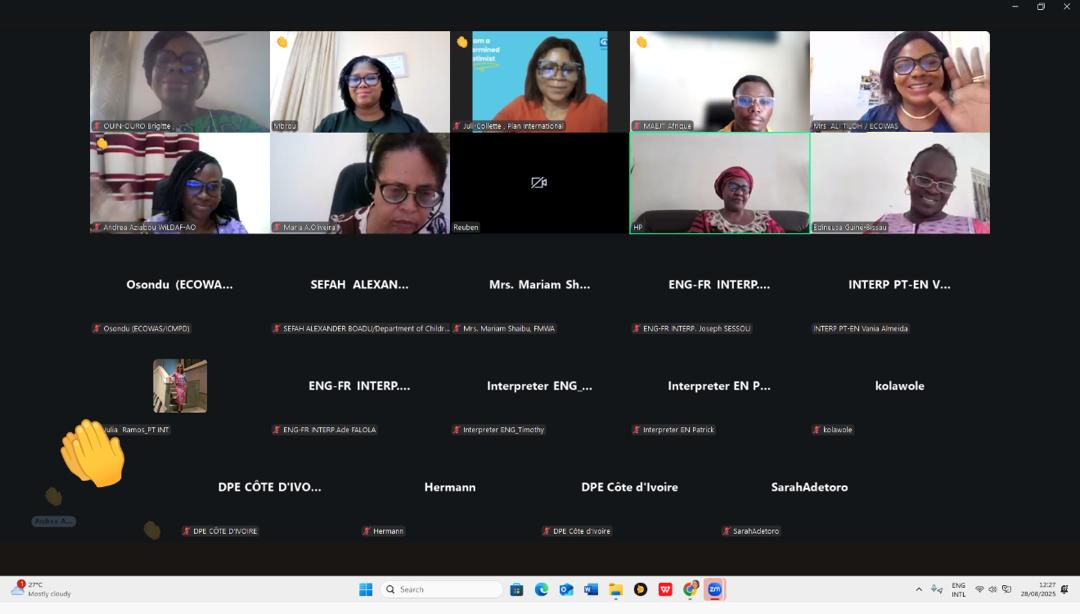
The Economic Community of West African States (ECOWAS) has reaffirmed its commitment to advancing child rights across the region following a three-day online meeting of directors responsible for child welfare in Member States.
The meeting, held from August 26–28, 2025, reviewed progress made since the adoption of the ECOWAS Child Policy by Heads of State and Government in June 2019. Discussions centered on national actions across the Policy’s four clusters of child rights, while also providing capacity-building support to help Member States integrate child rights programming into national development plans.
In her opening remarks, Dr. Sintiki Tarfa Ugbe, Director of Humanitarian and Social Affairs at ECOWAS, represented by Programme Officer Mr. Olatunde Olayemi, emphasized the Commission’s commitment to creating an enabling environment for every child in West Africa.
“Our priority is to ensure the rights and aspirations of every child are protected and advanced. This requires stronger collaboration among governments, partners, and communities,” Olayemi stated.
Technical sessions covered the Strategic Framework to Prevent and Respond to Violence Against Children, the ECOWAS Child Policy and its Strategic Plan, as well as child protection mandates of the Human Security and Civil Society Division.
Participants also reviewed a draft Terms of Reference for a proposed ECOWAS-Partners Child Rights Committee, discussed coordination within ECOWAS institutions, and shared updates on child protection initiatives led by organizations including UNICEF, IOM, ILO, Plan International, ISS-WA, and WILDAF-AO.
The meeting concluded with several recommendations, including:
strengthening information-sharing and data collection systems;
increasing budget allocations with child-sensitive focus;
and adopting a whole-of-society approach that involves governments, civil society, private sector, and community-based organizations.
Representatives from eight ECOWAS Member States, development partners, and child rights advocates participated in the regional dialogue.