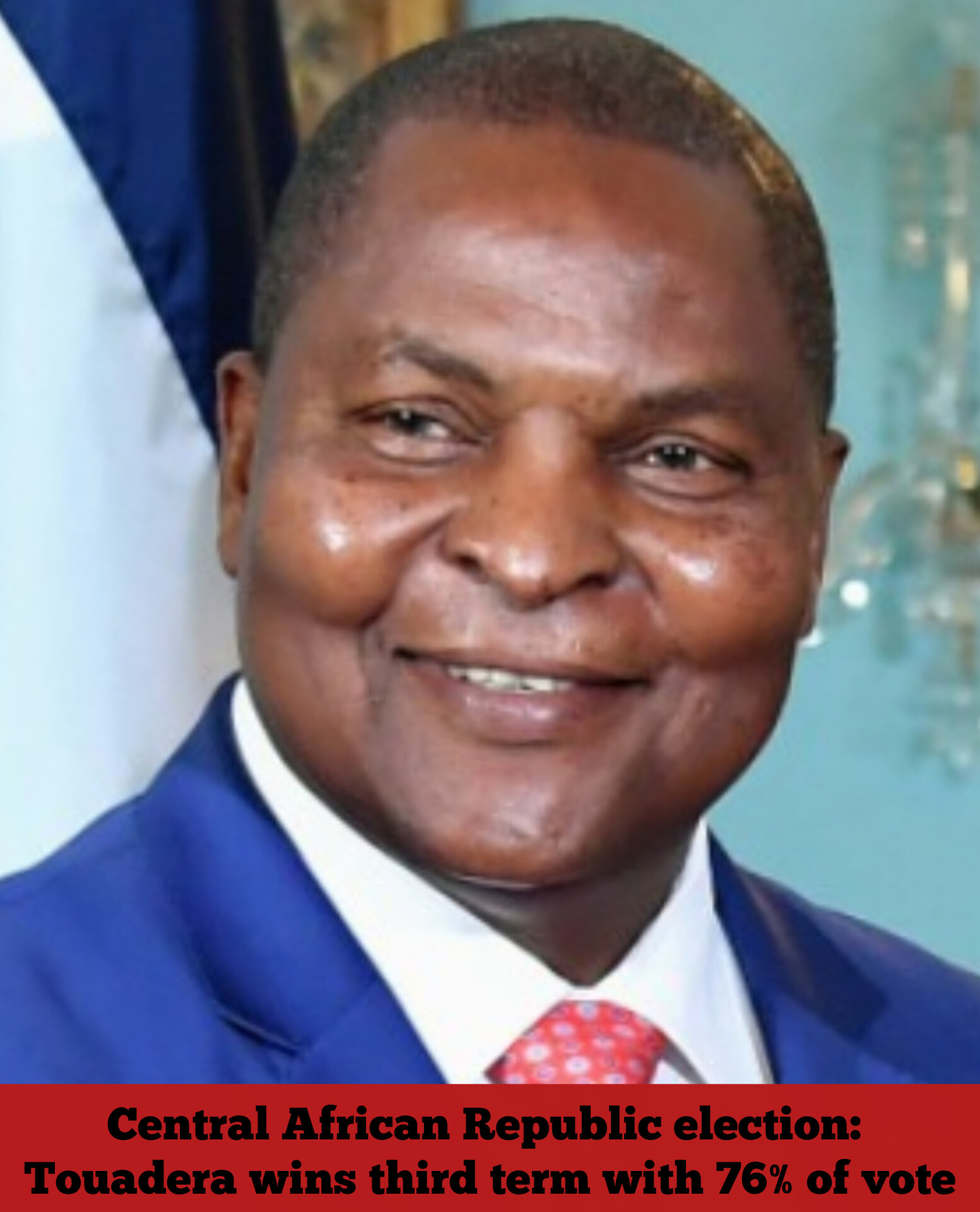
President Faustin-Archange Touadera has been re-elected as the leader of the Central African Republic (CAR) after securing a decisive victory in the country’s presidential election, according to provisional results released on Tuesday by the National Authority of Elections.
Touadera, 68, won more than 76 per cent of the votes cast, extending his grip on power to a third term following constitutional changes adopted in 2023 that cleared the way for his re-election. His closest challenger, Anicet-Georges Dologuele, finished second with about 15 per cent of the vote, while former prime minister Henri-Marie Dondra placed third with three per cent.
Announcing the results, the electoral authority said voter turnout stood at approximately 52 per cent in the polls, which were held alongside elections for national, municipal and local lawmakers.
Opposition figures, however, rejected the outcome, with Dologuele claiming victory last week and alleging widespread irregularities. “The polls were marred by major irregularities,” he said, describing the process as neither free nor fair.
Reacting to the allegations, a spokesperson for Touadera dismissed the claims as baseless, warning that such statements could fuel instability. “These allegations are false and risk creating unrest,” the spokesperson said.
Henri-Marie Dondra also called for the annulment of the election, while parts of the opposition had earlier urged voters to boycott the polls, branding them a “sham” and criticising the absence of inclusive political dialogue.
Despite the disputes, African Union election observers said the voting process unfolded peacefully. “The elections were conducted in a calm environment,” the AU mission said in a preliminary assessment.
The final results are expected to be announced in mid-January, after the review of any appeals.
Stability Pitch Amid Poverty and Conflict
Touadera campaigned as a “stability candidate” in a country that has endured decades of civil wars, coups and authoritarian rule since gaining independence from France in 1960. While security has improved since his first election in 2016, clashes between armed groups and government forces persist in some regions.
During the campaign, the president highlighted infrastructure and security gains, including improved road networks, public lighting on major avenues in Bangui, and renovated drainage systems. He also pointed to reforms such as the rebuilding of the national army, free healthcare for women and young children, and increased spending on higher education, achievements largely backed by international partners.
Critics, however, have labelled him “President Wagner,” accusing him of relying heavily on Moscow and Russian paramilitary forces to bolster national security. His controversial 2019 peace deal with 14 armed groups, which integrated former warlords into government in exchange for disarmament, remains a point of contention.
Opposition candidates also complained of restrictions during the campaign. Dologuele and Dondra said they were prevented from travelling to the provinces to hold rallies and were forced to limit their activities to local neighbourhoods, schools and party offices. Both men also faced possible disqualification over allegations of holding dual citizenship.
The election comes against a backdrop of deep socio-economic hardship. About 71 per cent of Central Africans live below the poverty line, grappling with poor infrastructure, limited access to basic services, widespread unemployment and a rising cost of living.