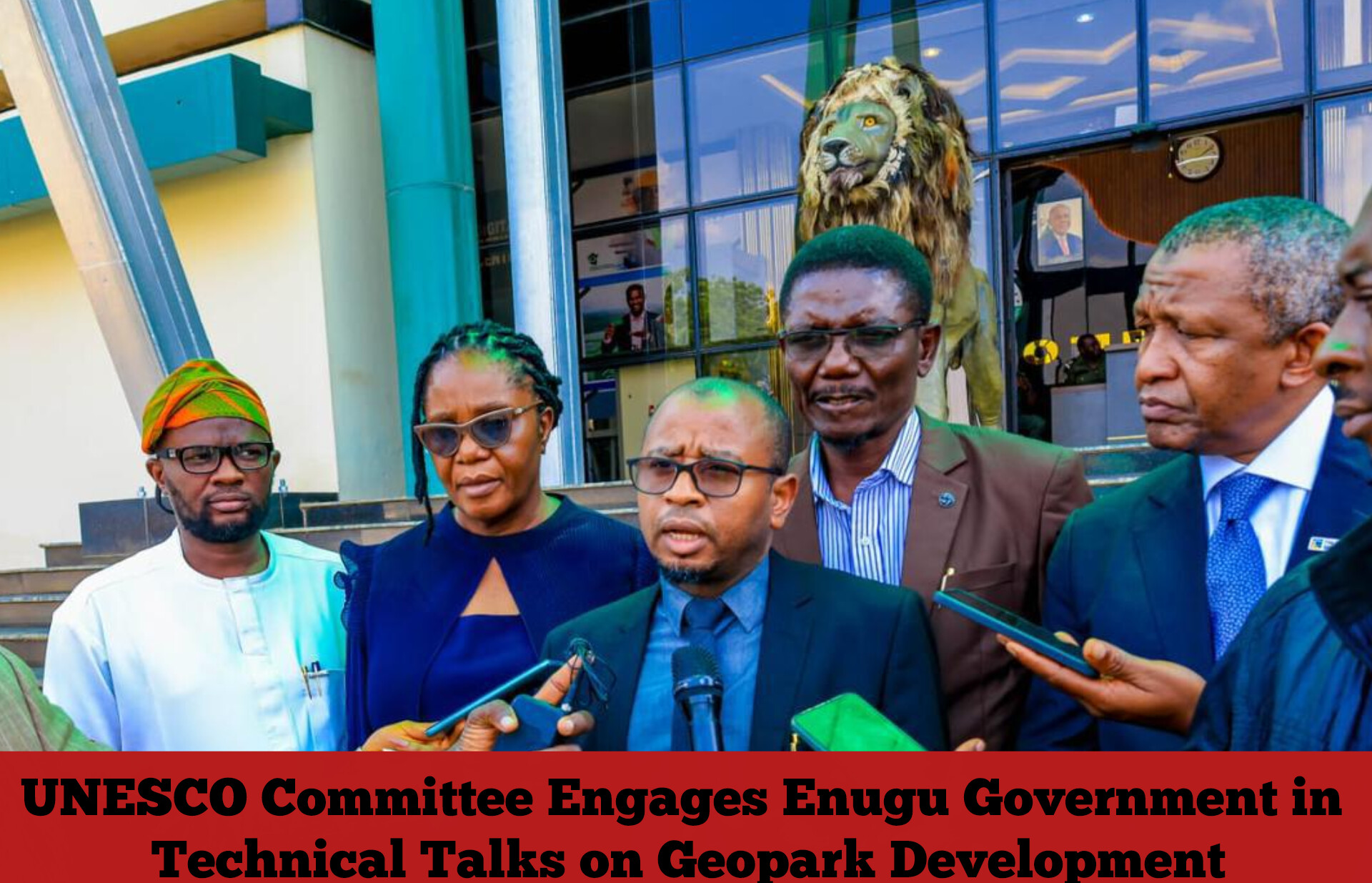
The UNESCO International Geoscience and Geoparks Programme (IGGP) Nigeria National Committee has commenced a high-level technical engagement with the Enugu State Government to advance geoheritage conservation and explore pathways for geopark development under the UNESCO framework.
The delegation, which paid a courtesy visit to Governor Peter Ndubuisi Mbah, included representatives of key geoscience bodies in Nigeria. Members of the team were led by the Director-General of the Nigeria Geological Survey Agency (NGSA) and Secretary of the UNESCO IGGP Nigeria National Committee, Professor Olusegun Ige, who was represented by Director Mrs Grace Okpala. Other delegates included Professor Nathaniel Goki of the Nigerian Mining and Geoscience Society (NMGS), Mr Uba Saidu Malami of the Geological Society of Nigeria, and Dr Ganiyu Mosuro of DigGeoNaija.
Discussions during the meeting focused on the global significance of Enugu State’s geological and cultural landscapes and the need to safeguard them through internationally recognised conservation mechanisms.
Governor Mbah stressed that protecting heritage assets is central to education, cultural continuity, and sustainable tourism.
“Preserving our geological and cultural heritage is critical to achieving our tourism development goals and increasing visitor numbers to Enugu State,” the governor said, adding that the state is committed to sustainable strategies that benefit local communities.
Speaking at the engagement, Chairman of the UNESCO IGGP Nigeria National Committee, Dr Aminu Abdullahi Isyaku, said Enugu hosts a wide range of geological features whose combined scientific, historical, and cultural values support a landscape-based conservation approach.
“The UNESCO International Geoscience and Geoparks Programme is a formal United Nations initiative that promotes responsible management of geological heritage while creating opportunities for education, research, and sustainable tourism,” Dr Isyaku explained.
He identified several locations as priority sites for geoheritage conservation and potential geopark development, subject to detailed technical assessments and stakeholder consultations. These include:
Ngwo Pine Forest, Cave and Waterfall System
Nike Lake and adjoining landscapes
Enugu coal mining heritage sites in Ngwo, Onyeama, and Iva Valley
Udi Plateau escarpment and sandstone formations
Ezeagu Waterfall and Ogbagada Caves
Milliken Hill and historic tunnels
Awhum Cave and Waterfall
Okpara Mines and old railway corridors
Dr Isyaku noted that the UNESCO IGGP framework discourages indiscriminate mineral exploitation and promotes ESG-aligned management of geological resources, balancing conservation with economic opportunities.
“Enugu’s identity as Nigeria’s Coal City provides a unique opportunity to show how post-mining landscapes can be repurposed for geotourism and sustainable development,” he said.
The Committee also recalled its recent briefing of Vice President Kashim Shettima, during which the Federal Government pledged support for geopark development and encouraged states to drive implementation through structured partnerships. Enugu State was selected as the first state-level engagement due to its strong geoheritage potential and alignment with emerging regional development priorities.
As a next step, the Committee proposed the establishment of a State Geopark Development Office to coordinate site management, community participation, and collaboration with state institutions, research bodies, and the UNESCO IGGP Nigeria National Committee.
The delegation expressed confidence that Enugu State is well positioned to play a leading role in Nigeria’s geopark journey, contributing to regional and global efforts to connect geology with culture, education, and sustainable economic growth.