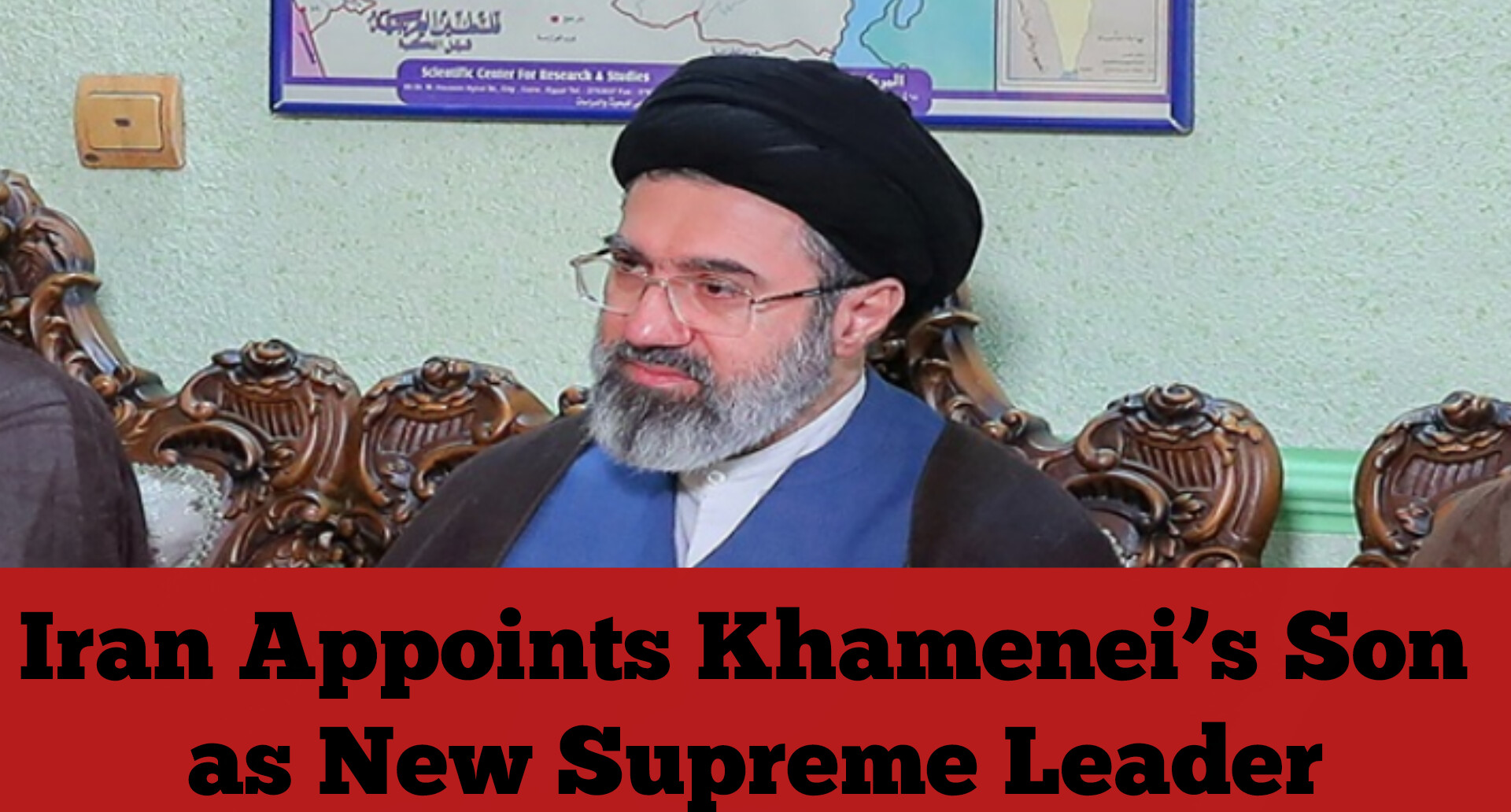
Iran’s powerful clerical establishment has appointed Mojtaba Khamenei as the country’s new Supreme Leader following the death of his father, Ali Khamenei, in recent U.S.–Israeli strikes that have intensified conflict across the Middle East.
The decision was announced nine days after the strikes killed the elder Khamenei and triggered a wider regional war. Iran’s Assembly of Experts convened to select a successor and named the 56-year-old cleric as the country’s third Supreme Leader since the 1979 Islamic Revolution.
In a statement, the clerical body said Mojtaba Khamenei “is appointed and introduced as the third leader of the sacred system of the Islamic Republic of Iran, based on the decisive vote of the respected representatives of the Assembly of Experts.”
The Assembly added that it “did not hesitate for a minute” in selecting a new leader despite what it described as “the brutal aggression of the criminal America and the evil Zionist regime.”
U.S. President Donald Trump had earlier dismissed the younger Khamenei as a “lightweight” and suggested Washington should influence the selection of Iran’s next leader.
“If he doesn’t get approval from us, he’s not going to last long,” Trump said in an interview with ABC News before the announcement.
However, Iran’s Foreign Minister Abbas Araghchi rejected the remarks, insisting the leadership decision was solely Iran’s.
“We will allow nobody to interfere in our domestic affairs,” Araghchi said during an appearance on NBC’s Meet the Press, while also demanding that Trump “apologise to people of the region” for triggering the conflict.
Meanwhile, fighting intensified as Israeli forces carried out overnight strikes on five oil facilities in and around Tehran, killing at least four people and igniting large fires that sent thick smoke over the Iranian capital.
Tehran’s governor said fuel distribution in the city had been “temporarily interrupted,” according to the IRNA news agency.
Residents described a dark haze blanketing the city of more than 10 million people as authorities warned that the smoke could be toxic.
“The blaze has been burning for more than 12 hours; the air has become unbreathable,” a 35-year-old Tehran resident said. “I can’t even go out to do the daily shopping.”
As the war entered its ninth day, Iran’s Islamic Revolutionary Guard Corps said it had enough supplies to continue missile and drone attacks for up to six months.
Explosions were also reported in Tel Aviv after Israel’s military detected a barrage of missiles launched from Iran. Emergency services said at least six people were wounded in central Israel.
A spokesperson for the Revolutionary Guards, Ali Mohammad Naini, said Iran had so far used only first- and second-generation missiles.
“We will use advanced and less-used long-range missiles in the coming days,” Naini warned.
The conflict is increasingly spilling into neighbouring countries.
Authorities in Saudi Arabia said two people were killed and 12 injured when a “military projectile” struck Al Kharj province, while Kuwait reported damage to fuel tanks at its international airport. Bahrain also confirmed damage to a water desalination.
Iran’s health ministry said at least 1,200 civilians had been killed and about 10,000 wounded in the fighting, although the figures could not be independently verified.
In Lebanon, health authorities reported that Israeli air strikes have killed at least 394 people since the country was drawn into the conflict a week ago, including 83 children and 42 women. Israel’s military also confirmed that two of its soldiers were killed during clashes in southern Lebanon.
Despite the intensifying conflict, analysts say there is still no clear path toward ending the war, which U.S. and Israeli officials warn could last for weeks.
President Trump has suggested Iran’s economy could be rebuilt if a leader “acceptable” to Washington replaces the late Supreme Leader.
Meanwhile, Pope Leo XIV called for an immediate end to hostilities.
“I pray that the roar of the bombs may cease, the weapons may fall silent, and a space for dialogue may open,” the Pope said.