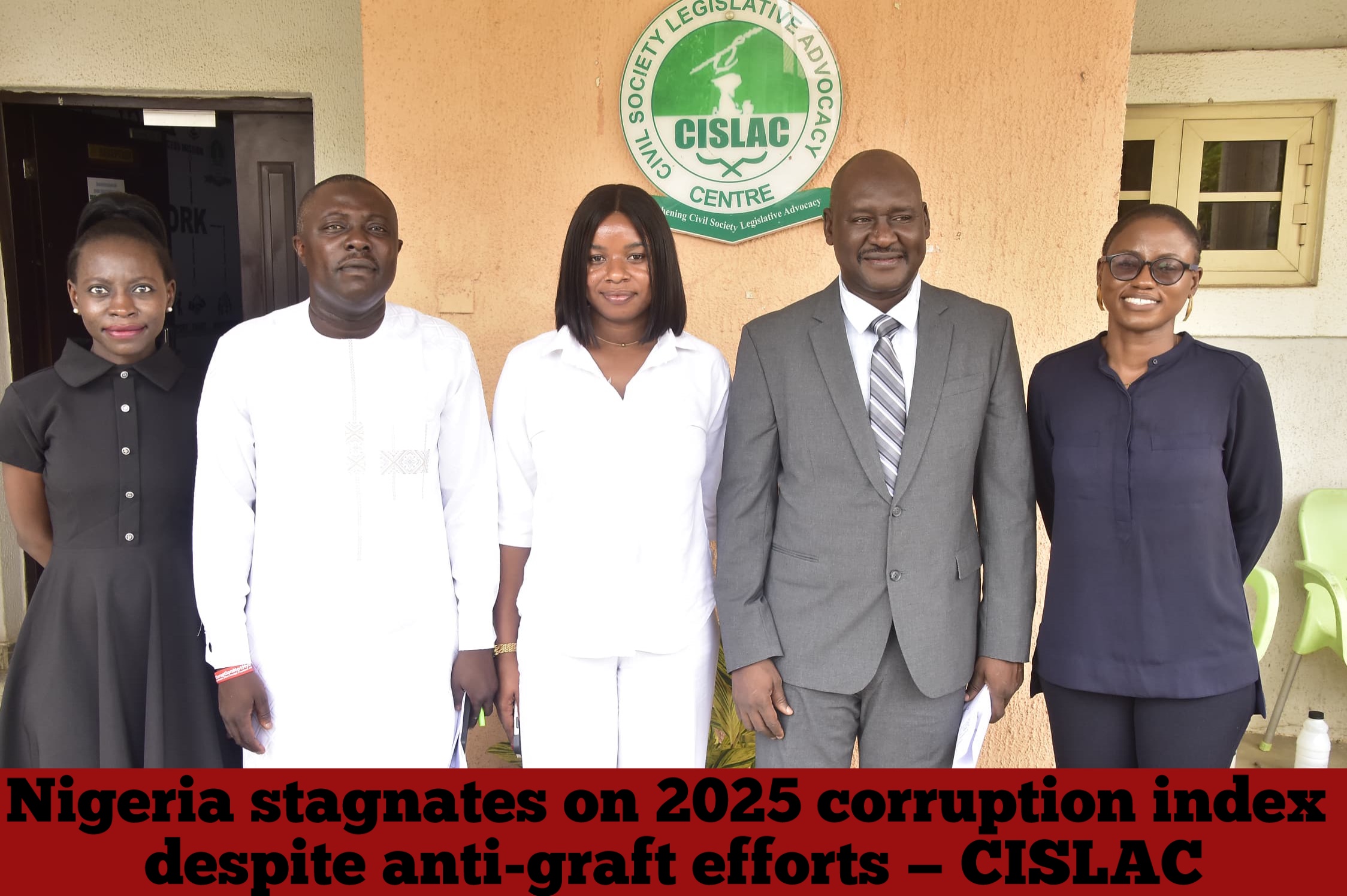
The Civil Society Legislative Advocacy Centre, CISLAC, says Nigeria’s performance in the 2025 Corruption Perceptions Index (CPI) reflects persistent governance and accountability challenges despite ongoing anti-corruption efforts.
The Executive Director of CISLAC, Mr. Auwal Rafsanjani stated this in Abuja, while reacting to Transparency International’s latest CPI report, which ranked Nigeria 142nd out of 182 countries with a score of 26 out of 100.
Rafsanjani, who noted that the CPI only captured public perception of corruption based on data from reputable institutions using rigorous research methodologies, acknowledged some positive developments, including improved asset recovery efforts by anti-corruption agencies.
He acknowledged some positive developments, including improved asset recovery efforts by anti-corruption agencies.
“Between October 2023 and September 2025, the Economic and Financial Crimes Commission (EFCC) recovered over ₦566 billion, $411 million, and more than 1,500 properties, while the Independent Corrupt Practices and Other Related Offences Commission (ICPC) recovered over ₦37 billion and $2.3 million in 2025.”
Rafsanjani who is also chairman, Board of Amnesty International, Nigeria highlighted Nigeria’s removal from the Financial Action Task Force (FATF) grey list in October 2025 after successfully implementing a 19-point action plan to strengthen its anti-money laundering and counter-terrorism financing frameworks.
On his part, Executive Director of the Centre for Fiscal Transparency and Public Integrity, Umar Yakubu, expressed concern over judicial corruption, legislative bribery, and oil revenue leakages.
“corruption in the judiciary, extortion in the legislature, and subsidy fraud continue to undermine governance and economic stability,”Yakubu said.
Also reacting to the report, the Senior Programme Officer at the Socio-Economic Rights and Accountability Project (SERAP), Folashade Arigbabu, called for far-reaching institutional reforms to strengthen Nigeria’s anti-corruption framework.
She stressed the need to guarantee the independence of anti-graft agencies, ensure transparent management of recovered assets, strengthen judicial oversight, and fully digitise government contracting and procurement processes.
Arigbabu further urged the National Assembly to expedite the passage of the Whistleblower Protection Bill and amend the Electoral Act to mandate the electronic transmission of election results, describing both steps as critical to improving transparency and accountability in governance.