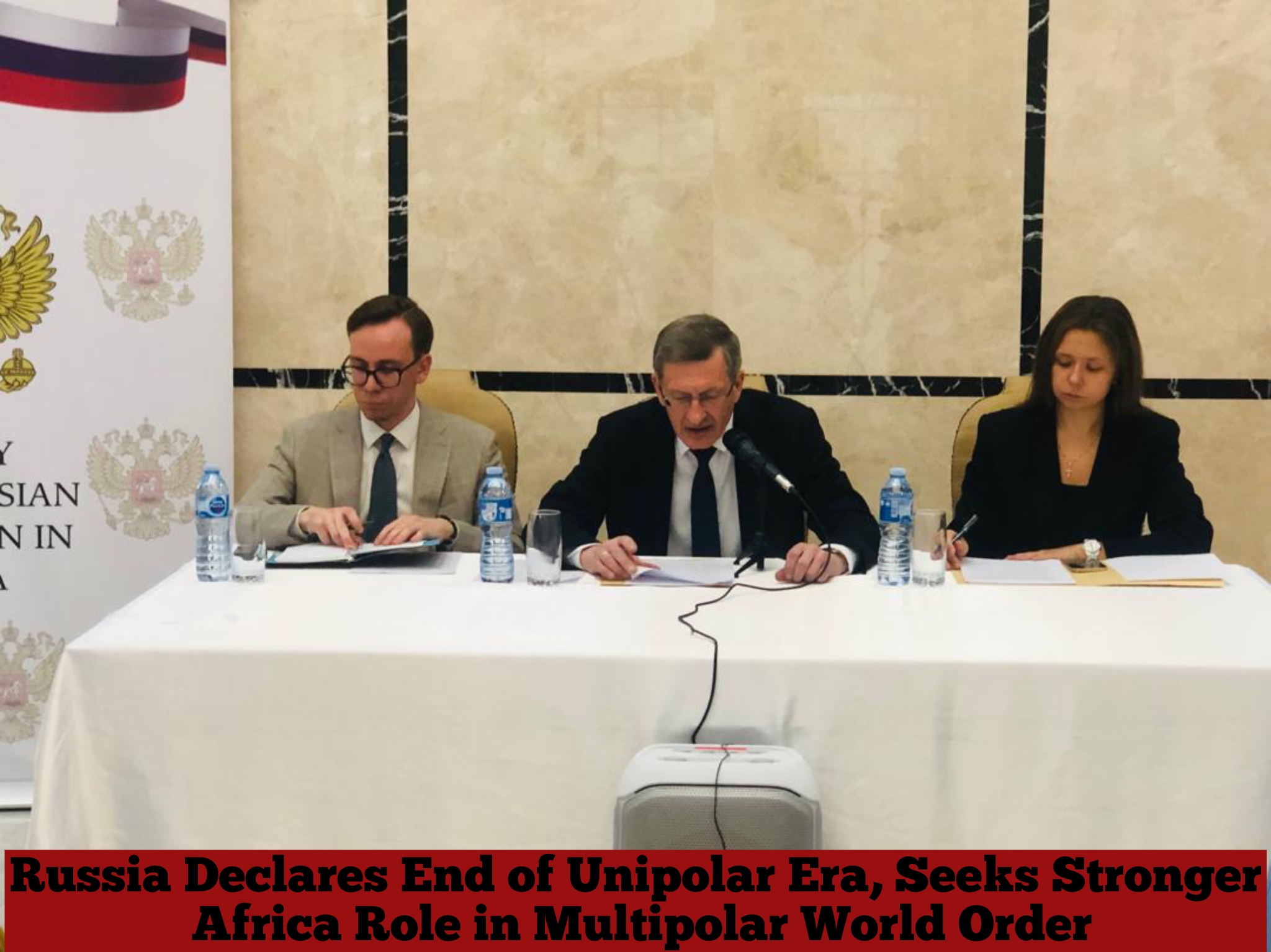
Russia says the era of a unipolar global system is over and has called for a more balanced international order anchored on sovereign equality, respect for international law and stronger representation for Africa and the Global South.
This was the thrust of a special briefing titled “Russia in a Multipolar World Order: African Perspective,” held to mark Russia’s Diplomatic Service Day. The event examined ongoing shifts in global politics and Moscow’s foreign policy priorities in the emerging multipolar era.
The Russian Ambassador to Nigeria, Mr. Andrey Podyolyshev stressed that diplomacy must return to dialogue rather than coercion.
“International cooperation remains essential for stability and development, yet diplomacy is increasingly replaced by unilateral actions and attempts to impose decisions on others,” the speaker said, adding that many states now suffer disregard for their sovereignty.
Citing President Vladimir Putin, he declared that “the era of a unipolar world is over,” noting the rise of new economic and political centres across Asia, Africa and Latin America.
According to the Ambassador, the combined purchasing-power GDP of BRICS countries now exceeds that of the G7, a development described as proof of irreversible global change.
“Multipolarity is not a slogan but an objective reality already taking shape,” the official stated. “No single model can claim universal status.”
The concept, it added, must rest on civilisational diversity where different cultures and political systems coexist without external diktat.
The Russian Ambassador reaffirmed his country’s commitment to the United Nations Charter as the foundation of international law, emphasizing principles of sovereign equality, non-interference and peaceful settlement of disputes.
“Security must be comprehensive, equal and indivisible. It cannot be ensured for some at the expense of others,” the briefing noted, warning that disregard for these principles fuels global crises.
He reiterated support for reform of global institutions to reflect contemporary realities, including expanded representation for Africa, Asia and Latin America on the UN Security Council.
A major focus of the discussion was Africa’s growing role in world affairs. The Russian Ambassador described the continent as “an independent actor, not an object of external influence,” with Agenda 2063 and the African Continental Free Trade Area cited as milestones of integration.
“Africa is already recognized as a third pole of global growth alongside the West and Asia,” the speaker observed, pointing to the continent’s demographic strength and resource potential.
Russia pledged to deepen partnerships with African nations based on equality and mutual benefit, rejecting conditional cooperation.
Humanitarian ties are also expanding, with more than 32,000 African students currently studying in Russia and scholarship quotas nearly tripled in recent years.
He highlighted Russia’s engagement through the UN, BRICS, the G20 and the Shanghai Cooperation Organisation as vehicles for building a fairer system. BRICS expansion, it said, demonstrates demand for a governance model not dominated by one bloc.
“Russia is not offering a new centre of diktat. We are one of the pillars of global balance – a balance that benefits everyone who values predictability,” the Ambassador emphasized.
He said that preparations for the third Russia–Africa Summit are underway, following the 2025 ministerial conference in Cairo which reaffirmed commitment to coordinated security and development initiatives.