
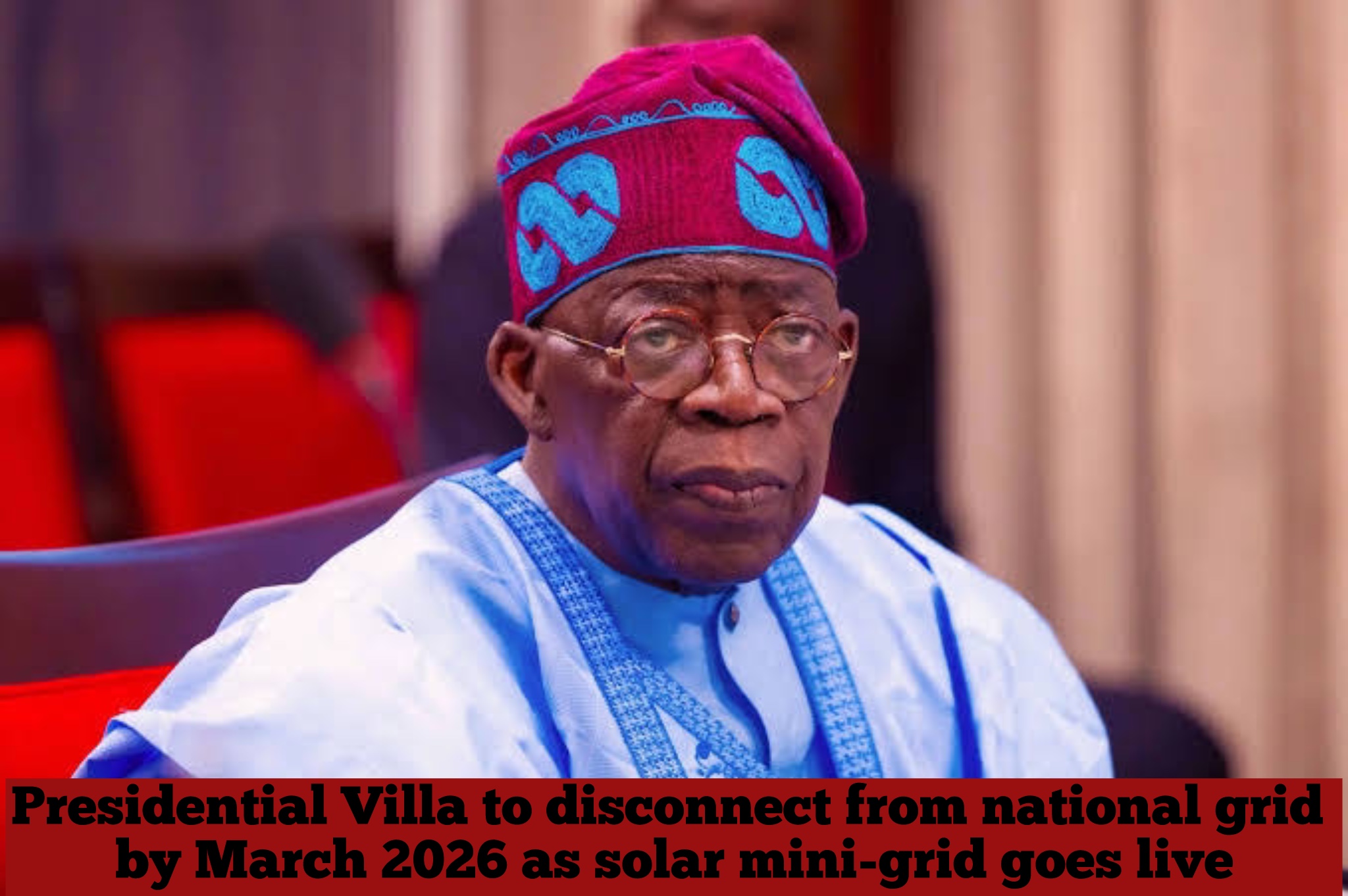
The Aso Rock Presidential Villa in Abuja will disconnect from Nigeria’s national power grid by March 2026 as it transitions fully to a newly completed solar mini-grid system.
The State House Permanent Secretary, Temitope Fashedemi, confirmed that the installation was finalized in late 2025 and has since undergone technical testing, with full reliance expected within the first quarter of 2026.
The solar project was backed by a N10 billion allocation in the 2025 budget and an additional N7 billion in the 2026 appropriation to ensure completion and operational readiness.
According to officials, the move is designed to reduce electricity costs, cut diesel consumption, and lessen the Villa’s reliance on a national grid that has struggled with frequent disruptions.
Fashedemi pointed to the State House Medical Centre’s earlier shift to solar energy in 2025 as proof of the system’s reliability. With battery storage support and limited grid input, the medical facility has maintained uninterrupted services.
Beyond cost savings, the transition addresses concerns over high electricity bills and alleged overbilling by distribution companies. Once the solar mini-grid becomes fully operational, most of the Villa’s aging diesel generators will be phased out, retained only for emergency backup.
The initiative forms part of the federal government’s broader energy diversification strategy, aimed at promoting renewable energy adoption, improving operational efficiency, and positioning key public institutions as models of sustainable power use in Nigeria.


