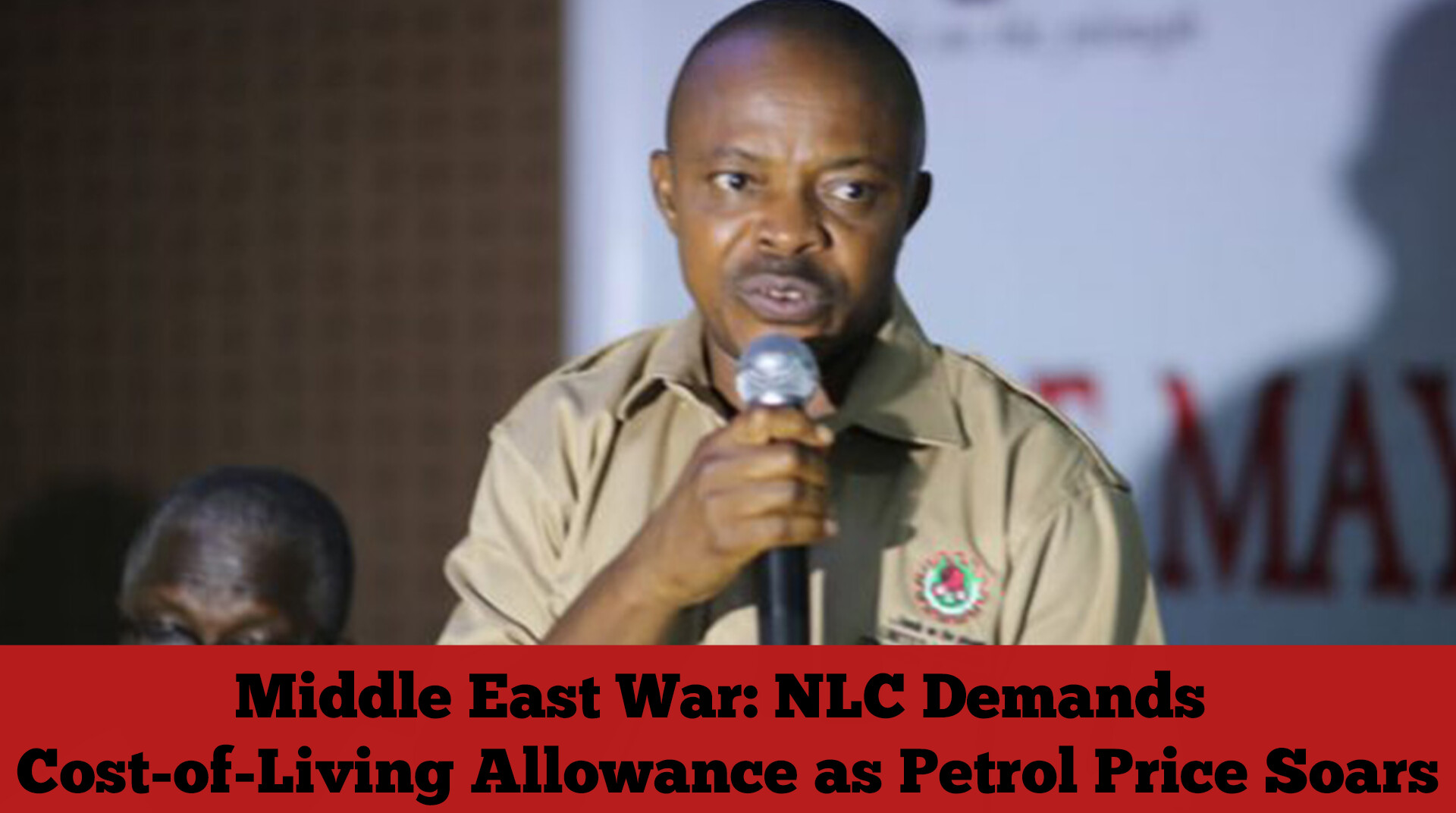
The Nigeria Labour Congress (NLC) has called on the Federal Government to introduce a cost-of-living allowance and grant tax relief for Nigerian workers to cushion the impact of the recent surge in petrol prices triggered by the ongoing crisis in the Middle East.
The labour union made the demand in a statement titled “Save Nigerians From This Shock: An Urgent Relief Has Become Necessary,” signed by its President, Joe Ajaero.
According to the NLC, the rising price of Premium Motor Spirit (PMS), commonly known as petrol, has worsened the economic hardship faced by workers and ordinary Nigerians.
The union urged the government to immediately introduce a wage award and cost-of-living allowance (COLA) for all workers to help them cope with the rising cost of living.
It also called for the expansion and overhaul of the government’s Cash Transfer Programme to ensure transparency and guarantee that assistance reaches the most vulnerable citizens.
“The transfers must reflect current inflation realities,” the union said.
The NLC further demanded immediate tax relief for workers, including the suspension of taxes affecting low-income earners and reforms in the taxation of the informal sector.
The labour body said the current situation had exposed the fragility of Nigeria’s downstream petroleum sector and intensified the suffering of workers and their families.
“NLC voices the collective anguish of millions of Nigerian workers who are bearing the brutal cost of a global capitalist crisis they did not create,” the statement said.
It added that the military escalation involving the United States, Israel, and Iran had triggered shockwaves across global oil markets, pushing petrol prices in Nigeria to between N1,170 and N1,300 per litre.
“This is a direct assault on the Nigerian people. While imperialist rivalries play out abroad with bombs and military escalation, Nigeria’s working class is being bombarded with poverty and hunger,” the NLC stated.
The union warned that Nigeria would remain vulnerable to global market shocks unless the government revives the country’s public refineries.
It called on the Federal Government to urgently rehabilitate and ensure the full operation of the Port Harcourt, Warri, and Kaduna refineries, stressing that billions of naira spent on turnaround maintenance must be accounted for.
“No nation achieves economic independence by exporting jobs and importing prices. The government must halt the decay of the public sector and ensure the full rehabilitation and operation of the refineries,” the NLC said.
The labour union also argued that the expected N30 trillion oil windfall from the ongoing Middle East crisis should be used to ease the economic burden on Nigerians.
“The estimated N30 trillion oil windfall expected from the Middle East crisis must not disappear like previous windfalls. These resources must be invested in the Nigerian people,” the statement said.
Meanwhile, Nigeria’s downstream petroleum sector has been experiencing intense volatility as marketers struggle to cope with fluctuating fuel prices linked to global crude oil movements.
Global oil benchmark Brent crude rose by about three per cent on Monday, reaching $106.50 per barrel, amid escalating tensions in the Middle East.
In Nigeria, the Dangote Refinery has repeatedly adjusted its petrol prices in response to the changing crude oil market.
The refinery increased its ex-depot price from N774 per litre to N874, and later to N995 per litre, representing an increase of about N221 within four days.
It subsequently raised the price again to N1,175 per litre, marking the fourth adjustment since to weeks ago.
Although the refinery temporarily reduced the gantry price by N100 to N1,075 per litre after crude oil prices fell, the price was later reinstated to N1,175 per litre as global crude prices surged again.
The National President of the Petroleum Products Retail Outlets Owners Association of Nigeria (PETROAN), Dr. Billy Gillis-Harry, said the price volatility may continue as long as the Middle East conflict persists.
“So long as this war is raging in the Middle East, we will continue to have fluctuations because the price of crude oil will continue to go high,” he said.
He warned that the association’s earlier projection that petrol prices could reach N2,000 per litre might eventually become a reality if the conflict drags on.
Gillis-Harry also urged the Federal Government to establish a domestic energy bank to provide funding for energy-related businesses, noting that many operators lack access to loans from commercial banks.
“Banks are not available to give us loans, and that’s why we have requested the government to set up a domestic energy bank that can take care of all the energy sources that are needed,” he added.