
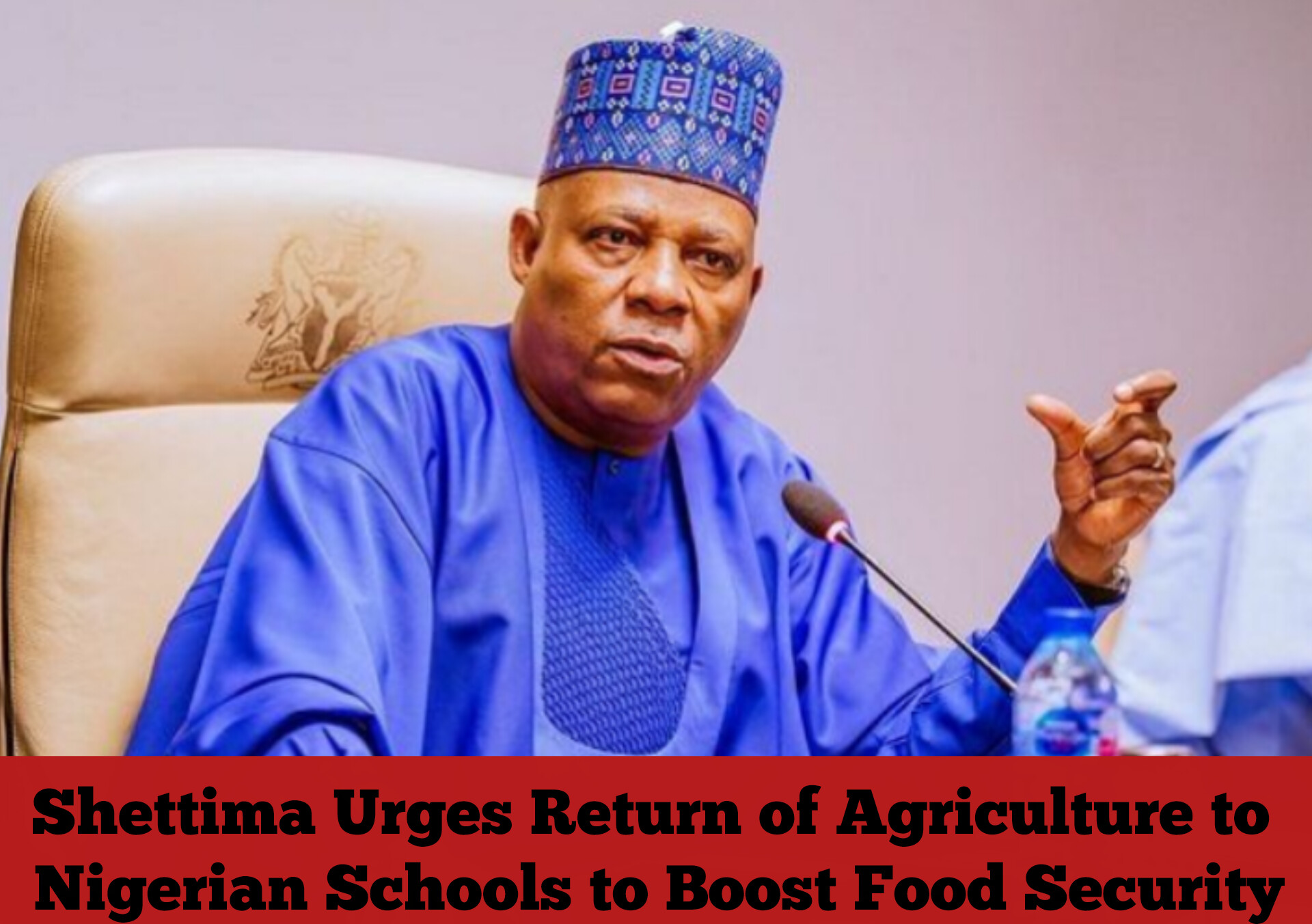
The Vice President of Nigeria, Kashim Shettima, has called for the reintroduction of agriculture into Nigerian schools as part of a national strategy to strengthen food security and economic stability.
Shettima made the call in Abuja during the General Assembly of Farmers, where he was represented by the Senior Special Assistant to the President on Public Health, Uju Rochas-Anwukah.
According to the Vice President, agriculture should return to schools not only as a subject but as a culture that shapes the mindset of young Nigerians.
“Agriculture must return to our schools. We must reintroduce agriculture as culture, not just curriculum,” Shettima said.
He urged schools across the country to establish functional farms and revive agriculture clubs to teach students the value of food production, land use, and agribusiness.
“Every school should have functional farms. Agriculture clubs must return—not only to teach planting, but to shape the mindset,” he added.
Shettima stressed that Nigerian children must grow up seeing farming as a viable and respectable profession.
“Our children must grow up knowing that food is wealth, that land is power, that farming is business, and that agriculture is not punishment, but possibility,” he said.
He further noted that national development begins with a strong agricultural foundation.
“The fundamentals of life—food, shelter, clothing—begin from the soil. And no nation industrialises without first securing its agricultural foundation.”
The Vice President also criticised the long-standing perception of farming as a low-status occupation, describing it as harmful to Nigeria’s food security and national growth.
“For too long in our dear nation, farming has been treated as a last option—a job for those who ‘could not make it’. That thinking is not just wrong; it is destructive,” he said.
Shettima emphasised that agriculture remains a nation-building profession and called on leaders to be directly involved in farming.
“Farming is not a low-status profession. Farming is a nation-building profession. Leadership must farm,” he said.
He urged national institutions, including the military, paramilitary agencies and the National Youth Service Corps (NYSC), to sustain institutional farms.
“Our national institutions—the Army, Air Force, Navy, NYSC, and paramilitary agencies—must sustain institutional farms. Not as charity, but as responsibility,” he added.
Also speaking at the event, the Minister of Defence, General Christopher Musa (retd.), acknowledged the security challenges facing farmers across the country.
He assured stakeholders of the Federal Government’s commitment to improving safety in farming communities and urged farmers to report security threats promptly.
Protecting farmers, he said, was essential to sustaining national food production.
In his opening address, the President of the All Farmers Association of Nigeria (AFAN), Dr Farouk Mudi, highlighted the impact of climate change, rising input costs, and insecurity on agricultural productivity.
“We are witnessing the ‘vanishing harmattan’ and erratic rainfall patterns. In the last year, the onset of rains in the Savannah belt was delayed by nearly 21 days, followed by flash floods that decimated over 500,000 hectares of rice and maize,” Mudi said.
He added that fertiliser and agrochemical prices had surged drastically.
“Two years ago, a bag of NPK fertiliser was N26,000; today, it is over N53,000. The cost of high-quality agrochemicals has risen by 300%.”
Mudi warned that farming was becoming too expensive for small-scale farmers.
“Farming is becoming too expensive for the very people who must provide the food,” he said.
Mudi also described Nigeria’s livestock sector as being in crisis despite the country’s large animal population.
“Nigeria is a livestock powerhouse with 21 million cattle, 43 million sheep, and 82 million goats. Yet, we spend $1.5 billion annually importing milk and dairy products,” he said.
According to him, farmer-herder conflicts have led to massive losses.
“In the last decade, we have lost over 10,000 lives and N500 billion in property to farmer-herder clashes. We have lost over 3 million cattle to rustling and unplanned migration.”
He said AFAN fully supports the National Livestock Transformation Plan, which promotes ranching and modern livestock management.
“We want our herders to become modern agribusinessmen in settled ranches, and our farmers to work their fields without fear.”
Mudi further revealed that Nigeria loses about $10 billion annually to food imports.
“Security is the first input of agriculture. Every year, Nigeria bleeds $10 billion to import food items like wheat, sugar, and fish. This is money that should be in the pockets of the farmers sitting in this room.”
Agriculture was once a core part of Nigeria’s educational system and rural economy, providing skills, employment, and food for the population.
However, reduced emphasis on practical farming in schools, growing dependence on food imports, insecurity, and climate challenges have weakened local food production and discouraged young people from entering the sector.

