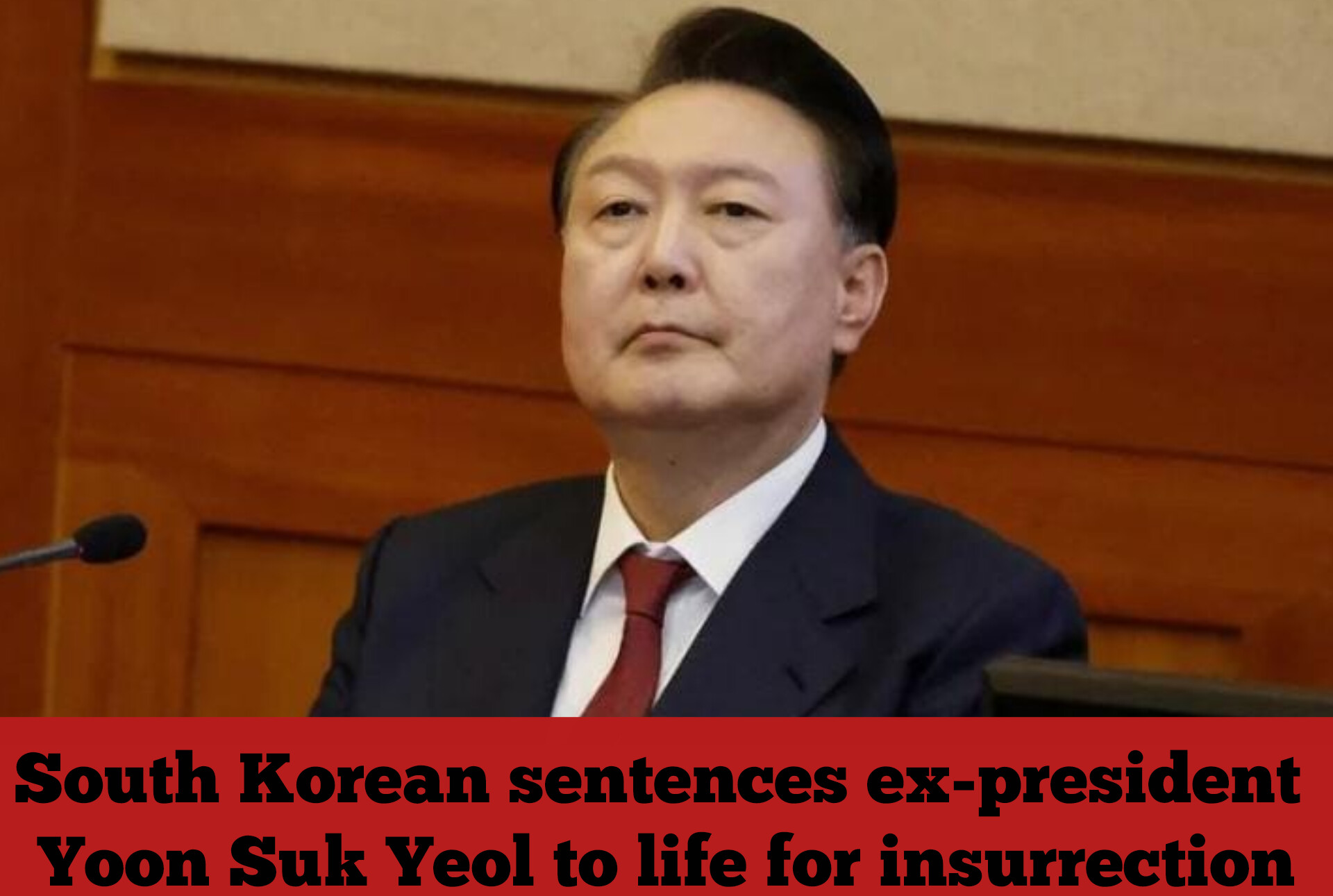
A South Korean court has sentenced former president Yoon Suk Yeol to life imprisonment after finding him guilty of leading an insurrection stemming from his declaration of martial law two years ago, in a case that has shaken the foundations of the country’s democracy.
Delivering the judgment at the Seoul Central District Court, presiding judge Ji Gwi-yeon said Yoon deliberately deployed troops to the National Assembly in an attempt to silence political opponents and cripple legislative activities.
“The court finds that the intention was to paralyse the assembly for a considerable period,” Ji said.
Yoon, 65, a hardline conservative, stunned the nation when he abruptly declared martial law in a late-night televised address, arguing that drastic measures were necessary to root out what he described as “anti-state forces” within parliament. The decree suspended civilian governance and ushered in military rule, before lawmakers overturned it in an emergency vote just six hours later.
According to the court, the declaration inflicted serious damage on South Korean society and democratic norms.
“The declaration of martial law resulted in enormous social costs, and it is difficult to find any indication that the defendant has expressed remorse,” Judge Ji added before announcing the sentence.
“We sentence Yoon to life imprisonment.”
Under South Korean law, insurrection carries only two possible penalties — life imprisonment or death. Prosecutors had pushed for the death sentence, urging the court during January hearings to impose the harshest punishment. However, South Korea maintains an unofficial moratorium on executions, making life imprisonment the most severe effective penalty.
Former defence minister Kim Yong-hyun was also convicted for his role in the crisis and sentenced to 30 years in prison.
Scenes of heavy security unfolded outside the courthouse as the verdict was read. Police in neon-coloured jackets formed barricades with buses parked nose-to-tail, while loud shouts rang out as a blue prison bus believed to be carrying Yoon entered the court complex.
Yoon has been held in solitary confinement while facing multiple criminal trials. He has consistently denied wrongdoing, insisting he acted to “safeguard freedom” and restore constitutional order against what he called an opposition-led “legislative dictatorship.” Prosecutors, however, accused him of spearheading an insurrection driven by a “lust for power aimed at dictatorship and long-term rule.”
The court also noted that Yoon had already been sentenced to five years in prison on lesser charges, with several senior officials facing lengthy jail terms related to the martial law episode.
The declaration triggered flash protests nationwide, rattled financial markets and caught key allies, including the United States, off guard. For many South Koreans, the crisis revived painful memories of past military coups, undermining the country’s image as a stable democratic beacon in Asia.
In a related development, Yoon’s wife, Kim Keon Hee, was sentenced earlier this year to 20 months in prison on unrelated bribery charges dating back to her time as first lady.