Public outrage has erupted following the sexual assault of several women and female students during the controversial ‘Alue-Do’ festival in Ozoro, headquarters of Isoko North Local Government Area of Delta State.
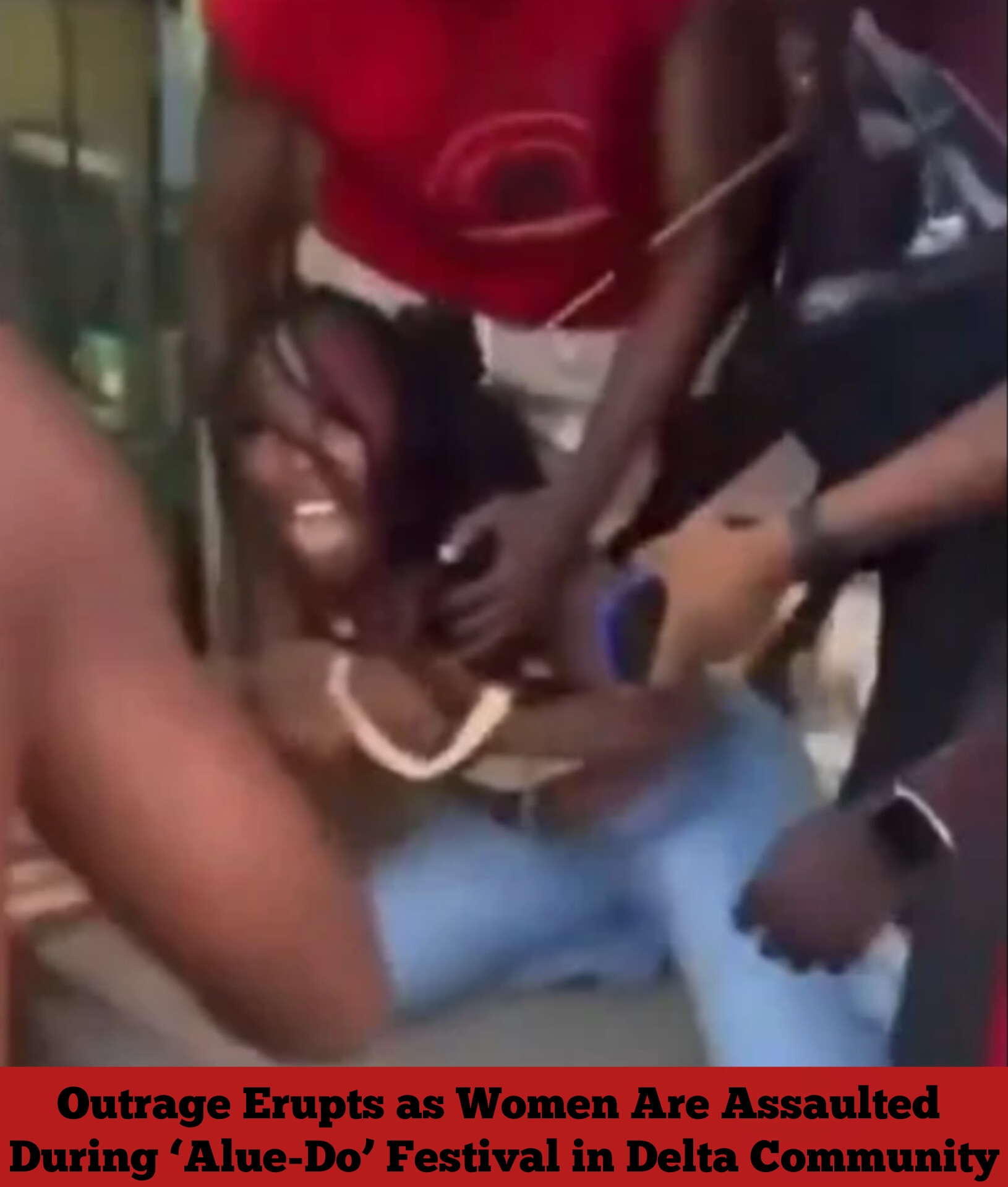
The incident, which occurred three days ago, gained national attention after disturbing videos surfaced on social media showing young women being chased, stripped, and molested in broad daylight by groups of youths.
In one of the widely circulated clips, a young woman seated on a motorcycle was dragged to the ground by attackers who tore her clothes while assaulting her. Another video captured a victim fleeing as her dress was pulled off, leaving her exposed, while a separate clip showed a woman struggling to shield herself from a mob.
The number of victims could not be independently verified as of press time.
Residents said the festival, described as a fertility rite intended to invoke blessings for couples seeking children, involves controversial practices, including restricting women’s movement during certain periods.
A female resident, who spoke on condition of anonymity, said prior warnings were issued.
“The organisers of the festival announced its commencement and warned that no woman should go out,” she said.
Many residents reportedly shut down businesses and stayed indoors, while non-indigenes fled the community.
On social media, a resident identified as Vallery wrote, “So bad. I locked myself inside the house.” Another user, Slim Mama, added, “Same here. I have been so scared to step outside my door.
The Ovie of Ozoro Kingdom, His Royal Majesty Anthony Ogbogbo, distanced himself from the festival, expressing shock at the development.
“I have more than 200 videos and photographs of what transpired… I have never heard that a festival is celebrated with girls being harassed, sexually molested or raped in my community,” the monarch said.
The Student Union Government President of Southern Delta University, Oribelua Precious, confirmed that some victims were students and had been hospitalised.
“The doctor confirmed that no student was penetrated but they were molested. Attempted rape is still a serious matter,” he said.
Precious added that students claimed they did not fully understand the warning issued before the festival.
“Who knows what would have happened in places where there are no cameras,” he said, calling for better communication of cultural practices in a student-populated environment.
In a joint statement, community leaders, including President-General Chief Berkley Asiafa and Secretary-General Prince Obaro Egware, condemned the incident, describing the actions of the youths as irresponsible and not reflective of local culture.
They confirmed that security agencies had been contacted and investigations were ongoing.
The Delta State Government described the incident as “barbaric and unacceptable,” stressing that cultural practices must not serve as a cover for criminal acts.
Commissioner for Works (Rural Roads) and Public Information, Charles Aniagwu, said:
“Such barbaric acts are totally unacceptable and have no place in our society.”
He directed security agencies to investigate and ensure perpetrators are prosecuted.
The Nigeria Police Force confirmed the arrest of a community leader, Omorede Sunday, and four others believed to be organisers of the festival.
Police spokesperson Bright Edafe said:
“The community head and chief organiser of the event and four other suspects have been arrested… No custom or tradition is superior to the rights of citizens.”
He added that the suspects had been transferred to the State Criminal Investigation Department, while investigations continue.
The Minister of Women Affairs and Social Development, Imaan Sulaiman-Ibrahim, ordered the arrest of all suspects and called for a thorough investigation.
“No cultural or traditional practice can justify or excuse sexual violence in any form,” she said.
The National Association of Nigerian Students (NANS), Zone B, described the incident as a gross violation of human rights and a threat to student safety, urging security agencies to ensure justice is served.
The incident has drawn widespread condemnation from citizens, activists, and legal experts.
Former Minister of Education, Oby Ezekwesili, described the development as a
failure of governance and preventive policing.
“When a society begins to warn women to stay indoors to avoid being attacked… that society signals a collapse of law, order and moral leadership,” she said.
Human rights lawyer Inibehe Effiong also condemned the practice, stressing that no culture permits the targeting of women.
“There can be no culture in any part of Nigeria that permits the targeting or discrimination of women,” he said.
A coalition of over 500 women’s rights organisations under Womanifesto described the incident as “organised and institutionalised abuse,” calling for immediate prosecution of those responsible.
“This is not our culture… it must be treated as a crime,” the group stated.
Legal experts further emphasised that Nigeria’s Constitution and the Violence Against Persons (Prohibition) Act guarantee the rights to dignity, freedom of movement, and protection from inhumane treatment.