
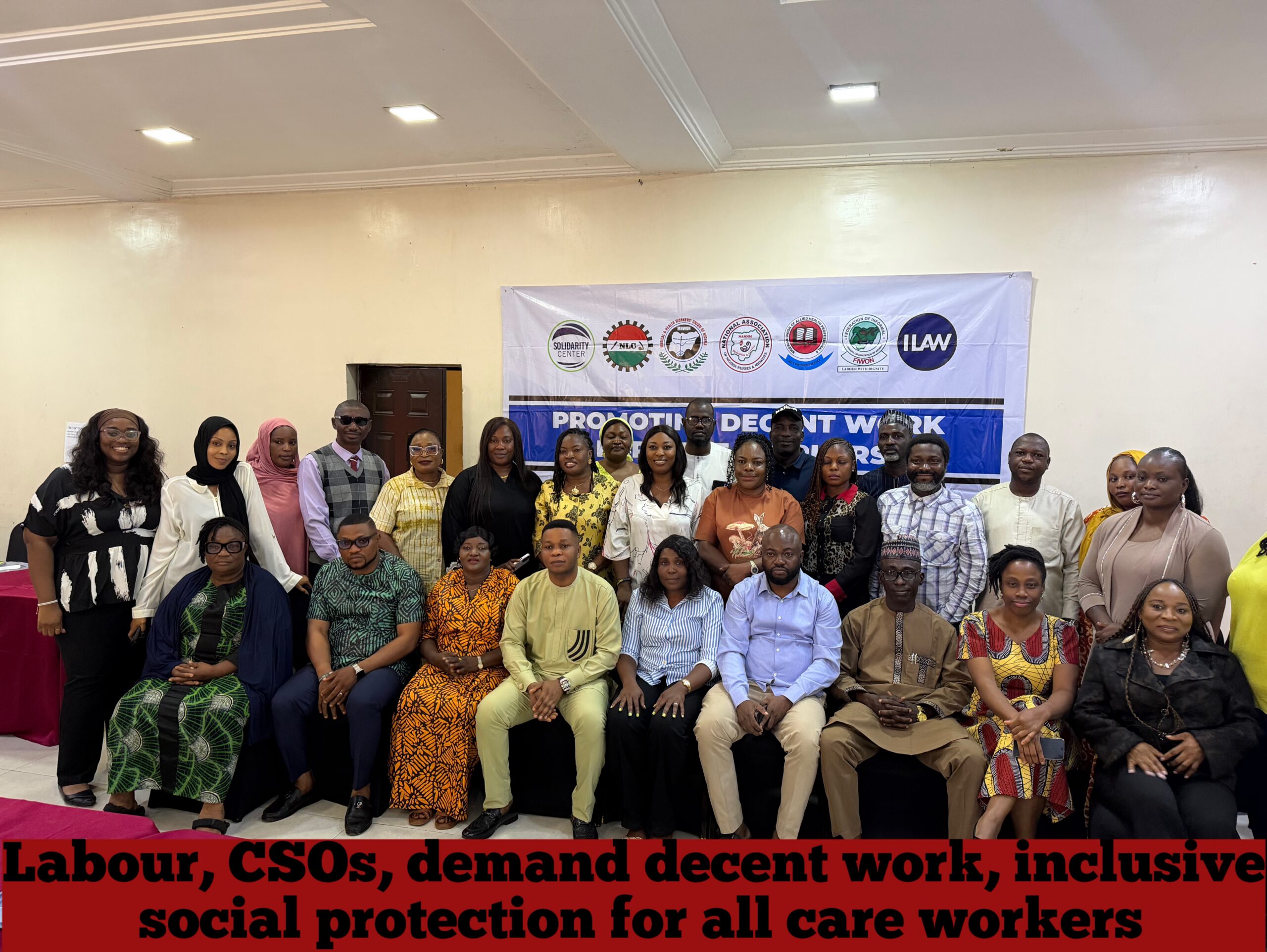
The Coalition of Civil Society Organisations and Labour Unions has called for urgent reforms to improve the welfare, wages and working conditions of care workers across Nigeria, describing them as the backbone of society and a critical driver of the nation’s economy.
Speaking at the Care Economy Sector Coalition Building and Advocacy Workshop in Abuja, the Chairman of the Medical and Health Workers Union of Nigeria (MHWUN), FCT Council, Comrade Shuaibu Onucheyo maintained that many care workers lack job security, receive poor wages and remain vulnerable to exploitation by their employers.
Onucheyo, who is also the Chairman, Joint Health Sector Unions, JOHESU in the FCT, condemned the activities of unregulated labour agents who recruit informal care workers and deduct portions of their earnings. He urged governments at all levels to establish a formal agency to recruit and regulate care workers which would improve their welfare and protect them from exploitation.
“Some workers earn as little as ₦30,000 monthly despite spending a significant portion of their income on transportation. There is the need for sustained public awareness to improve their working conditions,” he said.
He further highlighted challenges confronting workers in the formal sector, including poor remuneration, sexual harassment, maltreatment and excessive working hours, calling for stronger policies to protect the rights, dignity and wellbeing of care workers across the country.
Also speaking, the Senior Assistant General Secretary of the National Association of Nigerian Nurses and Midwives (NANNM), Comrade Nanman Kash, described care work as essential to the stability of families, communities and the nation, adding that its contribution to economic growth is often overlooked.
Kash said the emerging coalition is working to identify and map care workers across different sectors to ensure they are recognised and included in national discussions on the care economy.
She noted that the initiative seeks to raise public awareness of the role played by hotel workers, domestic workers, informal workers, teachers, nurses, community health workers and other professionals who provide critical care services.
She urged teachers, nurses, doctors, domestic workers and other care professionals to build stronger alliances to collectively advocate improved welfare, labour rights and expanded social protection.
The Programme Officer of the Solidarity Center, West Africa Office, Suzie Okome, said despite their invaluable contributions in essential services, many care workers continue to endure poor remuneration, inadequate social protection and difficult working conditions in both the formal and informal sectors.
“Whether we like it or not, care workers are a pillar of society. If we don’t have adequate care in the economy, we won’t even have a country or a world to live in,” she said.
According to Okome, the workshop was organised to deepen participants’ understanding of the care economy, highlight its contribution to Nigeria’s Gross Domestic Product (GDP), and strengthen advocacy for policies that guarantee better wages, improved working conditions and greater recognition for care workers.
She also called for the formalisation of workers in the informal care sector, stressing that many domestic caregivers and other informal care workers are excluded from collective bargaining agreements and social protection schemes because of the nature of their employment.
“We have to look for creative ways to formalise them so that even though they are not under the basic usual settings, they are still able to benefit from collective bargaining agreements and social protection,” Okome said.
According to her, strengthening the care economy through inclusive policies would enhance workers’ welfare while boosting national productivity and economic growth.
The coalition in support of the Solidarity Center was formed to amplify advocacy for decent working conditions for care workers across Nigeria.