
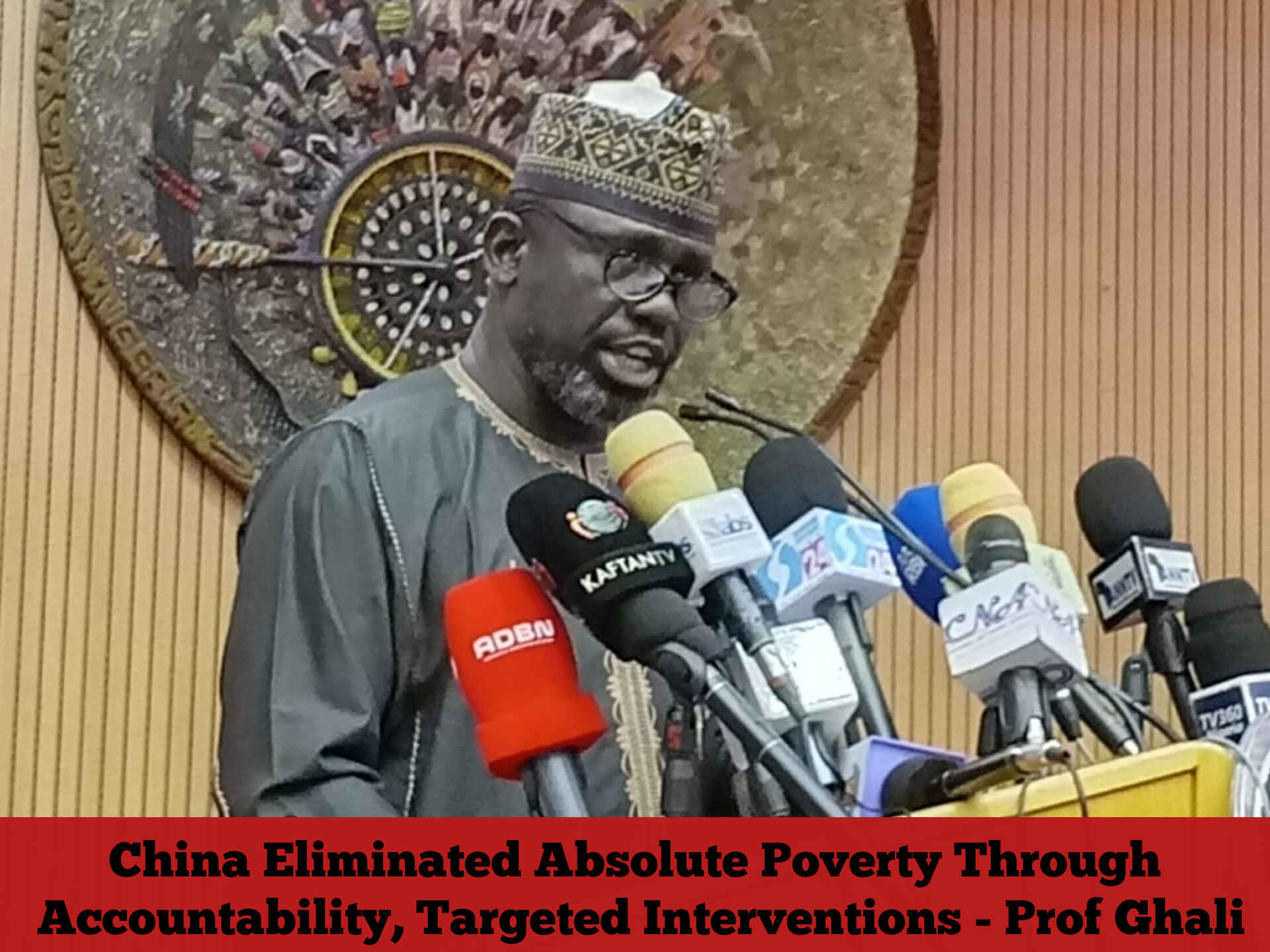
Provost of the Anti-Corruption Academy of Nigeria and Head of Contemporary China-Africa Research, Prof Sheriff Ghali Ibrahim, has outlined China’s targeted poverty reduction strategy as a model worthy of study in efforts to address poverty challenges in Nigeria.
Speaking at a one-day workshop on Nigeria’s poverty alleviation and China’s development model organised by the Diplomatic Correspondents’ Association of Nigeria (DICAN) at the Ministry of Foreign Affairs, Abuja, Prof Sheriff Ghali Ibrahim said China lifted more than 800 million people out of extreme rural poverty over four decades through a combination of economic reforms, targeted interventions, infrastructure development and strict accountability mechanisms.
He noted that China’s poverty reduction framework combined sustained market-driven economic growth with Targeted Poverty Alleviation (TPA), local industry promotion and large-scale infrastructure investments. According to him, the country eliminated absolute poverty in 2020 based on World Bank criteria.
The scholar explained that China’s approach shifted from broad regional assistance to household-level profiling aimed at identifying the specific causes of poverty and tailoring solutions to individual families.
Among the key strategies highlighted were sustained economic growth, development-oriented poverty relief through job training, and policies aimed at balancing urban and rural development by directing resources from industrial centres to less-developed agricultural communities.
Prof Sheriff Ghali Ibrahim also outlined implementation measures adopted by China, including extensive household surveys, the deployment of government officials and specialised work teams to rural communities, and collaboration between wealthier eastern provinces and less-developed western regions.
Other measures included the relocation of residents from ecologically fragile and remote areas to locations with better infrastructure and market access, as well as massive investments in roads, rail networks, electricity and digital connectivity.
He added that China’s poverty reduction campaign relied on rigorous monitoring, verification and accountability systems designed to assess poverty alleviation outcomes at county and village levels. [citation]
The presentation also highlighted the “10,000 Enterprises Help 10,000 Villages” initiative, which integrates private-sector participation into poverty reduction efforts through industrial development, employment creation and public welfare programmes.
The workshop focused on examining China’s development experience and exploring lessons that could inform poverty alleviation policies and governance reforms in Nigeria.