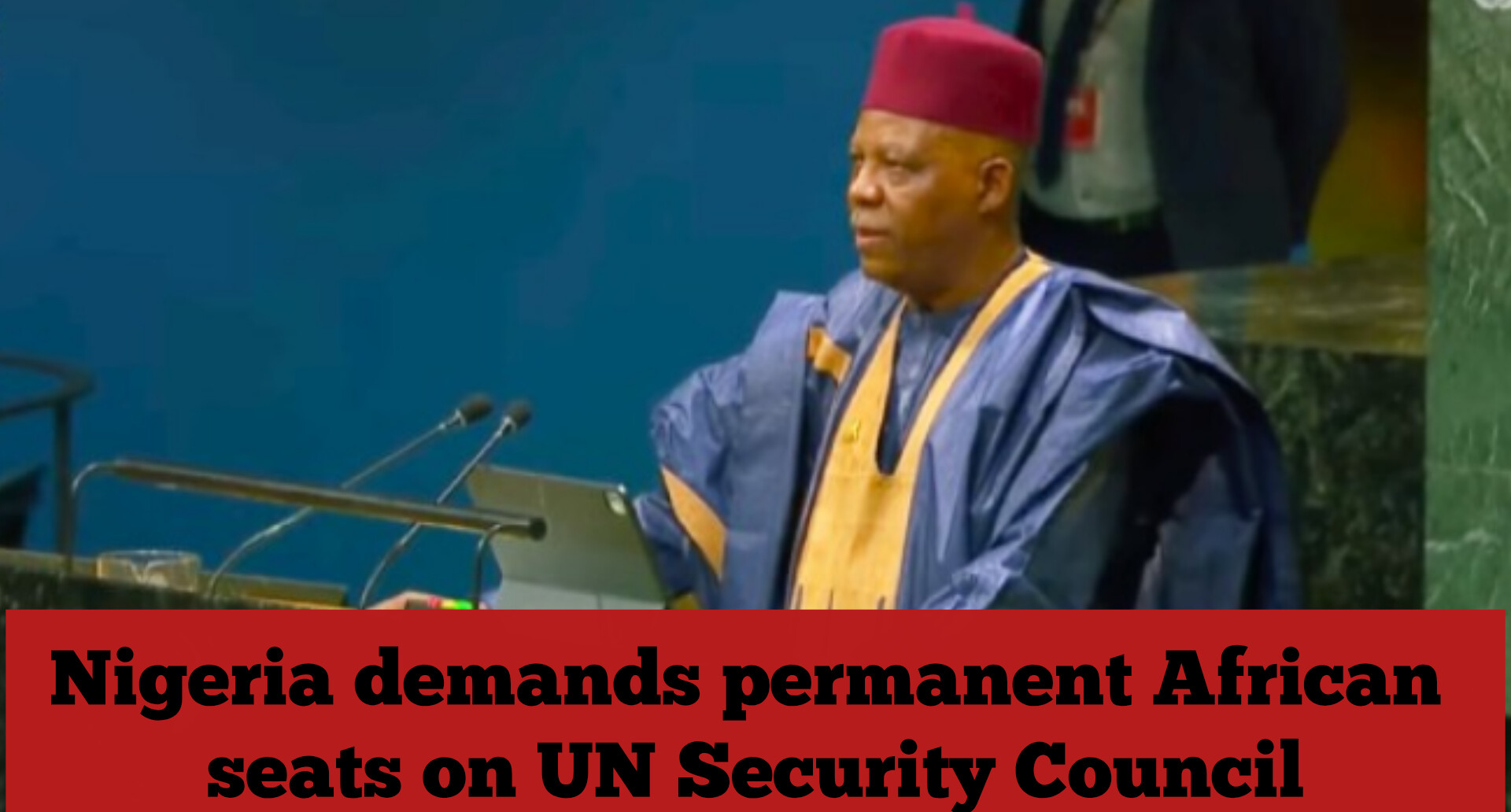
Nigeria has renewed its call for permanent representation for Africa on the United Nations Security Council, saying the current structure no longer reflects the distribution of global power.
Vice President Kashim Shettima made the call on behalf of President Bola Tinubu while delivering Nigeria’s address at the 81st United Nations General Assembly in New York.
Shettima said the reform of the UN must begin with restructuring the Security Council to give Africa a permanent voice in its decision-making.
“Africa cannot continue to fill the council’s agenda while remaining absent from its permanent membership,” he said.
Nigeria is demanding at least two permanent seats for Africa, with the full rights and responsibilities of permanent membership, including the veto for as long as it remains part of the council.
It is also seeking five non-permanent seats for Africa, in line with the Ezulwini Consensus and the CFTA Declaration.
Nigeria highlights peacekeeping role
Shettima said Nigeria’s demand is supported by its contributions to international peace and security over several decades.
He cited Nigeria’s involvement in Liberia, Sierra Leone, Darfur, Mali and The Gambia, as well as its role through the Economic Community of West African States, African Union and Gulf of Guinea partnerships.
He said Nigeria remains committed to mediation, democratic governance, counter-terrorism and maritime security.
“Nigeria stands ready to assume greater responsibility on the strength of obligations honoured and sacrifices made over decades in the service of peace,” Shettima said.
Nigeria calls for climate finance reforms
Nigeria also urged developed countries to provide accessible and predictable financing to help developing nations tackle climate change without undermining their development.
Shettima said Africa contributes less than four per cent of global greenhouse gas emissions but suffers disproportionately from climate-related consequences.
He reaffirmed Nigeria’s commitment to the Paris Agreement and its target of achieving net-zero emissions by 2060.
According to him, Nigeria’s energy transition strategy combines renewable energy, clean cooking, gas as a transitional fuel, climate-smart agriculture and nature-based solutions.
Shettima backs responsible artificial intelligence
Nigeria also called for greater international cooperation in harnessing artificial intelligence for development.
Shettima said AI could transform healthcare, agriculture, governance and economic productivity if deployed responsibly.
“We can deploy artificial intelligence to wage war or use it to transform healthcare, agriculture, governance, and economic productivity,” he said.
He said Nigeria is investing in digital public infrastructure, broadband connectivity, innovation systems, research institutions and technology entrepreneurship.
The Vice President said developing countries face significant pressure from debt servicing, limiting their ability to invest in education, healthcare and infrastructure.
Nigeria therefore called for reforms to the international financial architecture, wider access to concessional financing and debt sustainability frameworks that recognise development needs.
Shettima also backed private capital, blended finance and South-South cooperation as tools for sustainable development and infrastructure investment.
Nigeria urges stronger action against insecurity
Shettima said terrorism, organised crime, cyber attacks and illicit financial flows require stronger international cooperation.
He noted that Nigeria’s fight against Boko Haram, ISWAP and other armed groups has shown that military action must be supported by education, economic opportunities and accountable governance.
He also called for urgent diplomacy to address conflicts in Sudan and other war-torn countries, urging all parties to protect civilians and respect international humanitarian law.
“We place our faith in diplomacy because military victories alone cannot secure lasting peace,” he said.
Shettima said the United Nations should strengthen peacekeeping while placing greater emphasis on peacebuilding, mediation, institution-building and sustainable development.
Nigeria backs African trade and industrialisation
Nigeria also highlighted the African Continental Free Trade Area as a major opportunity to deepen regional integration and expand intra-African trade.
Shettima said Africa must move beyond exporting raw materials and focus on manufacturing, technological innovation, value addition and knowledge-driven growth.
He said Nigeria remains committed to working with other countries to build a more inclusive and effective United Nations.
“Nigeria pledges cooperation over confrontation, dialogue over division, hope over fear, and partnership over isolation,” he said.
He added that a reformed United Nations was essential to building a peaceful, just and sustainable world for future generations.