

Nigeria’s Minister of Agriculture and Food Security, Senator Abubakar Kyari, has reaffirmed the Federal Government’s determination to place agriculture at the core of national industrialization, in line with President Bola Ahmed Tinubu’s *Renewed Hope Agenda*.
Speaking at the G20 Africa Outreach Meeting on Industrialization and Agriculture in Abuja, Senator Kyari said Nigeria was transitioning from a consumption-based to a production-driven economy, leveraging agriculture as a strategic tool for economic transformation.
“The path to national prosperity lies in adopting an agri-industrial approach that fosters a symbiotic relationship between agriculture and industry,” Kyari stated. “We must ensure that agriculture supplies raw materials and drives demand for manufactured goods, while industry provides the inputs and technologies that accelerate agricultural growth.”
He highlighted the Special Agro-Industrial Processing Zones (SAPZ) initiative, supported by the African Development Bank (AfDB), the International Fund for Agricultural Development (IFAD), and the Islamic Development Bank, as a major driver of rural transformation.
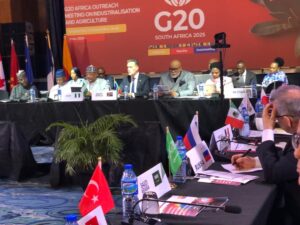
According to the minister, the SAPZs are designed to create jobs, attract private investment, and enhance food security through modern infrastructure and value chain integration.
“Our goal is to make agriculture profitable, competitive, and a key foundation for industrialization and inclusive growth,” Kyari emphasized.
Minister of State for Industry, Trade and Investment, Senator John Enoh described the G20 Africa Outreach as a strategic platform linking agriculture, industry, and continental trade under the African Continental Free Trade Area (AfCFTA) framework.
He said Africa’s future prosperity depended on its ability to process raw materials locally and build sustainable agro-industrial value chains that serve both domestic and regional markets.
“Africa exported cocoa but imported chocolate; we grew cotton but imported garments,” Onyereri said. “To reverse this, agro-industrialization is not an option—it’s an imperative.”
The Minister outlined four key pillars guiding Nigeria’s industrial policy: enhancing productivity at the farm level, developing agro-industrial processing zones, promoting local manufacturing linkages, and strengthening trade integration through AfCFTA.
“Nigeria is not speaking from theory—we are connecting farms to factories and aligning domestic policy with continental ambition,” Onyereri added. “Our vision is to move from planning to production, from raw exports to value-added trade.”
Director of Reforms and Innovation at the Ministry of Foreign Affairs, Ambassador Akinremi Bolaji, said Nigeria’s participation in the G20 Africa Outreach aligns with its 4D Diplomacy Trust Development, Democracy, Demography, and Diaspora anchored on economic diplomacy.
“This summit perfectly fits into Nigeria’s desire to become a production country under President Tinubu’s Renewed Hope Agenda,” Ambassador Bolaji said. “You cannot talk about production without talking about industrialization, and that is why the Ministries of Agriculture and Trade are leading this engagement.”
He emphasized that Nigeria’s continuous invitation to G20 meetings since 2023 reflects the country’s growing recognition as an African powerhouse.
“Since Nigeria’s first invitation to the G20 in 2023, the country has attended every summit—from Brazil to South Africa. This shows that our membership of the G20 is no longer a question of if, but when,” Bolaji noted.
The envoy commended the strong diplomatic ties between Nigeria and South Africa, describing them as vital to Africa’s coordinated engagement with global economic powers.
He added that the outreach series, which includes meetings in Nigeria, Ethiopia, and South Africa, underscores Africa’s growing influence in shaping global policy and economic direction.
“Once the economy thrives, it must reflect in every household,” he said. “That is the true measure of the Renewed Hope Agenda—an economy that touches every family.
The South Africa’s Acting Chief Director, Regional Organizations, Mr. Ben Joubert, described Nigeria’s hosting of the G20 outreach as “a demonstration of continental partnership and leadership.”
“Africa’s inclusion in the G20 agenda is a milestone, and we commend Nigeria for providing intellectual and diplomatic leadership at this critical time,” Mr. Joubert stated.
He reaffirmed South Africa’s readiness to collaborate with Nigeria and other African nations to ensure that the upcoming G20 Summit in Johannesburg consolidates Africa’s development priorities in industrialization, food security, and trade.
The G20 Africa Outreach Meeting serves as a prelude to the upcoming G20 Summit, where leaders are expected to discuss policies for inclusive global growth, sustainable agriculture, and industrial development.
This year’s outreach focuses on “Industrialization and Agriculture for Shared Prosperity,” emphasizing Africa’s role as both a resource and innovation hub in the global economy.
With Africa hosting the G20 Summit for the first time, participants say the Abuja meeting reflects a new phase of continental ownership in shaping development cooperation and investment frameworks.