

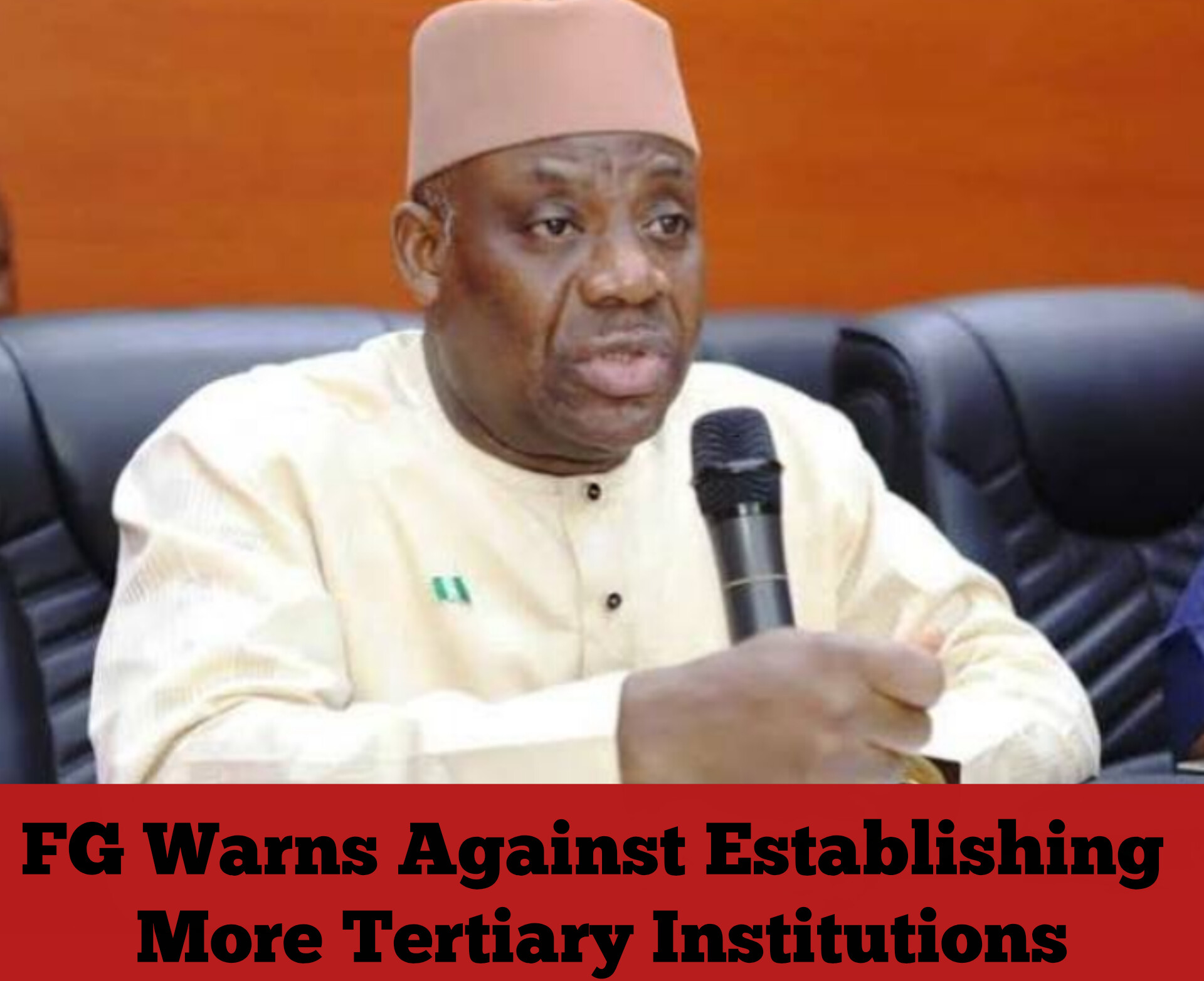
The Federal Government has appealed to the National Assembly to suspend the approval of bills establishing new federal universities, polytechnics and colleges of education for seven years.
The government says the continued creation of tertiary institutions could worsen the country’s education funding crisis, weaken academic standards and increase pressure on existing resources.
The appeal is contained in a memo from the Federal Ministry of Education, dated November 2026 and addressed to the President of the Senate, Godswill Akpabio.
In the memo, the Minister of Education, Dr Tunji Alausa, urges the Senate leadership and other lawmakers to exercise restraint in considering bills seeking to establish additional federal tertiary institutions.
He says the Federal Executive Council (FEC) approved the seven-year moratorium last year to address the proliferation of public tertiary institutions, duplication of academic programmes and under-utilisation of existing facilities.
According to Alausa, Nigeria’s immediate education challenge is no longer simply expanding access but strengthening existing institutions through improved funding, infrastructure, personnel and modern teaching and research facilities.
“The Federal Government’s position is that the immediate challenge confronting the tertiary education sector is not merely the expansion of access, but the urgent need to strengthen existing institutions,” he states.
He adds that the moratorium will allow the government to consolidate existing investments and improve the quality and capacity of institutions already established.
The minister warns that existing federal universities, polytechnics and colleges of education are struggling with inadequate lecture halls, overcrowded classrooms, insufficient laboratories, staff shortages and deteriorating facilities.
He argues that establishing more institutions without addressing these challenges could further undermine the quality of tertiary education.
Funding gaps raise concerns
Alausa also raises concerns over the government’s outstanding financial commitments to revitalising public universities.
He discloses that of the ₦1.3 trillion commitment under the 2013–2018 Federal Government-ASUU revitalisation agreement, only ₦250 billion was released.
He further says that of the additional ₦150 billion approved last year for Needs Assessment Intervention, only ₦50 billion was initially released.
“These funding gaps demonstrate the difficulty of meeting existing obligations and raise legitimate concerns about the capacity to sustain additional institutions without corresponding and guaranteed budgetary provisions,” he states.
The minister cites Ekiti and Imo states as examples of the financial and administrative challenges associated with establishing multiple tertiary institutions without sustainable funding.
He recalls that Ekiti State consolidated three state-owned universities into one institution, Ekiti State University, Ado-Ekiti, in 2011.
He also notes that some state governments have approached the Federal Government to take over their universities because of difficulties sustaining them financially.
According to him, establishing institutions without adequate funding could eventually force future administrations to merge, restructure or close them.
Alausa further identifies competing demands from Tertiary Education Trust Fund (TETFund), the Nigerian Education Loan Fund (NELFUND), vocational training programmes and staff allowances as reasons to prioritise existing institutions.
He says establishing a new tertiary institution involves long-term financial responsibilities, including land acquisition, infrastructure, recruitment, equipment, utilities and recurrent expenditure.
The minister maintains that the seven-year moratorium does not amount to a permanent restriction on expanding access to tertiary education.
Rather, he says it will give the government time to address existing deficiencies, improve academic standards and ensure that future expansion is financially sustainable.
He therefore appeals to Akpabio and the National Assembly leadership to support the policy by suspending the consideration and passage of bills establishing additional federal tertiary institutions during the period.
“The success of our education system should be measured not merely by the number of institutions established, but by the capacity of existing institutions to deliver high-quality education, produce competent graduates and contribute meaningfully to national development,” he states.
The memo is also copied to the Senate Majority Leader, Senator Michael Opeyemi Bamidele.


