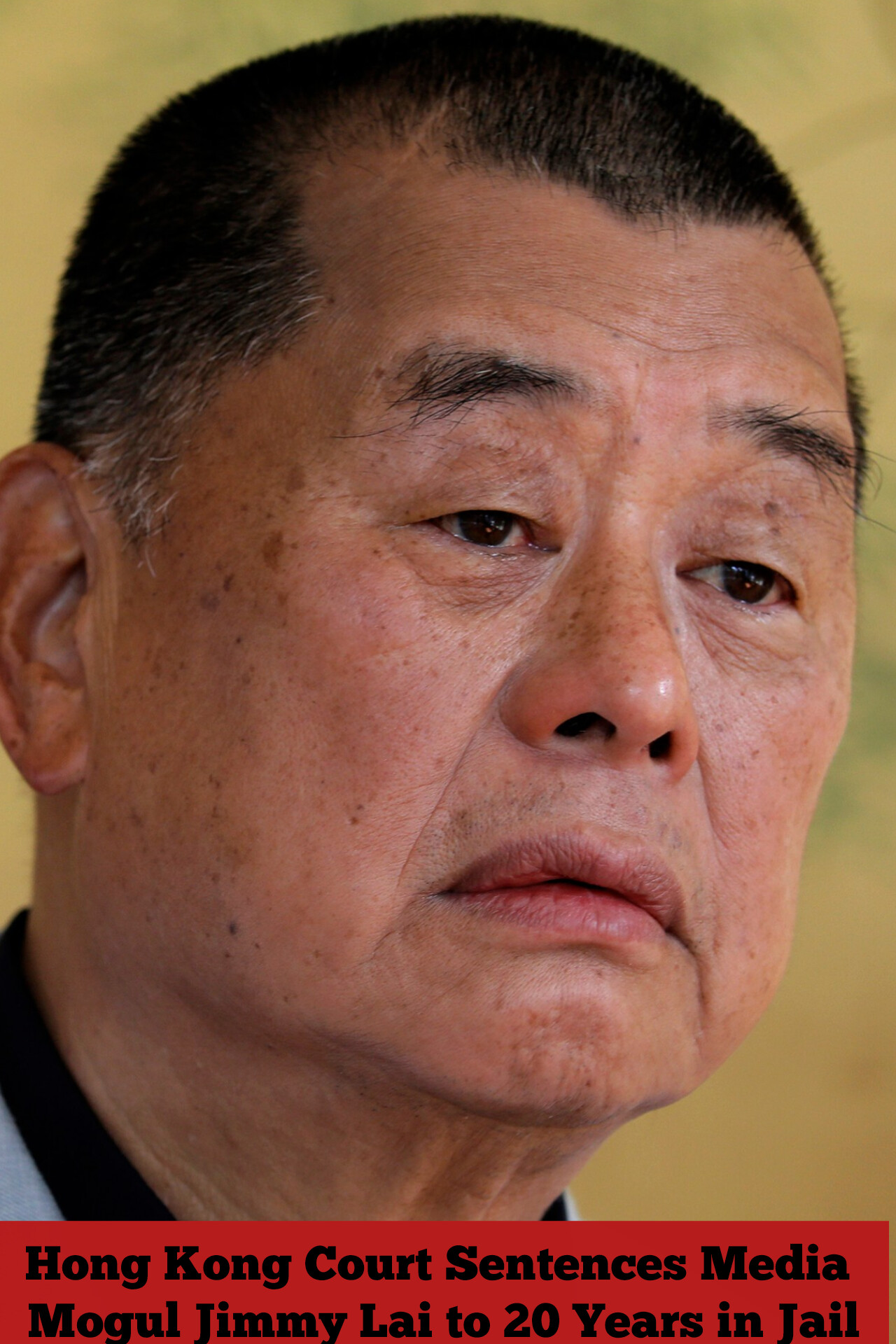
A Hong Kong court sentenced pro-democracy media tycoon Jimmy Lai to 20 years in prison for national security offences, a decision that has drawn sharp condemnation from international rights groups and foreign governments, who say the ruling marks a new low for press freedom in the city.
Lai, 78, the founder of the now-defunct Apple Daily newspaper and a British citizen, was convicted in December of colluding with foreign forces by urging sanctions against Hong Kong and of publishing what authorities described as “seditious” articles.
In a written summary, the judges said they imposed the sentence “after considering the serious and grave criminal conduct of Lai.” Two years of the term will run concurrently with an existing sentence, meaning Lai will serve an additional 18 years behind bars.
The punishment is the longest sentence imposed under Hong Kong’s Beijing-backed national security law, surpassing the previous record of 10 years handed to legal scholar Benny Tai.
Lai, who has been in custody throughout the trial, remained expressionless as the sentence was read out, according to journalists present in court. As he was led away, he waved solemnly to supporters in the public gallery, including his wife Teresa Lai, former Hong Kong bishop Cardinal Joseph Zen, and former Apple Daily staff.
Lai’s defence lawyer, Robert Pang, declined to say whether an appeal would be filed within the 28-day window.
“In these times, I don’t know what to expect,” Pang said when asked if the sentence met expectations.
While Teresa Lai left the court without comment, the couple’s children, who live overseas, strongly criticised the ruling.
“Sentencing my father to this draconian prison sentence is devastating for our family and life-threatening for my father,” said his son, Sebastien Lai, in a statement.
His daughter, Claire Lai, described the judgment as “a heartbreakingly cruel sentence,” adding that given his declining health in custody, “he will die a martyr behind bars” if the term is fully served.
Human rights organisations described the punishment as grossly disproportionate.
“The harsh 20-year sentence against 78-year-old Jimmy Lai is effectively a death sentence. A sentence of this magnitude is both cruel and profoundly unjust,” said Elaine Pearson, Asia director at Human Rights Watch.
Amnesty International called the case “another grim milestone in Hong Kong’s transformation from a city governed by the rule of law to one ruled by fear.”
Jodie Ginsberg, chief executive of the Committee to Protect Journalists, said the ruling was “the final nail in the coffin for freedom of the press in Hong Kong.”
British Prime Minister Keir Starmer had earlier confirmed that he raised Lai’s case with Chinese President Xi Jinping during a visit to Beijing last month. Following the sentencing, UK Foreign Secretary Yvette Cooper urged Hong Kong authorities to “end his appalling ordeal” and vowed to “rapidly engage further” with Beijing.
Taiwan’s government said the case would have a “chilling effect” beyond Hong Kong and accused authorities of trampling on free speech.
The United States has also repeatedly called for Lai’s release, including by President Donald Trump, according to previous statements.
China rejected international criticism, accusing foreign governments and organisations of smearing Hong Kong’s judiciary. Beijing described the sentence as “reasonable, legitimate and legal.”
Hong Kong Chief Executive John Lee welcomed the decision, calling the lengthy prison term “deeply gratifying.”
Security was tight around the West Kowloon Court, where dozens of former Apple Daily employees and supporters queued overnight in cold conditions for a chance to attend the hearing. Police deployed dozens of officers, an armoured vehicle and a bomb disposal unit to the area.
“I think this is equivalent to sentencing Lai to life imprisonment,” said Lam Ying-kit, a former history teacher, speaking outside the court.
Concerns remain over Lai’s health in custody. Prosecutors said he requested solitary confinement to avoid harassment, while authorities insist he is receiving “adequate” medical care.
Lai has long been a vocal critic of Beijing. His newspaper, Apple Daily, was forced to shut down four years ago following police raids and arrests under the national security law enacted after mass pro-democracy protests.
Eight other defendants linked to the paper, including six former executives, were sentenced to up to 10 years in prison after pleading guilty.
By the start of this month, Hong Kong authorities had arrested 386 people for national security-related offences, with 176 convictions, according to official figures.