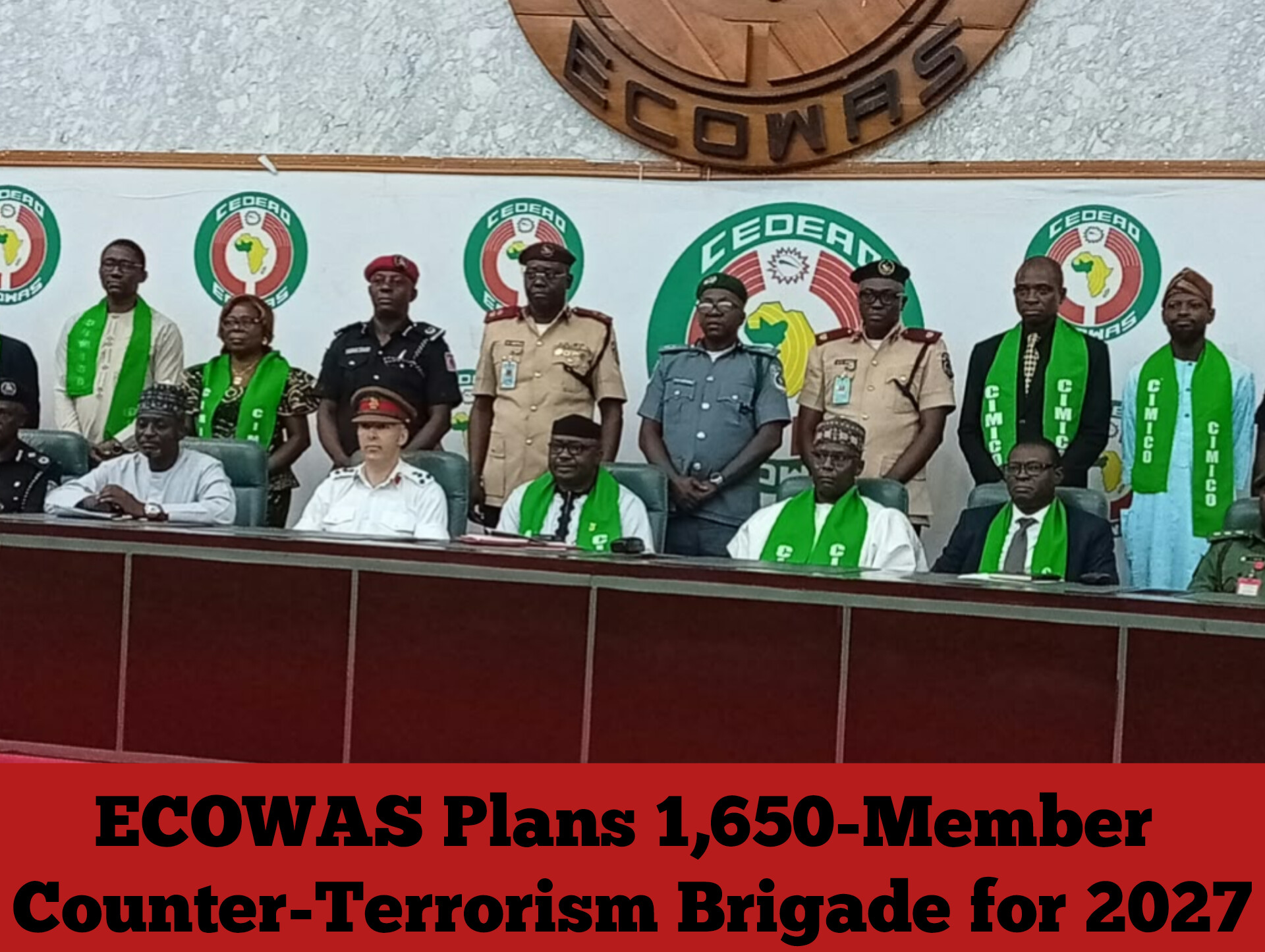
The Economic Community of West African States (ECOWAS) plans to activate a 1,650-member regional counter-terrorism brigade by 2027 as the bloc steps up efforts to contain terrorism and violent extremism across West Africa.
The ECOWAS Commissioner for Political Affairs, Peace and Security, Dr Isaac Armstrong, announced the plan in Abuja during a regional dialogue on strengthening the civilian dimension of the ECOWAS Standby Force.
Armstrong said the proposed ECOWAS Counter-Terrorism Brigade would combine military, police and civilian personnel, reflecting a shift towards a broader approach to regional security.
“ECOWAS is envisaging setting up a 1,650-man force as an ECOWAS Counter-Terrorism Brigade to confront the menace of terrorism,” he said.
“This force is at the heart of our Heads of State and Government, and the plan is for it to be up and running by next year.”
He said about half of ECOWAS member states had experienced terrorism, with countries in the Sahel particularly vulnerable to the spread of insecurity.
The bloc is also seeking to prevent terrorist groups from expanding into coastal West African states, including Ghana, Côte d’Ivoire and Togo.
Armstrong warned that military operations alone would not end the region’s security crisis.
“A kinetic approach is not sufficient. We must combine both the non-kinetic and the kinetic aspects of terrorism,” he said.
“You can kill as many terrorists as you can, but if you do not address the governance and human security issues, this fight will continue.”
The Nigerian Army also called for greater civilian participation in counter-terrorism operations, saying sustainable peace required cooperation between security forces and local communities.
In a speech delivered by Colonel Yakubu Mikka on behalf of the Chief of Army Staff, the Army said military, police and civilian capabilities should be integrated through humanitarian assistance, governance, strategic communication and community engagement.
“Terrorism cannot be defeated through military force alone,” the Army said.
“Communities are not merely beneficiaries of military protection. They are important partners in security operations.”
The Army said communities could provide intelligence and early warnings while helping security agencies prevent radicalisation and extremist recruitment.
The Inspector General of Police, represented by Deputy Commissioner of Police Gottam Richard, also stressed the importance of regional coordination and intelligence sharing.
The United Nations similarly urged stronger civil-military cooperation, saying communities should be treated as active partners in preventing insecurity.
Representing the UN Resident and Humanitarian Coordinator in Nigeria, Grace Bokazonde said military operations alone had rarely ended extremist violence.
“The military solution alone does not really help bring this problem to an end,” she said.
Bokazonde said local knowledge could help security agencies detect threats early, counter misinformation and radicalisation, and build trust with communities.
The dialogue, organised by the Centre for Civil-Military Cooperation in partnership with the ECOWAS Commission, seeks practical recommendations on early warning systems, community stabilisation and civic engagement.
The discussions form part of wider ECOWAS reforms aimed at strengthening the Standby Force’s capacity to respond to terrorism and violent extremism across the region.
[8