
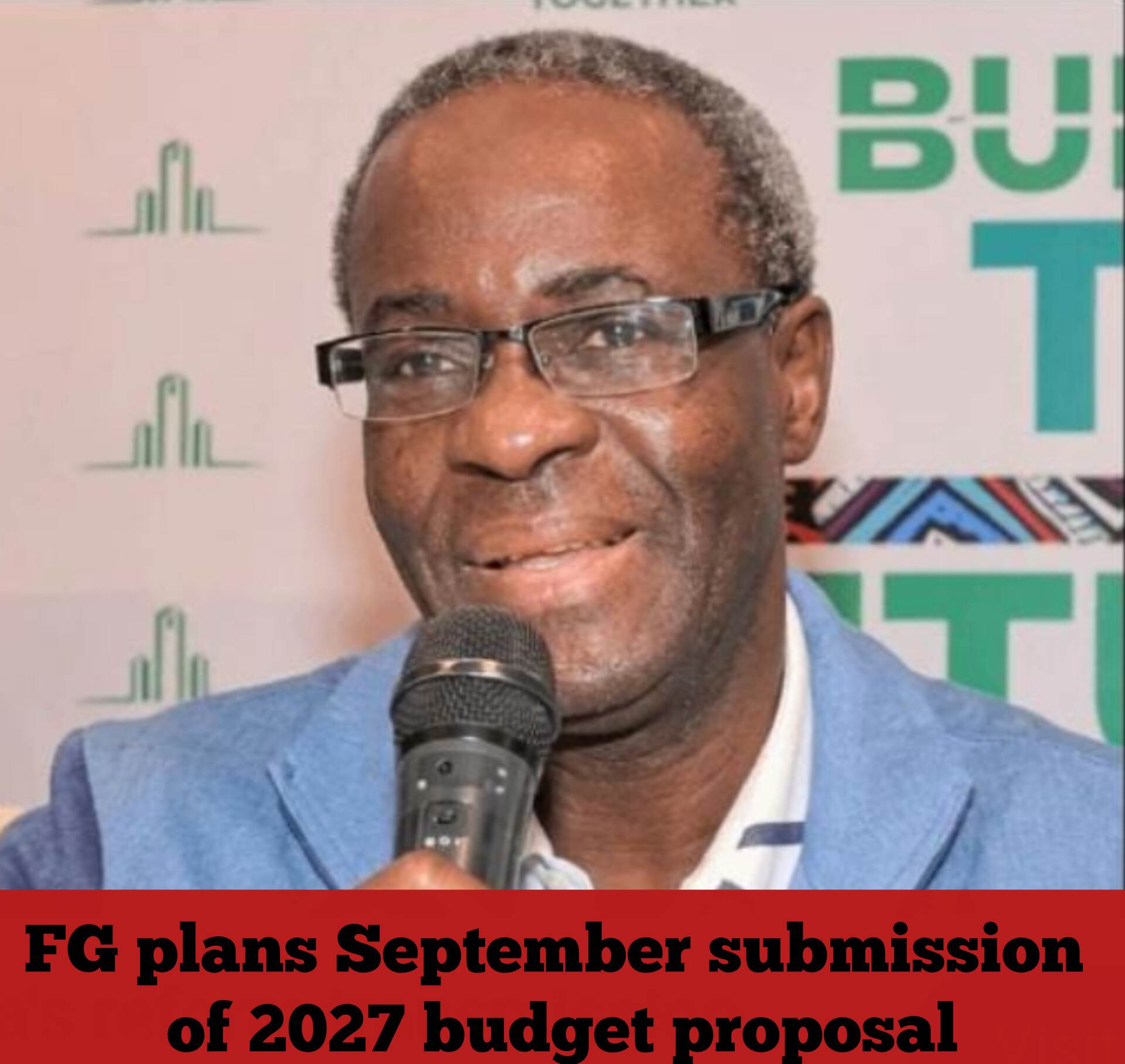
The Federal Government plans to submit its 2027 budget proposal to the National Assembly this month as it seeks to restore a more predictable budget cycle.
The plan is contained in the 2027 Personnel Costs Budget Call Circular, signed by the Director-General of the Budget Office of the Federation, Tanimu Yakubu.
The circular, issued to ministries, departments and agencies (MDAs), sets guidelines for preparing and submitting their personnel cost proposals for the 2027 fiscal year.
The Budget Office said the draft 2027–2029 Medium-Term Expenditure Framework and Fiscal Strategy Paper was concluded in July to support the planned September presentation.
“As you are aware, the 2027–2029 draft Medium-Term Expenditure Framework and Fiscal Strategy Paper was concluded by July 2026 in line with the Fiscal Responsibility Act 2007 to facilitate the submission of 2027 Budget to the National Assembly by September 2026,” the office said.
Although no specific date was given, the timetable would allow lawmakers to consider the proposal about three months before the start of the 2027 fiscal year.
Government tightens budget controls
The planned early submission comes amid concerns over delays and overlapping budget cycles that have affected Nigeria’s budget implementation in recent years.
The government has previously linked budget underperformance to differences in key economic projections, including crude oil prices and production, exchange rates, inflation and non-oil revenues.
Finance Minister and Coordinating Minister of the Economy, Taiwo Oyedele, has said harmonising the assumptions used by fiscal and monetary authorities should reduce gaps between budget projections and actual economic outcomes.
For the 2027 budget process, the Budget Office has also introduced stricter checks on government agencies and personnel spending.
MDAs are now required to submit the laws establishing them alongside their budget proposals.
The directive follows controversy over the inclusion of the Presidential Foreign Intervention Promotion Council (PFIPC) in the 2026 budget, despite questions over its legal status.
“To further strengthen the budget preparation process and mitigate against any entry of unestablished agencies in the FGN Budget, it has become compulsory for MDAs to submit budget proposals along with their respective Establishment Acts as failure to do so, may lead to rejection,” the circular said.
The PFIPC had been allocated about ₦1.3bn in the 2026 budget.
The House of Representatives subsequently opened an investigation, while President Bola Tinubu ordered a forensic investigation into the processes that allowed the agency to appear in the budget.
The Independent Corrupt Practices and Other Related Offences Commission (ICPC) later reported that the PFIPC had no legal backing and that its purported director-general, Adeniyi Adeyemi, was never appointed by the Federal Government.
ICPC Chairman Musa Aliyu said investigators also uncovered another questionable organisation operating within the Office of the Secretary to the Government of the Federation.
Following the findings, President Tinubu ordered the arrest of the organisation’s promoter, George Buchi Nwabueze, and suspended three permanent secretaries.
Amnesty International Nigeria Country Director Isa Sanusi said the controversy exposed weaknesses in government institutions.
“The incident of the fake government agency is an indictment of the Nigerian government,” Mr Sanusi said. “It is a practical indication of the rampant corruption within and around government agencies.”
The Budget Office also warned MDAs against including unauthorised workers on their payrolls.
“MDAs should note that payment of salaries and allowances are for legitimate employees of the FGN only. Any unauthorised payments from the personnel costs budget will attract appropriate sanctions,” it said.
MDAs must validate their payrolls against the Integrated Personnel and Payroll Information System (IPPIS) and Government Integrated Financial Management Information System (GIFMIS).
The circular states that no personnel cost provision will be made for federal employees not captured on either system unless they have an approved exemption.
Government agencies are also barred from budgeting for anticipated promotions. Only promotions already approved and effective should be included in the 2027 personnel budget.
The government said promotions taking effect during 2027 would instead be provided for centrally under the Service-Wide Vote.
The Budget Office also warned against unauthorised recruitment and said it would not accept claims arising from salary shortfalls or payroll lockouts caused by such recruitment.
Outsourced workers excluded
Outsourced workers, consultants, contract staff, National Youth Service Corps members and other non-permanent workers must not be included on the nominal rolls of MDAs.
“The staff of outsourced service providers must not be included in the nominal roll,” the circular said.
It warned that putting outsourced workers on government payroll would be treated as “willful fraudulent action” and reported to the relevant authorities.
The government has also introduced additional controls for federal health and education institutions to prevent the multiple capture of consultants, lecturers, interns and other workers on different payrolls.
A centralised Personnel Cost Monitoring Dashboard linked to IPPIS and GIFMIS is expected to allow the Budget Office to monitor personnel expenditure against budget provisions in real time.
MDAs are also required to submit their third-quarter personnel budget performance reports this month.
The Budget Office has set 4pm this week as the deadline for MDAs to submit hard and electronic copies of their 2027 personnel budget proposals and supporting information.
Ministers, chief executives and accounting officers must also certify the accuracy of the information submitted by initialling every page of the hard-copy proposals.