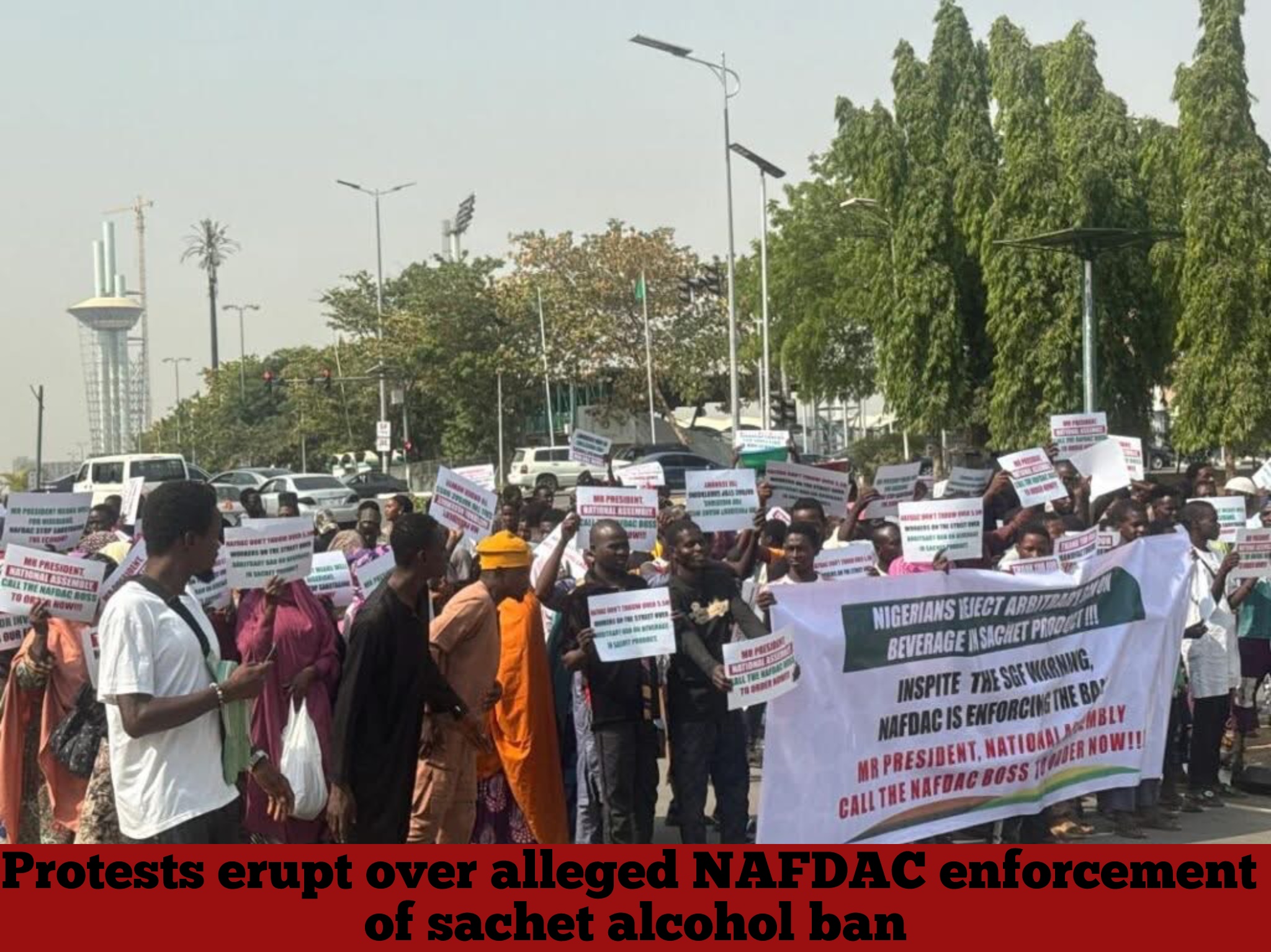
Protests have erupted following reports of the alleged enforcement of a ban on the production, distribution, and consumption of alcoholic beverages packaged in sachets and small PET or glass bottles below 200 millilitres by the National Agency for Food and Drug Administration and Control (NAFDAC).
A civic group, Concerned Citizens for Change, has accused the agency of acting in a high-handed and undemocratic manner.
Speaking at a press conference in Abuja on Friday, the group condemned what it described as a hasty enforcement process, warning that it could trigger serious economic consequences.
According to the group, reports attributed to NAFDAC indicate that enforcement of the ban has already commenced, allegedly based on resolutions of the Nigerian Senate.
This comes after NAFDAC, in a press release issued in November 2025, reaffirmed its commitment to fully enforce the ban on the production and sale of sachet alcohol and small-volume bottled alcoholic beverages by December 2025, in line with a Senate directive.
NAFDAC has stated that the action, ordered by the Senate and supported by the Federal Ministry of Health and Social Welfare, aligns with its mandate to protect public health.
The agency said sachet alcohol products, which often contain high alcohol content, are easily accessible, affordable, and concealable, making them prone to misuse, particularly among minors and commercial drivers.
It linked the consumption of such products to rising cases of domestic violence, road accidents, school dropouts, and other social vices.
However, speaking on behalf of Concerned Citizens for Change, Oluoha Chukwudi said the announcement by NAFDAC’s Director-General, Prof. Mojisola Adeyeye, contradicts the outcomes of earlier stakeholder engagements involving industry operators, regulators, and lawmakers.
He noted that discussions held at a stakeholders’ forum convened by the Federal Ministry of Health, which included members of the House of Representatives, resulted in key resolutions such as a one-year extension period and the development of a multi-sectoral National Alcohol Policy.
Chukwudi argued that the reported outright enforcement deviates from the agreements reached during those consultations, which were supervised by the Ministry of Health, the body constitutionally responsible for overseeing NAFDAC.
He expressed concern that the agency appeared to be bypassing the agreed framework without adequate consultation.
The group also questioned claims that sachet alcohol consumption is a major driver of underage drinking, citing reports of independent studies that allegedly dispute such assertions.
It added that industry operators have invested more than ₦1 billion in nationwide media campaigns promoting responsible drinking to curb alcohol abuse among minors.
Warning of severe economic fallout, Chukwudi said enforcing the ban could lead to the loss of over ₦1.9 trillion in investments, the retrenchment of more than 500,000 direct employees, and the disruption of approximately five million indirect jobs across the value chain.
He cautioned that such outcomes could undermine manufacturing growth and local entrepreneurship at a time when the economy is gradually recovering.
The group called on the Minister and Coordinating Minister of Health and Social Welfare to formally endorse and implement the validated National Alcohol Policy and its multi-sectoral framework.
It also urged the Senate to revisit the issue through a comprehensive stakeholder consultation, similar to the process previously undertaken by the House of Representatives.
Additionally, the group appealed to the Senate to rescind any directive authorising enforcement of the ban and to restrain NAFDAC from proceeding until the full rollout of the National Alcohol Policy framework.
It accused NAFDAC’s leadership of acting unilaterally and called for dialogue, transparency, and strict adherence to due process in resolving the controversy surrounding sachet alcohol regulation.