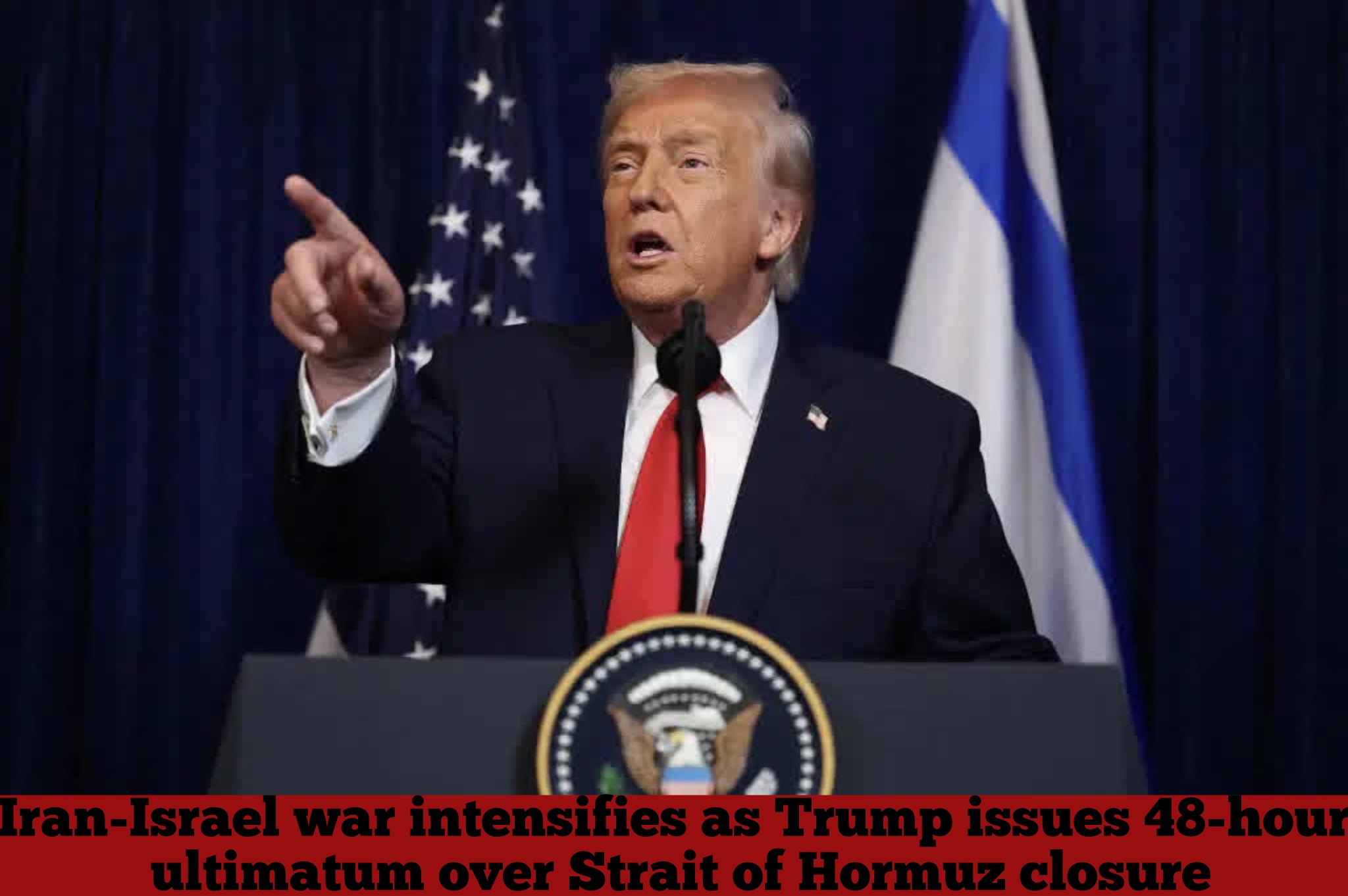
U.S. President Donald Trump on Saturday issued a 48-hour ultimatum to Iran, demanding the reopening of the strategic Strait of Hormuz or warning that Tehran’s energy infrastructure would be targeted.
The warning came as Iran launched its most intense attack yet on Israel, significantly escalating tensions in the region. Trump, posting on Truth Social, said the United States would “hit and obliterate” Iranian power plants, “starting with the biggest one first”- if the waterway was not reopened by Monday.
Iran’s Foreign Minister Abbas Araghchi responded by stating that restrictions applied only to vessels from countries involved in military actions against Iran. He added that ships from neutral countries would be assisted.
In retaliation to Trump’s warning, Iran’s military said it would target energy and desalination facilities linked to the United States and its regional allies.
Meanwhile, Iranian missile strikes penetrated Israeli air defenses, causing significant damage in southern Israel. In the town of Arad, at least 84 people were injured, including 10 in serious condition. Earlier, 33 people were wounded in Dimona, where a missile struck near a sensitive site widely believed to be associated with Israel’s undeclared nuclear capabilities.
The Israeli military confirmed a direct hit on a building in Dimona, with casualties reported across multiple locations, including a 10-year-old boy seriously injured by shrapnel.
Iran said the strike on Dimona was in response to attacks on its Natanz nuclear facility, a key site in its nuclear program that sustained damage during earlier hostilities. The Islamic Revolutionary Guard Corps (IRGC) also claimed attacks on other Israeli towns and military targets in Kuwait and the United Arab Emirates.
Following the Natanz incident, Rafael Grossi, head of the UN nuclear watchdog, called for restraint to avoid the risk of a nuclear accident.
Israel denied responsibility for the Natanz strike but said it had targeted a facility at a Tehran university allegedly involved in developing components for nuclear weapons tied to Iran’s ballistic missile program.
The conflict has intensified over three weeks of sustained U.S.-Israeli bombardment, with Iran continuing to launch missile and drone attacks across the region. Tehran also attempted a long-range strike on a U.S.-UK base in Diego Garcia, though the attack was unsuccessful.
The United Arab Emirates reported aerial threats after Iran warned against allowing attacks from its territory near the Strait of Hormuz.
The ongoing standoff has disrupted global oil markets, with Brent crude prices rising above $105 per barrel. Several nations, including the UK, France, Germany, Italy, South Korea, Australia, the UAE, and Bahrain, issued a joint statement condemning Iran’s effective closure of the strait and expressing readiness to ensure safe passage.
Trump also criticized NATO allies, urging stronger action to secure the vital shipping route.
Analysts say Iran has demonstrated unexpected resilience despite significant losses, maintaining its ability to strike across the region. As the war enters its fourth week, uncertainty continues to grow over its potential global and economic impact.