
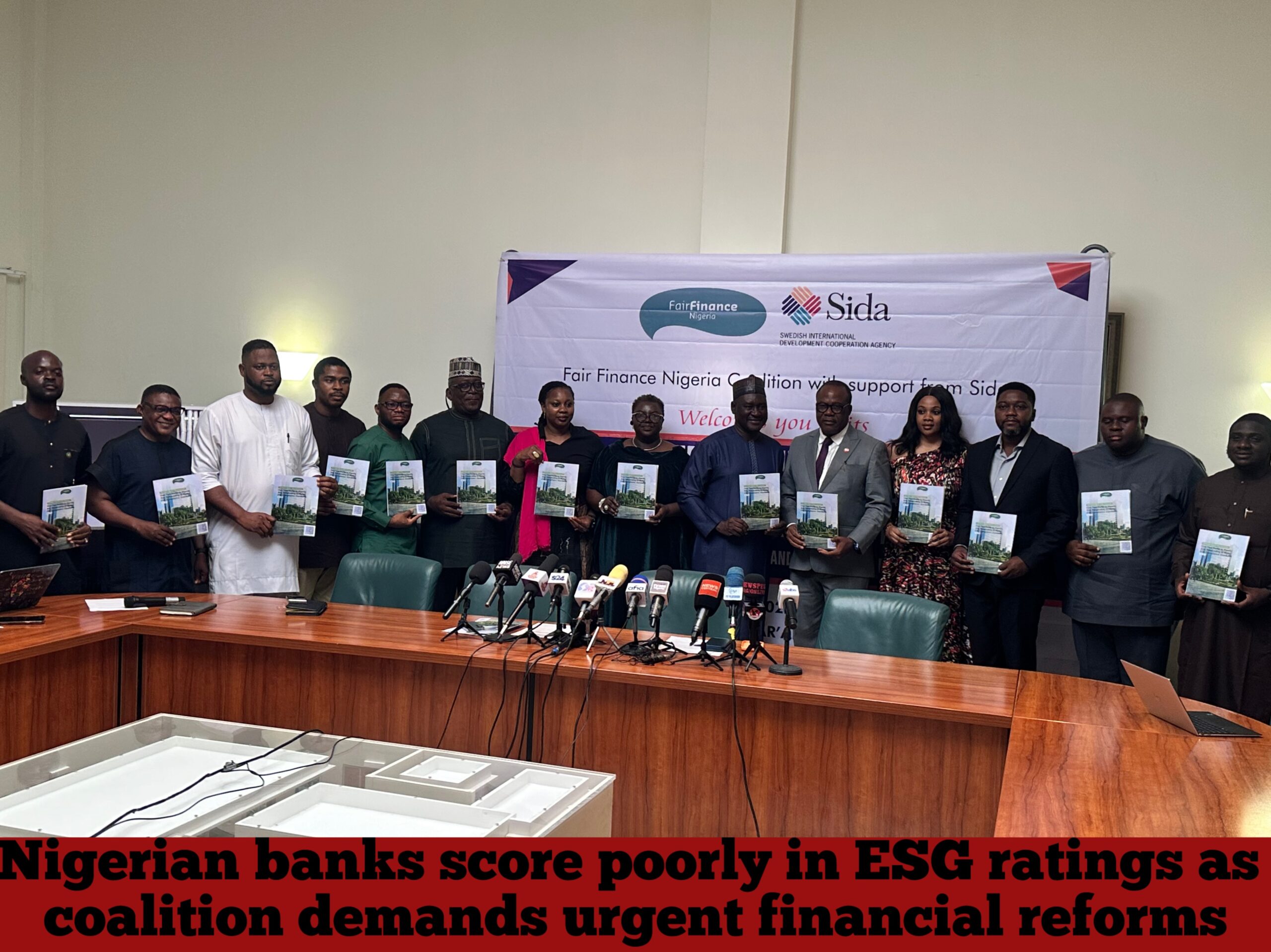
A coalition of non-governmental organisations operating under the Fair Finance Nigeria Coalition has called for urgent reforms to improve transparency and accountability within Nigeria’s financial system.
The demand followed a recent assessment that revealed poor performance among major Nigerian banks in global Environmental, Social and Governance (ESG) standards.
The report, unveiled during a media briefing in Abuja, showed that four leading banks—Access Bank, Standard Chartered, United Bank for Africa, and Zenith Bank, recorded an average score of just 1.7 out of 10 across more than 400 international sustainability benchmarks.
According to the findings, all four banks scored zero in tax transparency, as none publicly disclosed country-by-country revenues or provided links to subsidiaries operating in tax havens.
On climate action, the institutions achieved an average score of 0.9 out of 10, with the report highlighting continued financing of high-emission industries such as oil and gas without clear transition plans.
The assessment also identified weak commitments to human rights protection, biodiversity preservation, and the welfare of host communities impacted by financed projects. Speaking on the report, Executive Director of the Civil Society Legislative Advocacy Centre, Auwal Rafsanjani, said the findings exposed significant gaps that require urgent action from both regulators and financial institutions.
Rafsanjani expressed concern over the lack of tax transparency, warning that such opacity could enable illicit financial flows, money laundering, and the loss of critical public revenue.
He also noted that despite Nigeria’s vulnerability to climate change, the banks demonstrated weak commitment to climate action by continuing to fund high-emission sectors without defined transition strategies. He emphasised that the report aims to encourage compliance with global best practices rather than target specific institutions.
Also speaking, a representative of Oxfam in Nigeria, Henry Ushie, said the initiative seeks to promote a more sustainable and accountable financial system. He noted that the assessment was guided by frameworks such as the United Nations Guiding Principles on Business and Human Rights, which require organisations to respect human rights across their operations and value chains.
Ushie added that banks must go beyond internal policies to ensure their services, investments, and customer relations align with global standards of fairness and sustainability. He raised additional concerns about customer treatment, staff welfare, environmental practices, and the need to reduce carbon footprints while improving service delivery.
The coalition urged regulators, including the Central Bank of Nigeria and the Chartered Institute of Bankers of Nigeria, to review existing policies and align them with international standards. It also called on financial institutions to carry out self-assessments and take immediate corrective measures.
The group stressed that strengthening Nigeria’s financial system is essential for attracting investment, curbing corruption, and ensuring sustainable economic growth.
The Fair Finance Nigeria Coalition includes organisations such as BudgIT, CISLAC, Connected Development, Policy Alert, STEPS, and Oxfam in Nigeria, with support from the Swedish International Development Cooperation Agency.