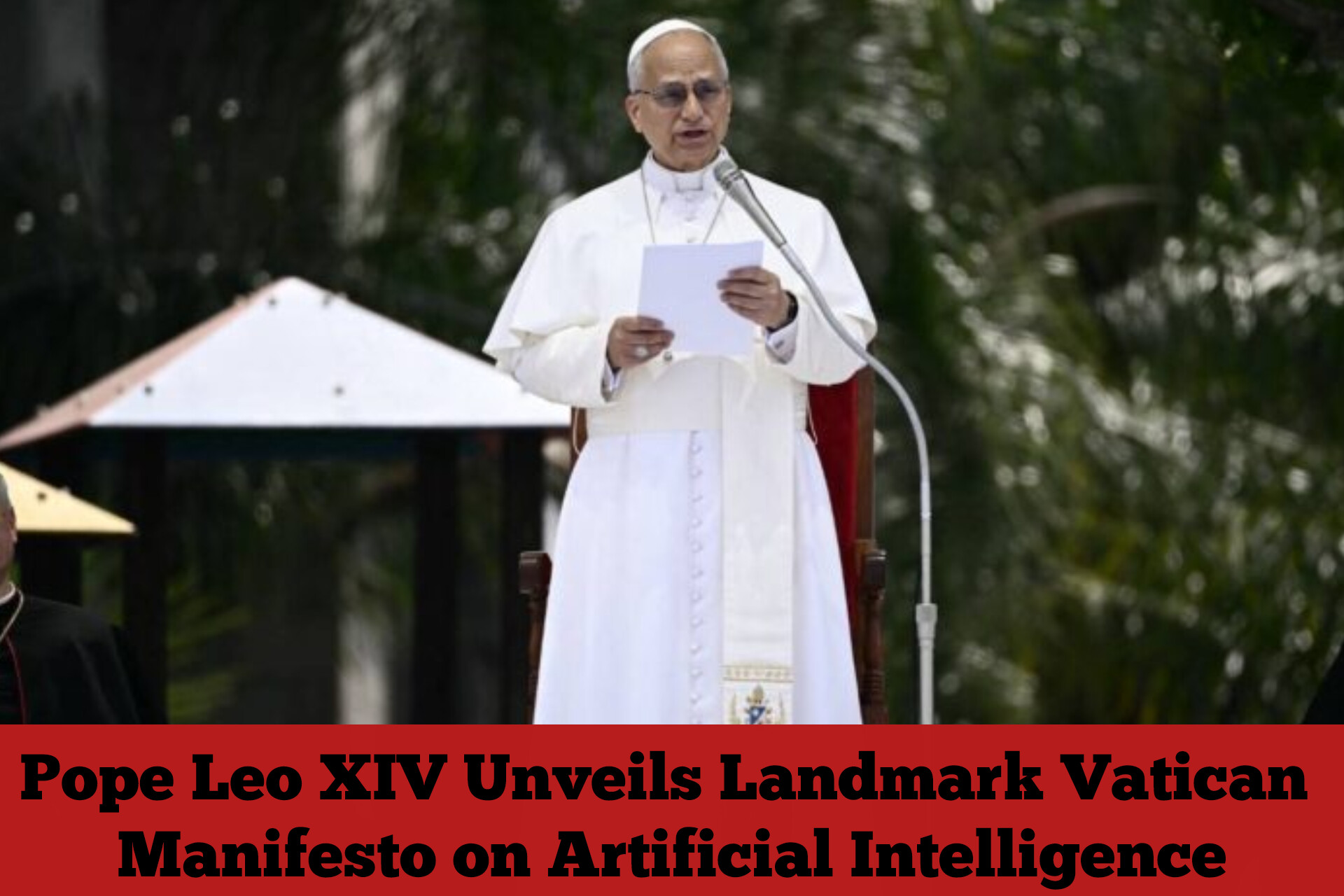
Pope Leo XIV is set to unveil a landmark Vatican document on artificial intelligence, outlining the Catholic Church’s response to the ethical, social and environmental challenges posed by the rapidly advancing technology.
The document, titled “Magnifica Humanitas” (Magnificent Humanity), marks the first time a pope will personally attend the presentation of an encyclical — one of the Church’s most authoritative teaching documents.
The event at the Vatican will bring together senior Holy See officials and leading technology experts, including a co-founder of AI company Anthropic, highlighting the growing dialogue between the Church and the technology sector.
Pope Leo, the first American pontiff, has made artificial intelligence a defining issue of his papacy since his election a year ago. He has repeatedly expressed concern about the impact of AI on human dignity, truth and global security.
The pontiff has strongly criticised the use of AI in warfare, warning against what he described as a dangerous trend of allowing machines to make life-and-death decisions.
“Delegating decisions concerning the life and death of human beings to machines” risks creating a “destructive spiral”, he has said.
He has also cautioned against what he describes as the gradual replacement of reality with digital simulations and warned about the environmental consequences of the global race for rare earth minerals used in advanced technologies.
The Vatican says Magnifica Humanitas builds on the Church’s long-standing social teachings and aims to protect people in what it calls the “AI era”.
The encyclical was signed during the 135th anniversary of an 1891 teaching issued by Pope Leo XIII, whose writings laid the foundations of modern Catholic social doctrine during the Industrial Revolution.
Observers say the new text could have a global impact similar to that of Pope Francis’ climate encyclical Laudato Si’, which influenced political debate and environmental advocacy around the world.
Political scientist Marijana Grbesa said the Church sees parallels between today’s technological revolution and the upheaval caused by industrialisation in the 19th century.
“The Industrial Revolution transformed the labour market, people’s lives, hegemony and power dynamics,” she said.
“At the time, it was necessary to train individuals in the use of tools. The same is true today: we need to train and educate.”
However, she suggested the pope’s message will go beyond education alone.
“It’s a wake-up call for the whole of civilisation,” she said, urging societies “to be rational when we use these tools”.
Pope Leo has repeatedly stressed the importance of digital literacy, arguing that people must understand how algorithms influence their understanding of the world.
He recently warned that AI could be used to fuel “polarisation, conflict, fear and violence” and criticised the lack of transparency surrounding the algorithms powering increasingly popular chatbot systems.
The encyclical follows years of Vatican engagement with artificial intelligence. Seven years ago, the Holy See launched the “Rome Appeal for an AI Ethic”, calling for technological development that respects human dignity and fundamental rights.
The debate comes as AI’s economic influence expands rapidly. According to the United Nations, the technology could be worth as much as $4.8 trillion in the coming years, while raising concerns that wealth and power may become concentrated among a small number of companies and countries.
Last year, UN Secretary-General Antonio Guterres warned that the world had limited time to ensure artificial intelligence develops “for peace, for justice, for humanity”.
With Magnifica Humanitas, Pope Leo is seeking to place those concerns at the centre of global discussion, urging governments, businesses and citizens to ensure technological progress remains firmly anchored in human values.