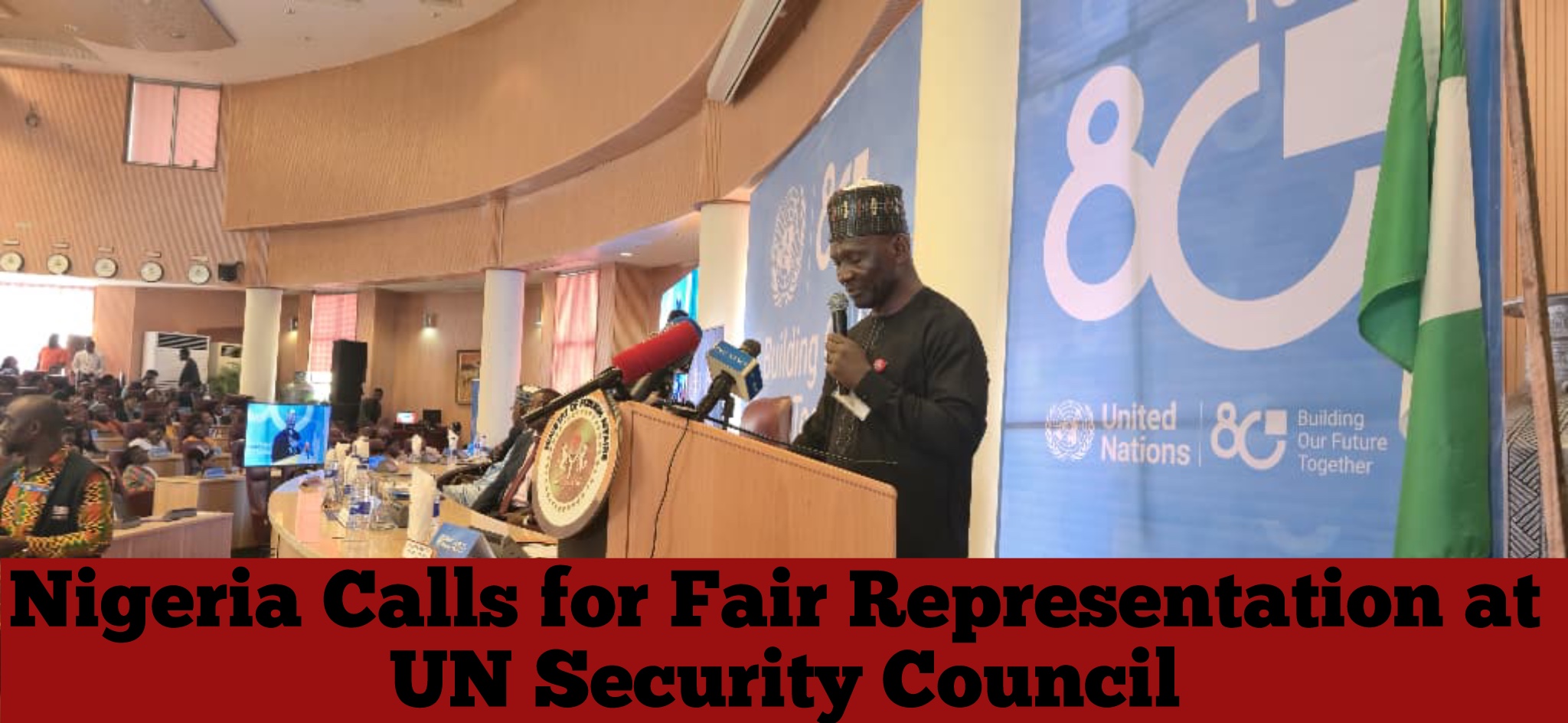
Nigeria has renewed its call for fairness, equity, and inclusiveness in the global decision-making process, especially within the United Nations Security Council, as the world body marks its 80th anniversary.
Speaking at an event in Abuja to commemorate the milestone, the Permanent Secretary of the Ministry of Foreign Affairs, Ambassador Umar Ahmed—represented by the Chief of Protocol, Ambassador Wahab Akande—said Africa’s demand for permanent representation at the UN Security Council was both legitimate and urgent.
“The call for permanent seats at the Security Council is not a plea for favour but a demand for fairness and equity. It is a call for continental representation and reform that restores credibility to the very institution upon which the hope of multilateralism rests,” Ambassador Ahmed stated.
He emphasized that a reformed and inclusive United Nations would strengthen global peace, enhance development cooperation, and ensure that no region of the world is left behind in decision-making.
The UN Resident and Humanitarian Coordinator in Nigeria, Mr. Mohamed Malik Fall, described the 80th anniversary as a moment for reflection and recommitment to the UN’s founding values of peace, human rights, and development.
“At 80, the United Nations must deliver better — to women, to young people, and to the most vulnerable. We must act together to make the next decade one of hope, justice, and shared prosperity,” Fall said.

He reaffirmed the UN’s commitment to supporting Nigeria’s national development priorities through collaboration in areas such as poverty reduction, humanitarian response, climate resilience, and youth empowerment.
Professor Lawrence Ezemonye, Vice Chancellor of KADA University and President of the Institute of Environmental Practitioners of Nigeria, said the anniversary should inspire reforms that reflect current global realities.
“The UN we want must be smarter, more responsive, and more networked,” he said. “It must leverage technology, inclusivity, and environmental sustainability to address emerging global challenges.”
From the civil society community, Ms. Bridget Osakwe, Executive Director of the West Africa Network for Peacebuilding (WANEP), urged global leaders to invest in peacebuilding at the grassroots level. She said communities affected by conflict must be seen as partners in peace, not just beneficiaries of aid.
“Peace cannot be imported or imposed; it must be nurtured through trust, inclusion, and justice,” Osakwe noted.
On his part, human rights lawyer, Mr. Chino Edmund Obiagwu, emphasized that the UN’s future relevance depends on how effectively it addresses economic and social inequalities.
“Beyond political declarations, the UN must act to protect rights that matter to everyday citizens—access to justice, economic fairness, and social dignity,” he said.
Adding youthful voices to the call for reform, youth representatives Daniella Ituen and Timilehin Adewuyi highlighted the need for greater youth inclusion in decision-making processes. They said the UN’s sustainability depends on empowering young people to contribute solutions to global challenges.
The event, organized in partnership with the UN system and the Nigerian government, featured reflections on the theme “The UN at 80: Building a Better Future Together.” It ended with goodwill messages, prayers for peace, and renewed commitments to multilateral cooperation.
“The next eighty years must be about solidarity, inclusion, and transformation,” Fall concluded. “That’s how the United Nations will continue to matter to the people it serves.”