
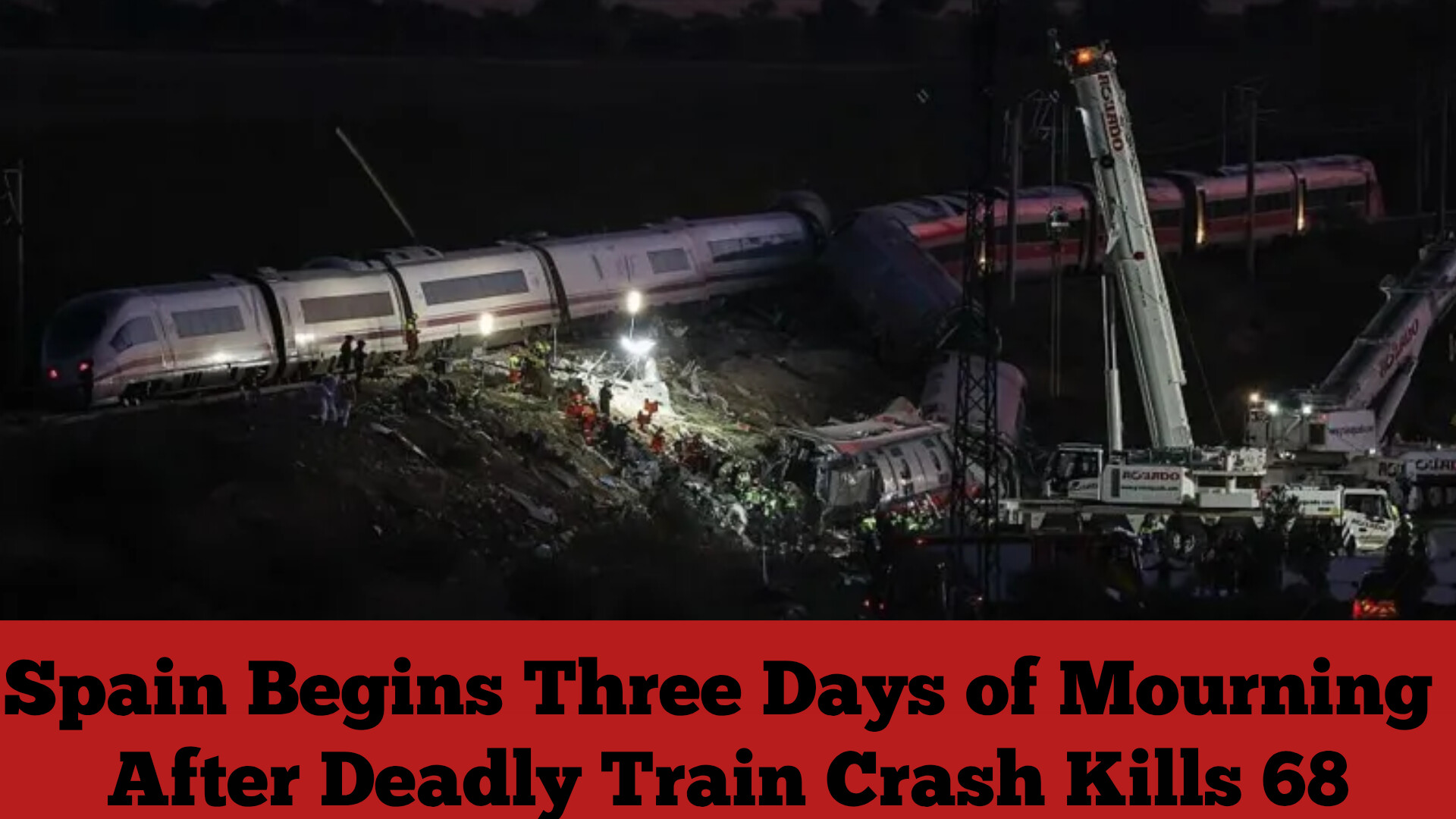
Spain begins three days of national mourning after a high-speed train collision kills 68 people and injures scores of others, leaving families desperately searching for missing relatives.
The crash occurred in Castilla-La Mancha, central Spain, when a train operated by state-owned Renfe struck the rear of a stationary train belonging to private operator Iryo.
Emergency crews continued searching through the wreckage overnight, using cranes to lift twisted metal as they looked for more victims along the railway line linking Madrid and Seville.
The disaster, one of Europe’s deadliest rail accidents this century, raises fresh concerns about railway safety in Spain.
Survivors described scenes of chaos as passengers were thrown from their seats and carriages were damaged in the collision.
Josimar Medina, a 31-year-old Peruvian tourist travelling with his girlfriend, said he was asleep when the crash happened.
“I woke up and I was in the air,” he told AFP.
Another survivor, Pablo Mejia, 42, sustained head injuries but said a last-minute change of seat may have saved his life.
Recalling the impact, he said there was “a very strong hit” and described seeing people lying on top of one another, seats ripped out and suitcases scattered across the train.
“I think I’ve been born again,” he said.
Authorities have established a centre at a school in Urda, about 130km south of Madrid, where relatives can seek information about their loved ones.
Red Cross workers are providing psychological support to distressed families as identification efforts continue.
Red Cross psychologist Carmen Garcia said relatives were experiencing different reactions, including shock, anger, sadness and anxiety.
“The grieving will be complicated,” she said, warning that the process would involve “long and hard hours”.
The Civil Guard has also opened four offices in Madrid, Toledo, Cordoba and Seville to collect DNA samples from relatives and help identify missing victims. Blood donation centres have been established in Castilla-La Mancha and Madrid.
Jose Miguel Fernandez, a parish priest in Urda, said supporting grieving families was crucial.
“What matters most is being with the victims’ relatives, that they feel the closeness, because words at a time like this are pointless, but a hug helps,” he said.
Transport Minister Oscar Puente said an automatic control system had failed along a 69km stretch of track, forcing trains in the area to stop.
However, he questioned the decision to resume services before the problem was resolved.
The control centre decided to “resume traffic in circumstances that, from our point of view, are inexplicable,” Puente said.
He added that the control centre “had more than enough time to verify the error, and they did not fix it”.
According to the minister, the Renfe train travelled about 25km before colliding with the stationary Iryo service.
Investigators are expected to examine the circumstances surrounding the collision and the reported failure of the control system.
The crash comes after another deadly high-speed rail collision in southern Spain earlier this year. That accident, which occurred in Andalusia after a train derailed and crossed onto an adjacent track, killed 46 people. Investigations into that incident remain ongoing.
The latest disaster is likely to intensify scrutiny of the government’s management of Spain’s railway network as Prime Minister Pedro Sanchez faces mounting political pressure ahead of a general election.