
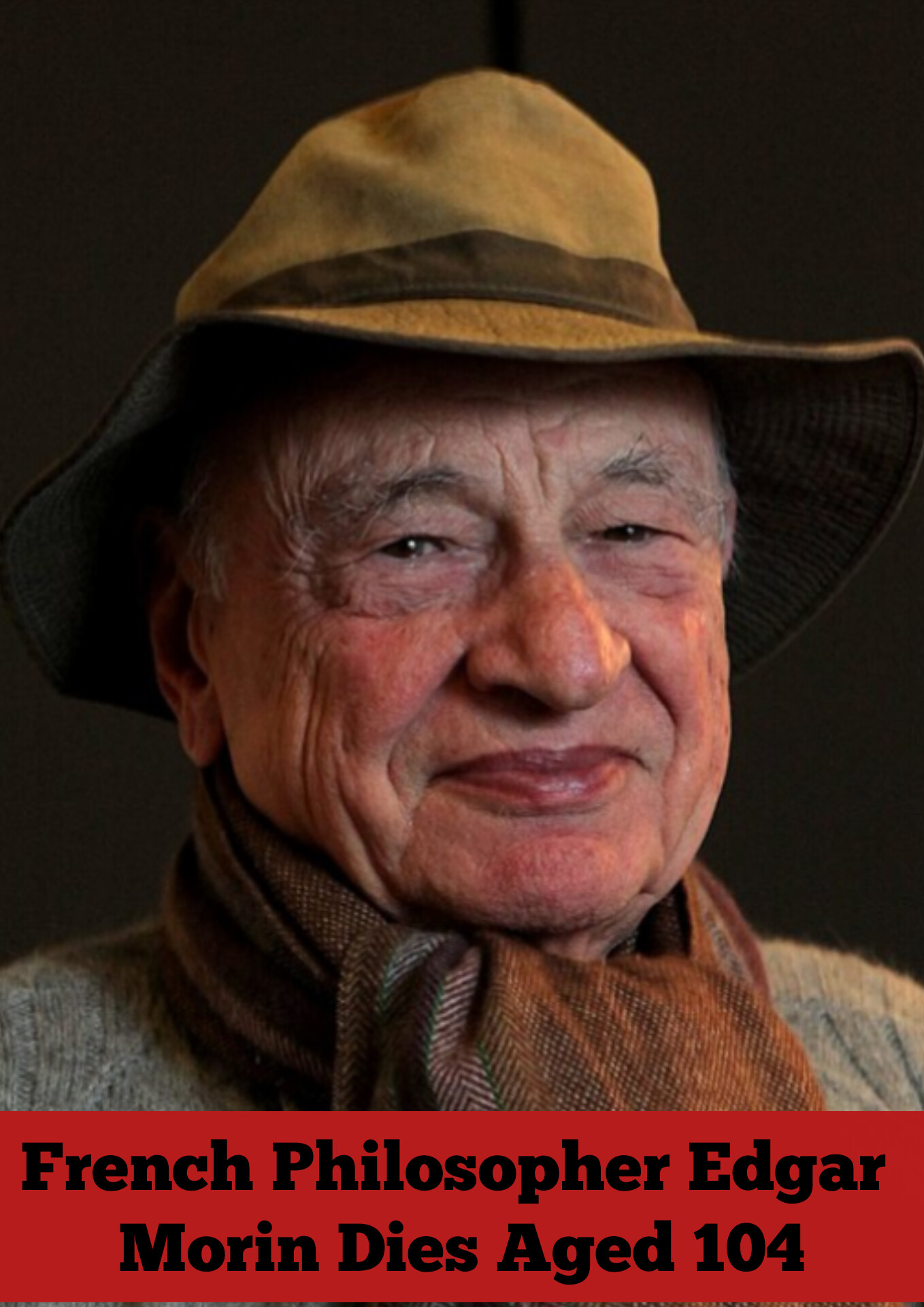
French philosopher and sociologist Edgar Morin, one of the country’s most influential public intellectuals and a former member of the French Resistance during World War II, has died at the age of 104.
His death was announced by his wife, Sabah Abouessalam Morin, who paid tribute to a thinker whose work shaped debates on humanity, globalisation, ecology and democracy for more than seven decades.
“Until his final days, Edgar Morin remained attentive to the world, to others, and to the great human issues that nourished his thinking,” she said in a statement.
“Today, the void he leaves behind is immense. But his courage, his loyalty to people and to ideas, his moral rigor and his hope continue to accompany us.”
Widely regarded as one of France’s foremost intellectual figures, Morin dedicated his life to promoting critical thinking and challenging dogma. The left-leaning newspaper Liberation described him as “the grandfather of all French people and the memory of the last century”.
Born Edgar Nahoum in Paris to Jewish parents who had emigrated from Greece, Morin joined the French Resistance against Nazi occupation under the pseudonym that would later become his public identity.
After the war, he built a distinguished academic career, developing a transdisciplinary approach that drew on sociology, philosophy, psychology, biology and anthropology. He often described himself not as a sociologist but as a “humanologist”.
Morin became internationally known for co-creating the groundbreaking 1961 documentary Chronicle of a Summer with filmmaker Jean Rouch. The film, which explored the lives of ordinary Parisians through unscripted conversations, helped establish the “cinema verite” style and transformed documentary filmmaking.
Reflecting on his intellectual approach, Morin once told TV5 Monde: “What does it mean to be human? What is globalisation? What is life? These questions require us to connect knowledge that is currently scattered across fields of research.”
Even after turning 100, Morin remained an active commentator on world affairs. Through books, interviews and social media, he addressed issues ranging from climate change and nationalism to war and social division.
A prolific author of dozens of books, he spent his later years warning of the dangers posed by environmental degradation, unchecked capitalism and rising extremism.
In one of his final public reflections, he expressed concern about humanity’s future but maintained hope.
Lamenting what he called an “absence of awareness that we are marching towards the abyss”, he nevertheless rejected pessimism, quoting German poet Friedrich Hölderlin: “Wherein lies the danger also grows the saving power.”
Morin’s influence extended far beyond academia. His writings on complexity, ecology and human interconnectedness earned him admiration across generations and political divides.
In recognition of his contribution to French intellectual life, President Emmanuel Macron invited him to a state dinner to mark his 100th birthday.
His death closes a chapter in French public life, ending the remarkable journey of a thinker whose voice helped interpret many of the defining challenges of the modern era.