
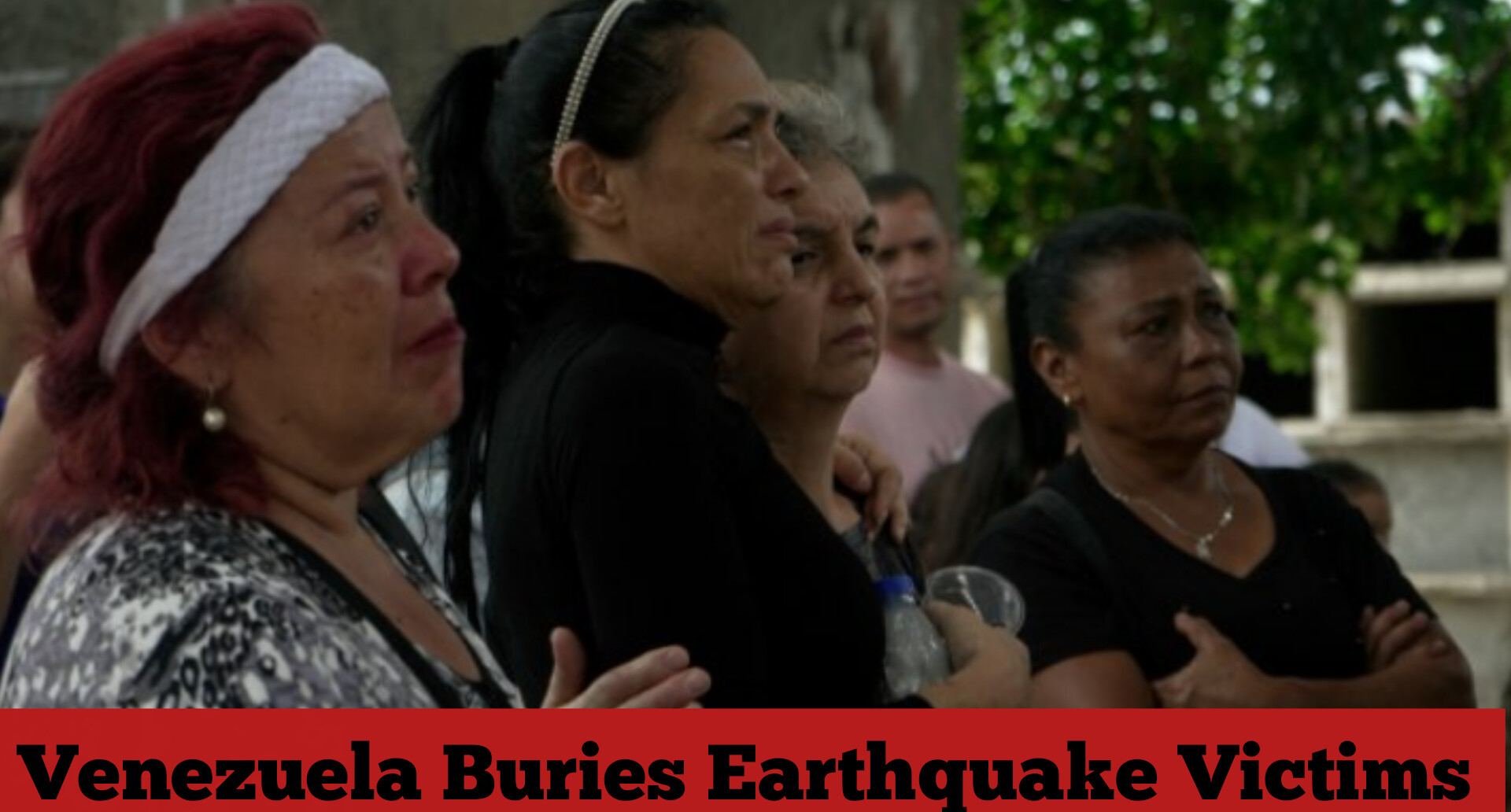
The United States military has reopened a major seaport in Venezuela’s worst-hit earthquake zone as authorities begin burying more than 1,700 people killed by two devastating earthquakes, with tens of thousands still unaccounted for.
Five days after the back-to-back quakes flattened entire neighbourhoods, rescue efforts are increasingly turning into recovery operations as hopes of finding more survivors continue to fade.
According to official figures, at least 1,700 people have died and about 5,000 have been injured, although the government has not released an official number of those missing. Independent estimates suggest the number of missing could be in the tens of thousands.
The Port of La Guaira has resumed operations after repairs by the US military, allowing aid deliveries to reach the disaster zone. The USS Fort Lauderdale docked at the port with emergency supplies, while American airmen worked to restore operations at Simon Bolivar International Airport near Caracas, which also sustained heavy damage.
At a warehouse serving as a temporary morgue, hundreds of unidentified bodies lay in white and black body bags as grieving relatives waited outside for news of missing family members. Forensic teams continued identifying victims while rescue workers searched collapsed buildings despite diminishing hopes of finding anyone alive.
A fresh 4.6-magnitude earthquake rattled the region, triggering renewed panic among survivors.
The Venezuelan government has deployed military personnel across La Guaira and introduced permits for access to the disaster zone, prompting criticism from residents who accuse authorities of responding too slowly to the crisis.
A total of 27 countries have deployed nearly 40 search-and-rescue teams, involving more than 2,000 personnel and over 160 search dogs, according to the United Nations’ coordinator in Venezuela, Gianluca Rampolla.
“The United Nations will provide 10,000 body bags,” Rampolla said, adding that the organisation hopes the final death toll will be lower despite the expiry of the critical 72-hour rescue window.
One rare success came when 21-year-old Aaron Levi was pulled alive from the rubble in the coastal town of Tanaguarena, five days after the earthquakes struck.
The UN estimates that about seven million people have been affected by the disaster, which is expected to inflict economic losses of approximately $6.7 billion, equivalent to six percent of Venezuela’s gross domestic product.
At Caracas’ only public cemetery, crematoriums are operating around the clock as families bury their loved ones.
“It was a horrible experience, pulling him out, his children,” Sergio Vergara said after recovering the bodies of his nephew and relatives from a collapsed building in La Guaira.
Others are still waiting for confirmation of their loved ones’ fate.
“My family is there — I’m told my sister and her children are there, as well as the children of my brother,” Wilker Molalla said while waiting to identify remains.
“There were 11 people in my household; only two of us survived because we were at work,” he added.
The disaster has also deepened political tensions.
Opposition leader and Nobel Peace Prize laureate Maria Corina Machado accused the government of interim President Delcy Rodríguez of blocking her return from exile.
“I am ready and close to Venezuela and will do whatever it takes for us to meet there,” Machado said in a video posted on X, claiming authorities had closed the country’s airspace to prevent her return.
The Venezuelan government has not responded to the allegation, while Washington, which is coordinating relief operations on the ground, has also declined to comment.