
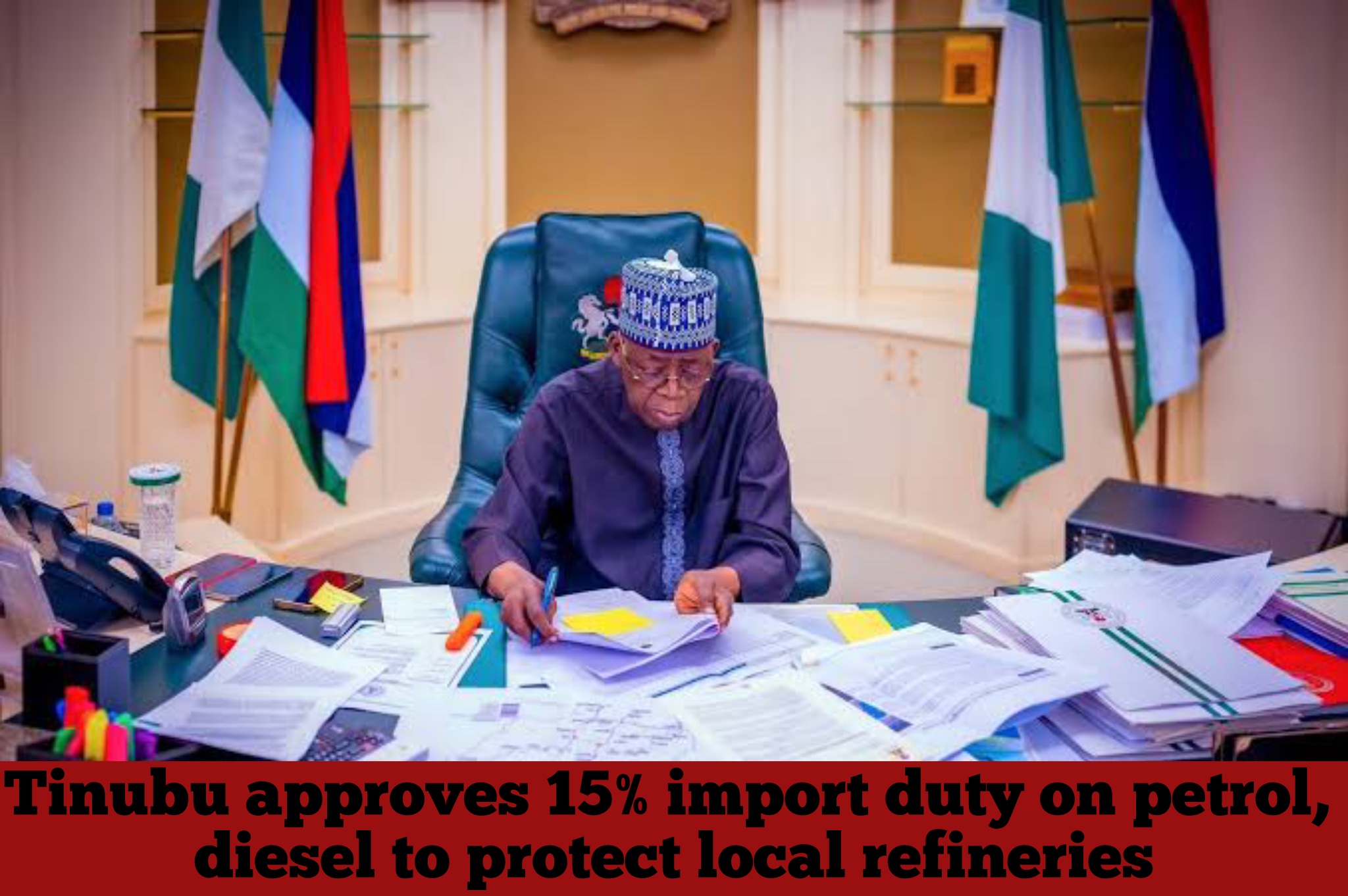
President Bola Tinubu has approved the introduction of a 15 per cent ad-valorem import duty on petrol and diesel imports into Nigeria.
The new policy aims to protect domestic refineries, stabilise the downstream petroleum market, and promote energy security which may lead to a modest increase in pump prices.
In a letter dated October 21, 2025, and made public on October 30, 2025, President Tinubu instructed the Federal Inland Revenue Service (FIRS), the Nigerian Midstream and Downstream Petroleum Regulatory Authority (NMDPRA), to immediately implement the new tariff.
The directive, signed by his Private Secretary, Damilotun Aderemi, followed a proposal from FIRS Executive Chairman Zacch Adedeji.
According to the letter, the 15% import duty will be applied to the cost, insurance, and freight (CIF)value of imported petrol and diesel. The move is part of the administration’s market-responsive import tariff framework, designed to align fuel import costs with domestic production realities.
Adedeji explained that the measure supports ongoing reforms aimed at boosting local refining capacity, ensuring price stability, and strengthening the naira-based oil economy under the government’s Renewed Hope Agenda.
“The goal is to operationalise crude transactions in local currency, support domestic refiners, and ensure a stable and affordable fuel supply across Nigeria,” Adedeji stated.
He noted that while domestic refining of petrol and diesel had grown with diesel production now meeting local demand, market instability persists due to the gap between import parity pricing and local cost recovery levels.
He said the misalignment would undermine local producers and discourage investment.
Adedeji emphasised that the government’s role to protect consumers and domestic producers from unfair pricing practices while maintaining a level playing field for refiners to recover costs and attract new investments.
The new tariff, he added, would discourage duty-free fuel imports from undercutting local refineries, helping to create a competitive and sustainable downstream environment.
Government projections suggest that the 15% duty could raise the landing cost of petrol by about ₦99.72 per litre, bringing the Lagos pump price to approximately ₦964.72 per litre ($0.62). This remains below the regional averages — Senegal ($1.76), Côte d’Ivoire ($1.52), and Ghana ($1.37)per litre.
The policy comes as Nigeria pushes to reduce dependence on imported fuel and ramp up domestic refining. The 650,000 barrels-per-day Dangote Refinery in Lagos has begun producing diesel and aviation fuel, while modular refineries in Edo, Rivers, and Imo states are producing petrol on a smaller scale.
Despite this progress, imports still meet about 67 per cent of Nigeria’s petrol demand, underscoring the urgency of government measures to stimulate local production and stabilise the fuel market.


