
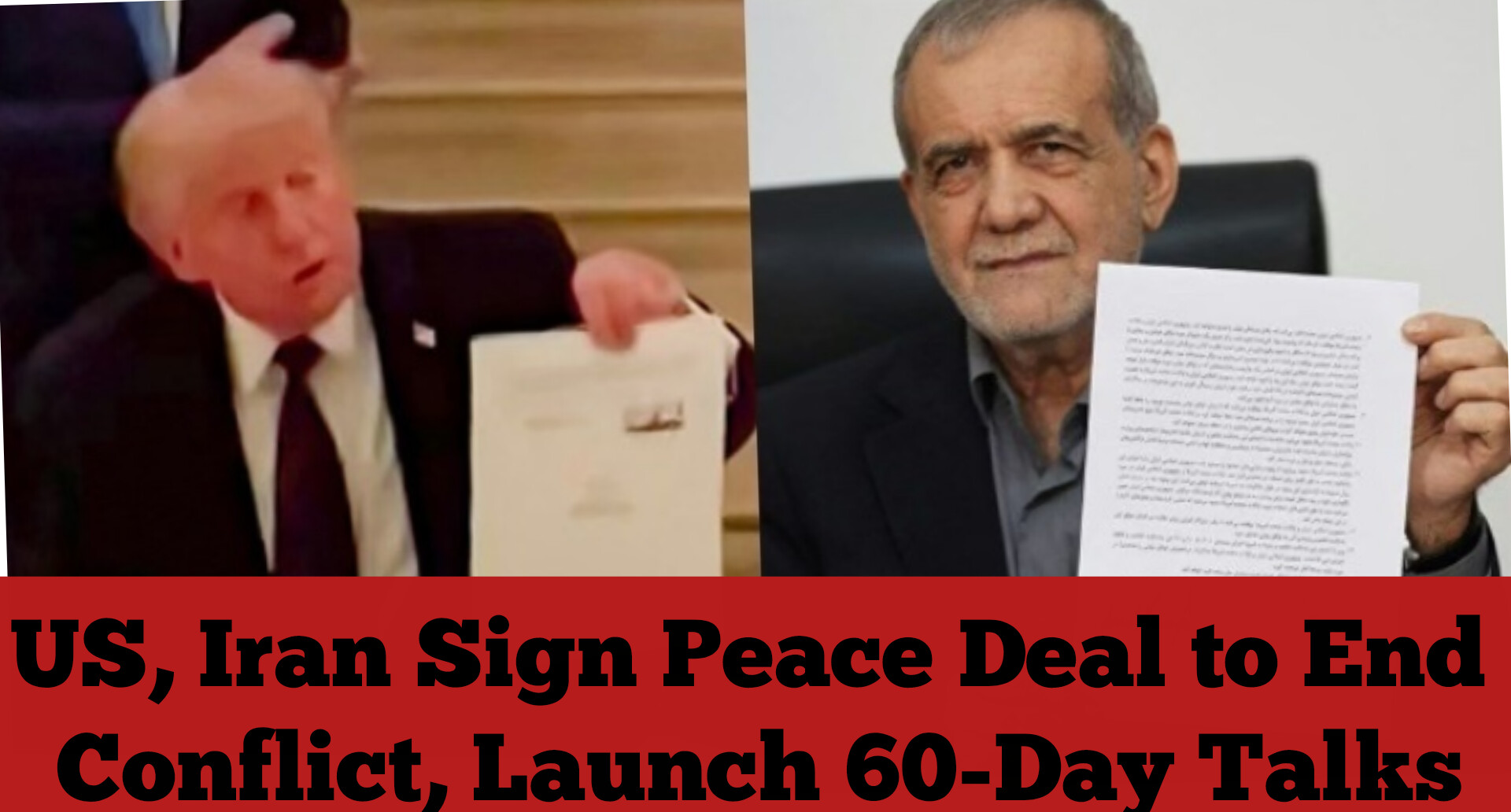
The United States and Iran have signed a landmark agreement aimed at ending months of conflict in the Middle East, with a formal ceremony scheduled in Switzerland to launch a 60-day period of negotiations toward a final peace settlement.
US President Donald Trump signed the memorandum of understanding during a candlelit dinner at the Palace of Versailles after the G7 summit, according to footage shared by one of his aides.
“Just signed it,” Mr Trump told reporters as he left the palace.
The agreement, which was also signed by Iranian President Masoud Pezeshkian, seeks to halt a conflict that began earlier this year following US and Israeli military strikes on Iran and subsequent Iranian missile and drone attacks across the region.
Iranian Foreign Ministry spokesman Esmaeil Baqaei confirmed the deal, telling the state news agency IRNA that the document “was finalized with the signatures of the presidents”.
Pakistan’s Prime Minister Shehbaz Sharif, who played a mediating role in the negotiations, said the agreement “shall enter into force with immediate effect”.
A ceremony in Switzerland will “commemorate this landmark event and commence with the technical level talks”, Mr Sharif said.
Key provisions
Under the memorandum, the United States, Iran and their allies have agreed to an “immediate and permanent termination of military operations on all fronts, including in Lebanon”.
Both sides also pledged not to launch military action against one another and to respect the sovereignty and territorial integrity of regional states.
The agreement commits Washington and Tehran to reaching a final settlement within 60 days, although the deadline can be extended by mutual consent.
Nuclear commitments
Iran reaffirmed its pledge not to develop or acquire nuclear weapons.
The memorandum states that Tehran’s stockpile of enriched uranium will be addressed through a mutually agreed mechanism under the supervision of the International Atomic Energy Agency (IAEA).
Until a final deal is reached, Iran will maintain its current nuclear programme while the United States has pledged not to impose new sanctions or deploy additional forces in the region.
Sanctions and economic relief
The United States has agreed to begin lifting restrictions on Iranian ports immediately and complete the process within 30 days.
Washington also pledged to terminate sanctions against Iran and release frozen Iranian assets once the memorandum is implemented.
The US Treasury will issue waivers allowing exports of Iranian crude oil and petroleum products, alongside related banking, insurance and transport services.
A major economic component of the deal includes plans by the United States and its regional partners to develop a reconstruction and development package worth at least $300bn for Iran.
Strait of Hormuz to reopen
Iran has committed to restoring safe commercial navigation through the Strait of Hormuz, one of the world’s most important energy shipping routes.
Commercial traffic is expected to resume immediately, with full restoration targeted within 30 days after the removal of mines from the waterway.
The conflict had severely disrupted maritime trade after Iran effectively closed the strait and the United States responded by restricting shipping linked to Iranian ports.
UN backing planned
The memorandum states that any final agreement reached between the two sides will be endorsed through a binding resolution of the United Nations Security Council, providing international legal backing for the settlement.
If fully implemented, the accord could mark one of the most significant diplomatic breakthroughs in the Middle East in recent years, easing regional tensions and reducing uncertainty in global energy markets.