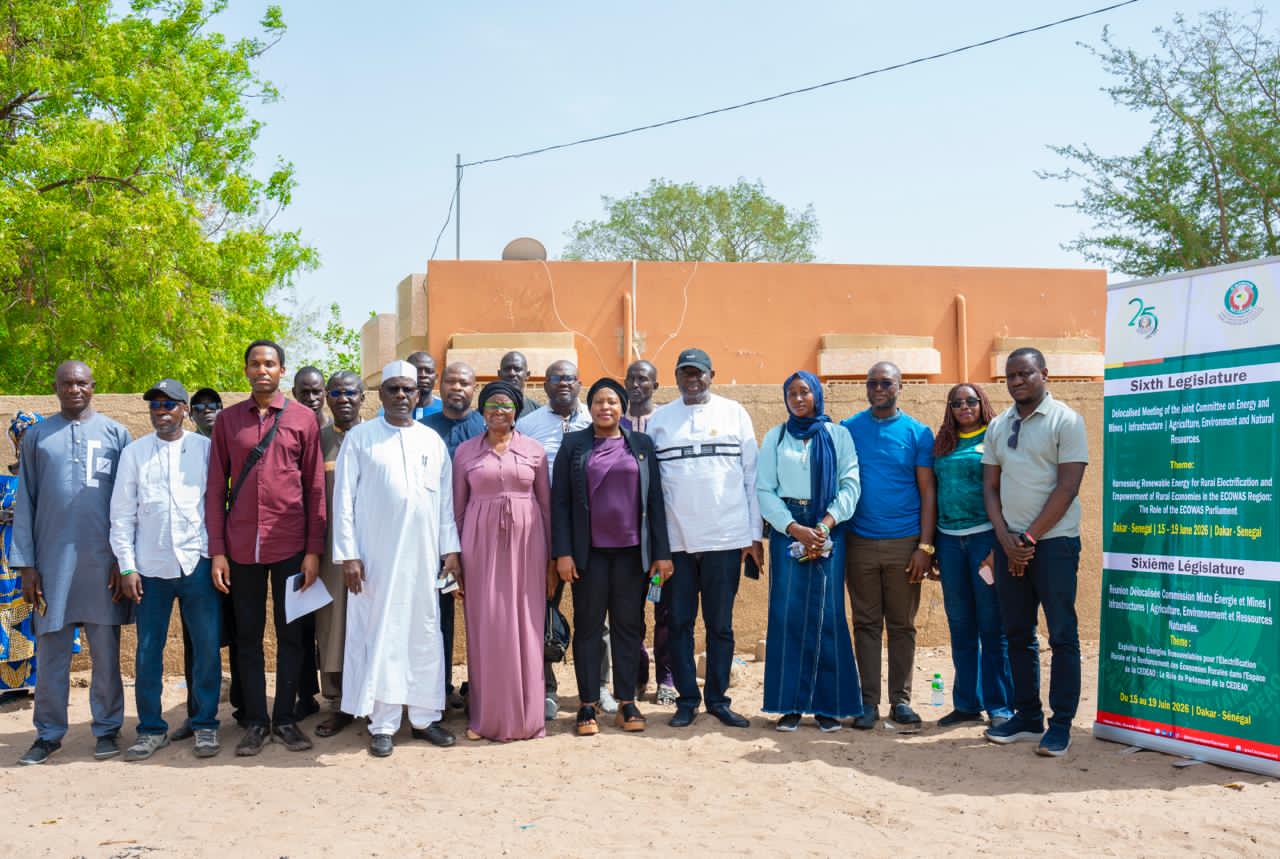
Members of the ECOWAS Parliament have commended Senegal’s solar-powered rural electrification initiative in Ndiob, describing it as a model capable of transforming rural economies across West Africa despite facing growing challenges linked to rising energy demand.
The commendation followed a field visit by the ECOWAS Parliament Joint Committee on Energy and Mines, alongside Committees on Infrastructure, Agriculture, Environment and Natural Resources, to the Commune of Ndiob in Senegal’s Fatick Region on June 18, 2026.
The visit formed part of a delocalized meeting focused on harnessing renewable energy for rural electrification and strengthening rural economies within the ECOWAS region.
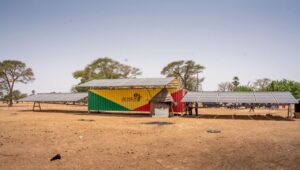
Led by Hon. Fanta Conté, the delegation inspected the Ndiob solar installation managed by Green Impact West Africa under a mandate from Senegal’s Rural Electrification Agency (ASER). The project, launched in 2019 and commissioned in 2021, is regarded as one of Senegal’s flagship rural electrification initiatives.
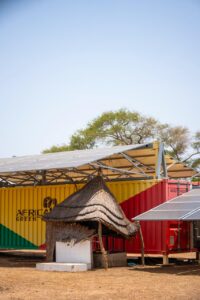
At the centre of the project is a Solartainer power plant equipped with 144 photovoltaic panels and a lithium-ion battery storage system capable of supplying electricity to three villages through a low-voltage distribution network supported by smart metering technology.
The facility currently serves households, small businesses and social institutions, including schools, health centres and places of worship. It also supports access to clean water through an integrated purification system and offers prospects for agricultural cold-chain services.
Residents told lawmakers that access to reliable electricity has significantly improved living standards, reducing dependence on candles, kerosene lamps and fuel-powered generators. Improved lighting has enhanced security and education, while businesses now operate for longer hours, boosting local economic activity.
Artisans, farmers and traders have particularly benefited from expanded access to power, with cold storage facilities helping to reduce post-harvest losses and improve agricultural productivity.
However, project operators and community members highlighted several challenges threatening the sustainability of the initiative. These include rising demand that now exceeds installed capacity, irregular voltage supply, difficulties in equipment maintenance, funding constraints and the need for stronger battery storage systems.
Speaking during the visit, Vice Chairman of the ECOWAS Committee on Infrastructure, Hon. Ahmed Munir, encouraged young people to embrace opportunities in the renewable energy sector by investing in solar installation and maintenance services.
Similarly, Chairman of the ECOWAS Parliament Committee on Agriculture, Senator Ali Ndume, urged women to leverage solar-powered equipment for income-generating ventures, particularly in food preservation and small-scale agro-processing.
A resident, Mustafa Faye, acknowledged the positive impact of the project but stressed the need for expansion to meet growing demand.
According to him, while solar energy has improved the quality of life in the community, existing batteries and infrastructure can no longer adequately support the increasing number of users.
Green Impact West Africa disclosed plans to expand electricity access to additional communities, introduce solar-powered cold-chain solutions for farmers and strengthen economic empowerment programmes for women and youths.
The company also aims to replicate the Ndiob model across other parts of Senegal and the wider West African region.
For the ECOWAS lawmakers, the Ndiob experience demonstrated the immense potential of renewable energy to drive rural development, create jobs and stimulate economic growth. They, however, emphasized that increased investment, improved storage capacity, supportive policies and stronger community participation will be critical to ensuring the long-term success of renewable energy projects across the region.