
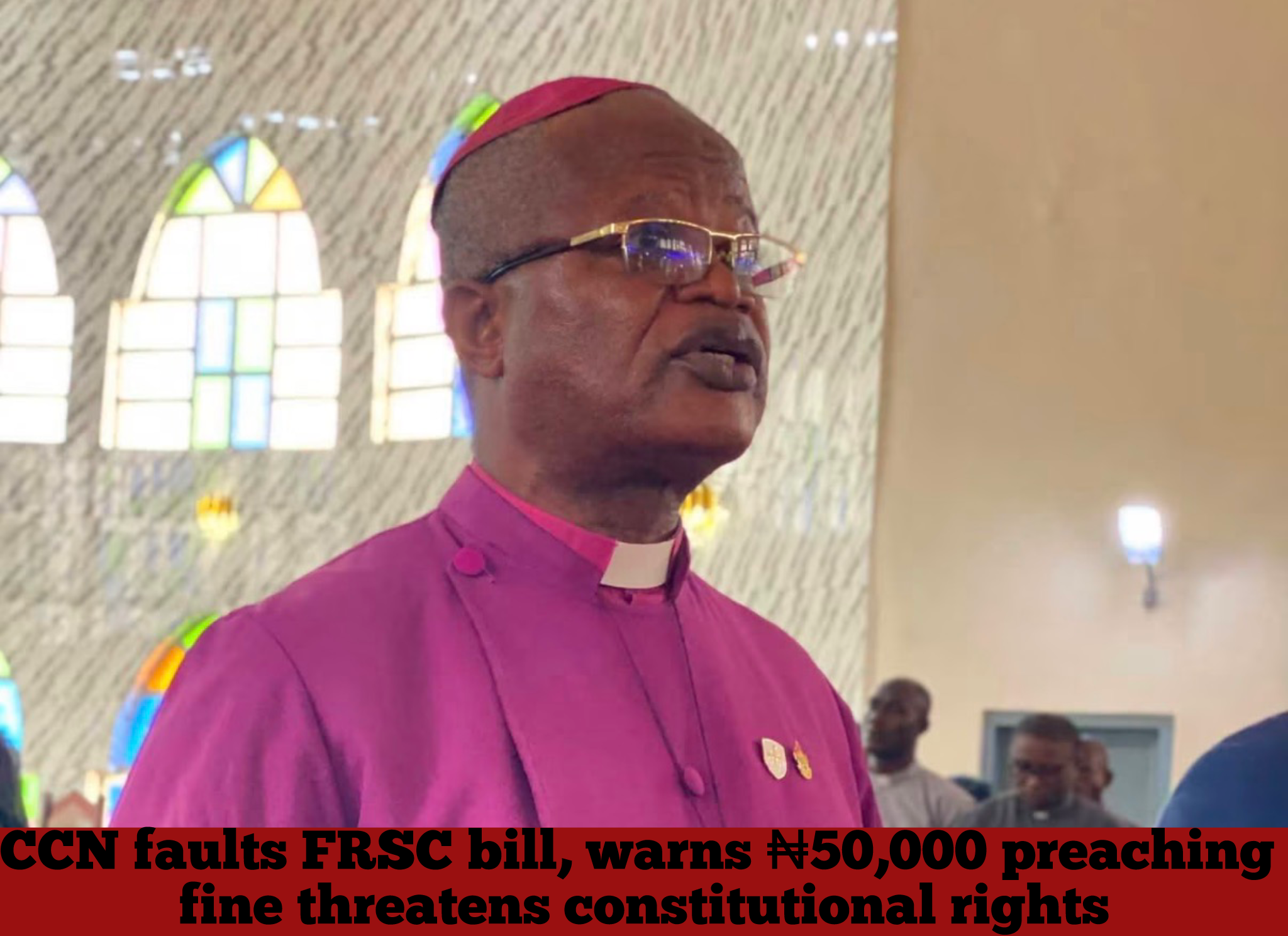
The Christian Council of Nigeria (CCN) has urged President Bola Tinubu and the National Assembly to review contentious provisions of the Federal Road Safety Corps (FRSC) Act (Amendment) Bill, 2026, warning that aspects of the proposed legislation could infringe on constitutional rights and further burden vulnerable Nigerians.
The council expressed particular concern over a provision prescribing a ₦50,000 fine for hawking, trading or preaching in commercial buses, arguing that placing Christian evangelism in the same category as commercial activities raises serious constitutional and human rights concerns.
In a statement issued on Friday and signed by its General Secretary, Rt. Rev. Evans Onyemara, the council said it supports efforts to improve road safety but insisted that such measures should not come at the expense of constitutionally guaranteed freedoms.
“The Christian Council of Nigeria fully supports every genuine effort aimed at improving road safety and reducing accidents on our highways. Respect for traffic regulations saves lives and should be encouraged,” the statement read.
The Senate recently passed the FRSC Act (Amendment) Bill, 2026, proposing a ₦100,000 fine for motorists who violate traffic lights and a ₦50,000 penalty for anyone caught hawking, trading or preaching in commercial buses.
Reacting to the development, the CCN said it was “deeply concerned” by the inclusion of preaching among the prohibited activities.
“While the objective may be to reduce distractions, the inclusion of preaching alongside hawking and trading raises legitimate concerns about freedom of religion and expression as guaranteed by the Constitution of the Federal Republic of Nigeria,” Onyemara said.
According to the council, commercial buses have for decades served as venues where Christians share brief messages of hope, repentance, encouragement and prayer with willing passengers. It argued that any attempt to restrict such peaceful religious expression must undergo careful constitutional scrutiny to avoid eroding fundamental freedoms or creating the impression that Christian evangelism is being unfairly targeted.
The council also criticised the proposed ₦50,000 fine for hawkers, describing it as a punitive response to the symptoms rather than the root causes of Nigeria’s economic challenges.
It noted that many Nigerians engage in street and mobile trading because of widespread poverty, unemployment and rising economic hardship, stressing that citizens should not be punished for trying to earn a living.
“The Council also believes that imposing heavy fines on people engaged in hawking fails to address the deeper issues of poverty, unemployment and economic hardship confronting millions of Nigerians. Poverty should not be criminalised,” the statement added.
The CCN urged the Federal Government to adopt more humane alternatives, including designated trading areas, age-appropriate restrictions where necessary, and sustainable economic empowerment programmes instead of punitive sanctions.
The council further appealed to President Tinubu, the National Assembly and other stakeholders to subject the bill to wider public consultation before it is signed into law.
It said the consultation process should involve faith-based organisations, civil society groups, transport unions, road safety experts and representatives of vulnerable communities to ensure the final legislation strikes a balance between public safety and constitutional rights.
“Nigeria needs laws that are firm yet compassionate, laws that protect lives without placing unbearable burdens on citizens who are already struggling to survive,” the statement said.
The CCN maintained that legislation should promote national unity rather than create divisions or perceptions of discrimination.
“The Christian Council of Nigeria believes that legislation should unite rather than divide, protect rather than alienate, and promote both public safety and fundamental human rights. As the moral voice of the nation, the Council remains committed to supporting policies that uphold justice, compassion, religious liberty and the dignity of every Nigerian,” the statement concluded.