
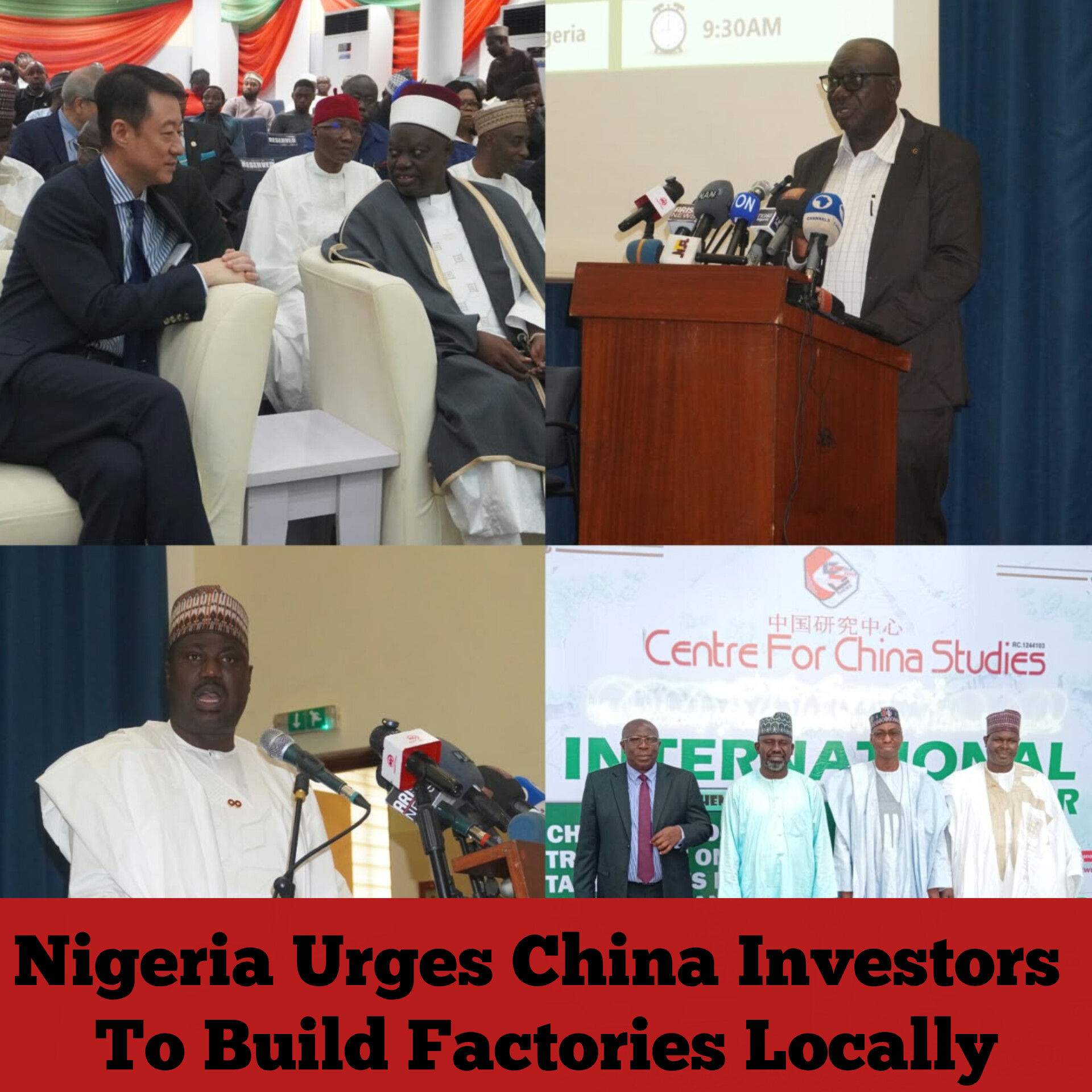
Nigeria has urged Chinese and other international investors to establish factories, processing plants and manufacturing industries in the country, saying future investment partnerships must focus on production and value addition.
The Permanent Secretary of the Ministry of Foreign Affairs, Dr Dunoma Ahmed, made the call in Abuja while representing the Foreign Affairs Minister at a seminar on China’s zero-tariff treatment for African countries and Africa’s economic transformation.
Dr Ahmed said China’s decision to remove tariffs on exports from African countries should be used to strengthen production capacity rather than encourage the export of unprocessed commodities.
“Nigeria is open for business, but increasingly, we seek investment that does more than extract. We seek investment that builds,” he said.
He said President Bola Tinubu’s economic agenda prioritised manufacturing, industrial value chains and job creation, adding that Nigeria’s natural resources should serve as the foundation for industrial development.
“We must transition from exporting resources to exporting value,” Dr Ahmed said.
He urged investors to establish production facilities, source materials locally, develop Nigerian suppliers and integrate local businesses into regional and global value chains.
Manufacturing, agro-processing, mineral processing, technology and innovation, he said, were critical sectors for Nigeria’s economic transformation.
China-Africa trade reaches $207bn
The Chinese Ambassador to Nigeria, Yu Dunhai, said Beijing’s zero-tariff policy was already producing measurable economic benefits across Africa.
He said China-Africa trade reached a record $207bn in the first half of 2026, while Chinese imports from African countries increased significantly following the introduction of the policy.
According to Mr Yu, Nigeria-China bilateral trade rose by 35% year-on-year to $18bn in the first half of 2026.
He added that Chinese imports from Nigeria increased by 80% to $2.3bn during the period.
“China’s zero-tariff policy is a long-term strategic commitment rooted in mutual respect and shared benefits,” Mr Yu said.
He said the policy was reducing export costs, expanding trade and encouraging local processing and industrial investment across African economies.
The ambassador also proposed a formal Agreement on Economic Partnership for Shared Development between China and African countries, including Nigeria, to provide long-term guarantees for investment and trade.
Nigeria’s Minister of State for Agriculture, Aliyu Abdullahi, described the policy as an opportunity to diversify exports beyond crude oil and accelerate agro-industrial development.
He said Nigeria’s priority should not simply be to increase exports but to produce higher-value goods capable of competing in international markets.
“The question is not, can Nigeria export more? The question is, can Nigeria export better?” he said.
Mr Abdullahi warned that tariff-free access to the Chinese market alone would not guarantee economic transformation.
He said Nigeria must improve agricultural productivity, processing capacity, logistics, quality standards and export certification to maximise the opportunity.
Director of the Centre for China Studies in Abuja, Charles Onunaiju, said China’s zero-tariff initiative presented Africa with an opportunity to accelerate industrialisation and reduce dependence on raw commodity exports.
He urged Nigeria to prioritise productive capacity, manufacturing and stronger value chains to maximise access to the Chinese market.
Mr Onunaiju said deeper Nigeria-China cooperation should focus on investment, technology transfer and industrial development that creates jobs and supports long-term economic growth.