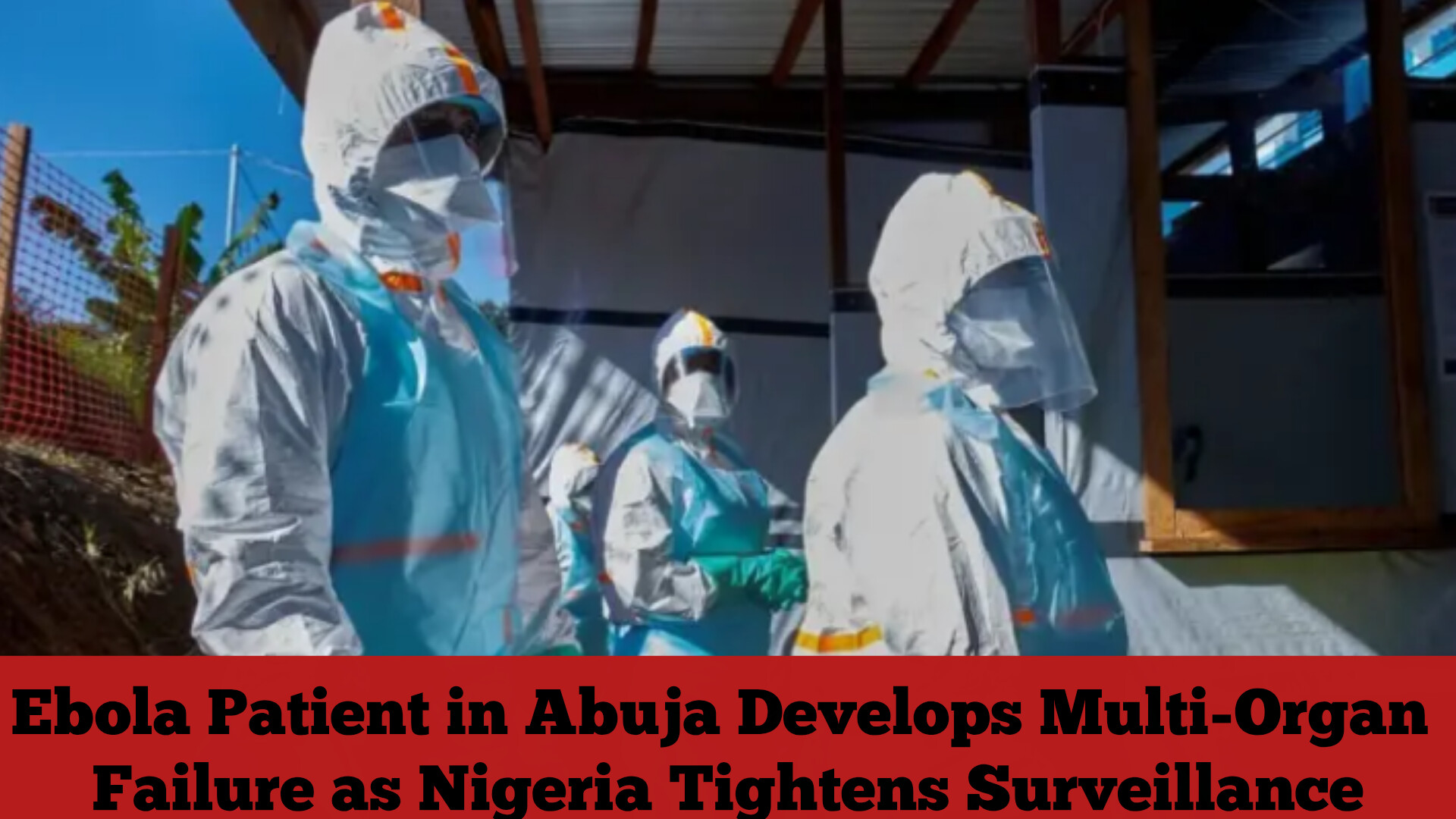
Nigeria has intensified its Ebola containment measures after a diplomat diagnosed with the Bundibugyo strain reportedly develops multi-organ failure in Abuja.
The patient’s identity and nationality have not been disclosed. The Nigeria Centre for Disease Control and Prevention (NCDC) confirmed the strain after conducting three rounds of molecular testing.
The agency’s Director of Public Health Laboratory Service, Olajumoke Babatunde, disclosed the development at an emergency meeting in Abuja.
“The patient’s condition has deteriorated. We did three levels of tests, but all were molecular. The strain was Bundibugyo,” she said.
The Bundibugyo strain is a rare type of Ebola virus first identified during an outbreak in Uganda. The virus spreads through direct contact with the blood and other bodily fluids of infected people or contaminated materials.
The development has prompted the Federal Government and state authorities to strengthen surveillance, contact tracing, airport screening and emergency preparedness to prevent further transmission.
The Coordinating Minister of Health and Social Welfare, Professor Muhammad Pate, says the government is working with Uganda and tracing contacts of the infected patient to contain the outbreak.
Speaking to State House correspondents after a meeting with the Chief of Staff to the President, Femi Gbajabiamila, at the Presidential Villa, Abuja, Pate urged Nigerians to remain vigilant without panicking.
“What is important is that we have found this one case,” he said.
“We are doing contact tracing, and we are putting containment measures to ensure that it doesn’t go into our population.”
The minister described the infection as an imported case and expressed confidence in Nigeria’s public health institutions.
“The Federal Government has competent authorities to deal with this. We have done it and we have good public health institutions. Nigerians should be reassured,” he added.
He urged residents to follow information from trusted public health sources and avoid spreading misinformation.
“We must be vigilant, but not panic. People should respect public health information from trusted sources and not spread misinformation and false rumours,” Pate said.
He added that the NCDC was working continuously and that the Presidential Task Force on Ebola remained active.
Pate also confirmed that the government was reviewing its response plans in coordination with the Office of the National Security Adviser and other relevant agencies.
The Minister of Aviation and Aerospace Development, Festus Keyamo, has directed the Nigeria Civil Aviation Authority (NCAA) to place 46 people linked to the case on a no-fly list for 21 days.
The list comprises 44 people who reportedly came into contact with the patient at a hospital after she developed symptoms and two domestic staff members.
Keyamo said the restriction would remain in place while health authorities assessed the individuals for possible infection.
“Whilst efforts are ongoing to isolate them for now until there is certainty they have not been infected with the virus, the Aviation authorities are required to put them on a no-fly list for at least 21 days,” he said.
He explained that the restriction corresponded with the period during which Ebola symptoms would normally be expected to develop.
The minister also directed the NCAA to notify domestic and international airlines and ordered the Federal Airports Authority of Nigeria (FAAN) to strengthen surveillance at international airports.
FAAN has begun installing temperature-screening cameras to identify passengers with elevated body temperatures. Passengers flagged by the equipment will undergo further medical assessment, while suspected cases will be isolated for evaluation.
Other measures include temperature checks, travel history assessments, digital health declarations, hand sanitisers and protective equipment for frontline workers.
The NCDC said the infected woman arrived from Uganda on 5 October, developed symptoms this month and sought treatment at a private hospital in Abuja.
Her travel history and failure to respond to malaria treatment prompted doctors to alert health authorities.
The incident manager of the National Ebola Disease Response, Dr Odianosen Ehiakhamen, said the 44 hospital contacts were mainly healthcare workers and support staff.
“For the 44 contacts, they are majorly healthcare workers and support staff of the hospital, because everything has happened within the hospital,” he said.
The NCDC says it has activated its incident-management system to coordinate case management, surveillance, contact tracing, infection prevention and public communication.
In a statement published on its X account, the agency said its incident action plan was being finalised, while response teams were already working on containment measures.
“The Incident Action Plan is being finalised today; NCDC teams are on the ground conducting case management and response activities, prioritising enhanced surveillance, contact tracing, infection prevention and control, and coordinated risk communication,” the agency said.
The World Health Organisation has also urged countries in the region to maintain heightened vigilance to support early detection and prevent further transmission.
The WHO has identified the virus as the Bundibugyo strain and declared the outbreak affecting the Democratic Republic of Congo and Uganda a public health emergency of international concern.
There is currently no approved vaccine or specific treatment for Bundibugyo virus disease, making early detection, supportive care and infection prevention particularly important.
The Senate has urged the Federal Government to introduce mandatory health screening for passengers arriving through international airports, seaports and designated land borders.
The lawmakers also called for emergency funding to strengthen disease surveillance, equip Port Health Services and prepare treatment and isolation centres across the 36 states and the Federal Capital Territory.
The resolutions followed a motion sponsored by Ondo South Senator Francis Faduyile, who warned that Nigeria faced a high risk of importing Ebola.
The Senate proposed health declaration forms, temperature checks and symptom screening for international arrivals, with enhanced monitoring for travellers who had visited or transited affected areas within the previous 21 days.
It also called for an amendment to the Quarantine Act of 1976 to reflect current public health challenges.
Senate President Godswill Akpabio urged government agencies to act proactively.
“We have to be proactive; everybody must take part. If it spreads, it will be a major problem,” he said.
The Senate directed relevant committees to inspect major entry points, engage responsible agencies and report back within four weeks.
Timilarly, the House of Representatives has called for stronger preventive measures and the immediate release of outstanding funds appropriated to health agencies.
The resolution followed a motion sponsored by Amobi Ogah, who represents Isuikwuato/Umunneochi Federal Constituency of Abia State.
The House warned that delays in identifying suspected cases, laboratory testing, isolation and contact tracing could increase the risk of transmission.
It also mandated its Committee on Infectious Diseases to obtain updates from relevant ministries and health institutions.
State governments have also intensified preparations following the Abuja case.
Anambra State said it had monitored 40 people of interest, with 33 completing their monitoring periods and being cleared. Seven remained under active follow-up at the time of the report.
Ogun State Commissioner for Health, Dr Tomi Coker, said the state had monitored and discharged 111 people of interest after they completed the required surveillance period.
She urged residents to remain calm, rely on official information and report possible exposure promptly.
Niger State has activated emergency operations and is completing an isolation centre, while Yobe State says it has established surveillance teams, isolation arrangements and contact-tracing mechanisms across all 17 local government areas.
The measures are intended to identify possible infections quickly and prevent the virus from spreading beyond the confirmed case.
Authorities have emphasised that being identified as a contact or person of interest does not automatically mean someone has Ebola. Such individuals require monitoring and appropriate public health assessment.
The Federal Government has also pledged to provide regular updates as the response continues.