

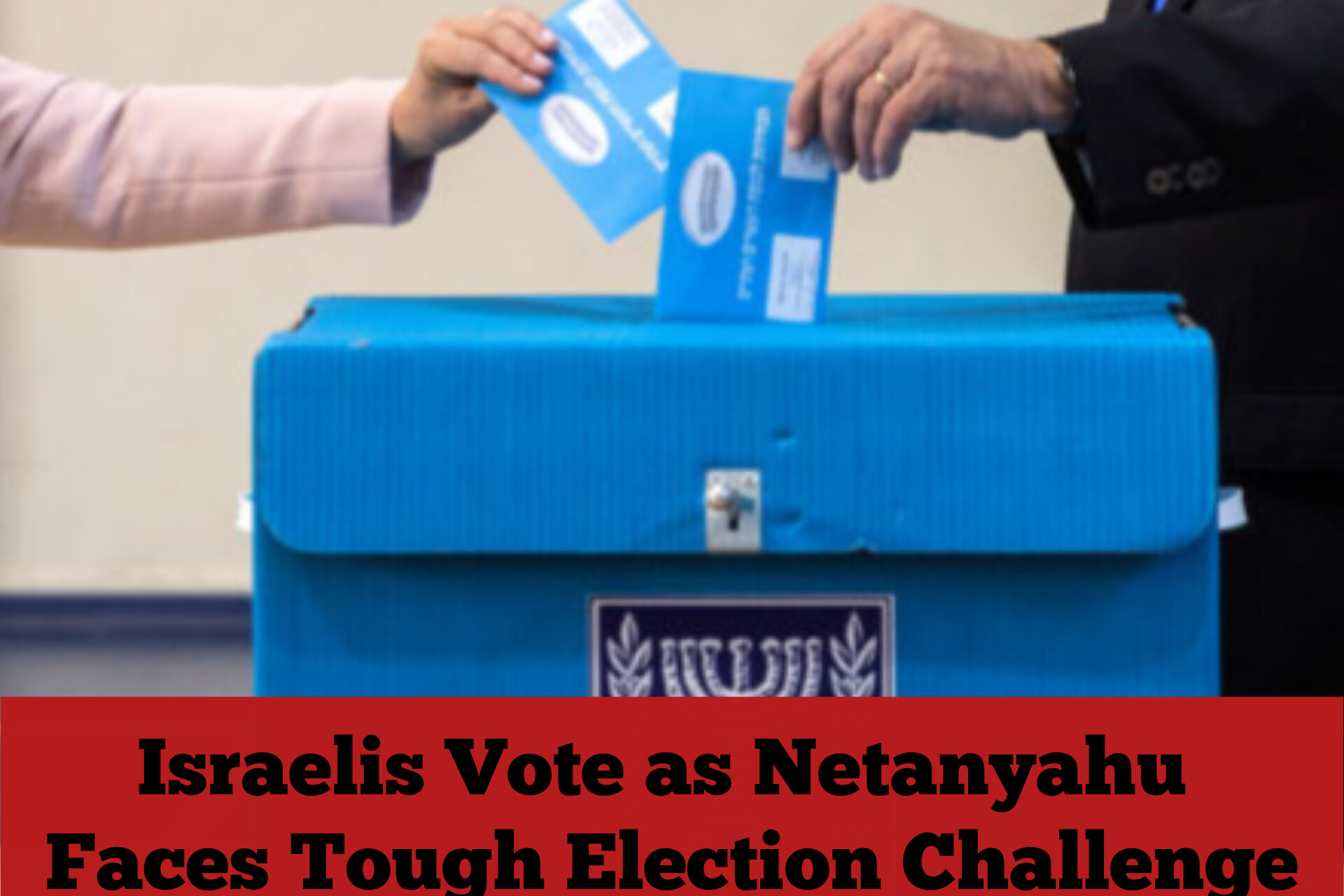
Israelis are voting in a closely contested parliamentary election with Prime Minister Benjamin Netanyahu facing a challenge from centrist rival Gadi Eisenkot amid growing concerns over national security and accountability for the October 7 Hamas attack.
The election is the first since the attack three years ago, which triggered a devastating war in Gaza and contributed to years of regional conflict.
About 7.3 million people are eligible to vote in the election, which could shape Israel’s political direction after years of military campaigns, rising international criticism and a shift towards right-wing religious nationalism.
The latest opinion polls published before voting showed Netanyahu running neck and neck with Eisenkot, a former military chief seeking to unseat the long-serving prime minister.
“I want change in our country. I want a good democratic centrist government,” Alexandra, 65, told AFP at a polling station in Jerusalem.
Another voter, 58-year-old real estate agent Uriel Brandler, described the election as one of the most important in Israel’s history and said he hoped for change.
Netanyahu, 77, has served as prime minister for more than 19 years across several terms. His campaign has focused on his security record and relationship with US President Donald Trump.
During his time in office, Israel has fought on several fronts, including Gaza, Lebanon and Iran, with Israeli forces also facing attacks from Hamas, Hezbollah and Yemen’s Houthi rebels.
However, Netanyahu has faced criticism over his government’s handling of the October 7 attack, the deadliest day in Israel’s history, and its refusal to establish an independent state commission of inquiry into the security failures.
Zipporah Bennett, an 85-year-old retiree, said she supported Netanyahu because of his experience.
“He has had the experience of navigating the country through a lot of difficult seasons,” she told AFP, praising his relationship with the United States.
Netanyahu returned to power four years ago with the support of far-right and ultra-Orthodox parties, whose influence has grown within his governing coalition.
The opposition has also criticised his government over exemptions from military service for ultra-Orthodox Jewish students, as the military faces personnel shortages.
Eisenkot promises inquiry into October 7 attack
Eisenkot, 66, a former military chief and political newcomer, has pledged to establish an independent commission to investigate the security failures surrounding the Hamas attack.
He leads an informal opposition bloc through his Yashar party, bringing together groups ranging from the right to the centre-left in an effort to challenge Netanyahu’s coalition.
Although Eisenkot has opposed the creation of a Palestinian state and expressed support for Israeli settlements, he has also promised action against violence by Israeli settlers.
Arab-majority parties, which represent about 21 per cent of Israel’s population, could play a decisive role if the election produces a closely divided parliament.
Neither Netanyahu nor Eisenkot has publicly committed to partnering with the predominantly Arab lists.
Yousef Jabareen, who heads one of the Arab-majority lists, told AFP he hoped for a high turnout among Arab voters to help remove Netanyahu’s coalition from power.
Polling stations are scheduled to close at 22:00 local time (20:00 GMT), with final results potentially taking several days to emerge.
No single party is expected to secure the 61 seats needed for a majority in Israel’s 120-member parliament, making coalition negotiations crucial to forming the next government.
The negotiations could take weeks or months, while a failure to reach an agreement could lead to another election.
The vote comes as Israel faces continued international criticism over its military campaign in Gaza, settlement expansion and violence in the occupied West Bank, issues that have intensified divisions over the country’s future direction.


