
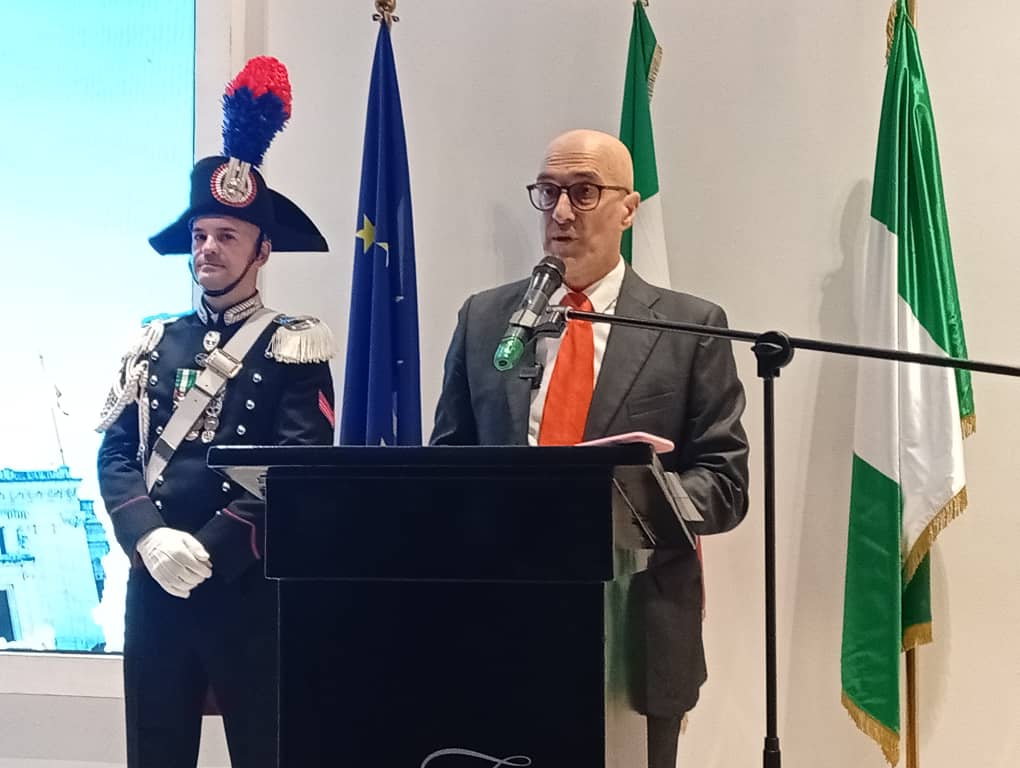
Italy’s Ambassador to Nigeria, Roberto Mengoni, has used celebrations marking the 80th anniversary of the Italian Republic to reaffirm his country’s commitment to democracy, gender equality, international cooperation and stronger ties with Nigeria.
Speaking during Italy’s National Day reception in Abuja, Mr Mengoni reflected on the country’s transformation since the end of World War II, describing the Italian Republic as “imperfect, sometimes troubled, but always beloved”.
The ambassador said the republic was founded in 1946 after Italians rejected fascism, colonialism and oppression, choosing instead to build a democratic society based on freedom, equality and inclusion.
“On 7 June 1946, Italians chose their country. They rejected the past and set up the foundation for a new society, free from fascism, free from colonialism and oppression,” he said.
Mr Mengoni highlighted Article 3 of Italy’s Constitution, which guarantees equality before the law regardless of gender, race, language, religion or political opinion.
He said Italy had made significant progress over the past eight decades, becoming a democratic nation that values solidarity, human rights and international cooperation.
A major part of the ambassador’s speech focused on the role of women in Italy’s development.
He recalled that women were granted voting rights for the first time during the 1946 referendum that led to the creation of the republic, describing it as the beginning of a long struggle for equal rights.
“Women have built modern Italy with their work and education,” he said.
Mr Mengoni acknowledged that despite progress, challenges remain, including unequal pay, under-representation in politics and boardrooms, higher unemployment rates among women and persistent gender-based violence.
Quoting former Italian minister Tina Anselmi, he said: “When women commit to change, their victories are victories for the whole society.”
The ambassador also stressed Italy’s longstanding commitment to peace, citing Article 11 of the Italian Constitution, which rejects war as an instrument of aggression.
He said Italy’s foreign policy over the past 80 years had been guided by the principles of peace and justice, adding that the country remained committed to the United Nations, the European Union and international peacekeeping efforts.
Mr Mengoni reiterated Italy’s support for Ukraine in its defence against Russian aggression and called for respect for international law and diplomatic solutions to global conflicts.
“Fueling the fire of resentment and hatred will only put us on the path toward international conflict,” he warned.
The ambassador praised decades of cooperation between Italy and Nigeria, noting that Italian businesses have played an important role in Nigeria’s economic development since independence.
He expressed optimism about increased investment and economic cooperation, particularly following the resolution of issues affecting Italian energy giant ENI earlier this year.
“Italy wants to support as much as possible Nigeria, her democracy and her progress,” he said.
Mr Mengoni also commended the Nigerian government’s efforts to improve security and protect citizens across the country.
He noted that Nigeria and Italy would later this year jointly chair the replenishment conference of the Global Partnership for Education, aimed at supporting education worldwide, particularly in Africa.
The ambassador paid tribute to the Nigerian community in Italy, revealing that about 132,000 Nigerians are legally resident in the country.
He described Nigerians as active contributors to sectors including transportation, agriculture, hospitality and commerce.
Highlighting the success of Italian volleyball star Paola Egonu, who was born in Italy to Nigerian parents, Mr Mengoni pointed to her achievements as an example of the positive contributions of people of Nigerian heritage to Italian society.
Looking ahead, he said Italy viewed Africa as a strategic partner in addressing common challenges such as terrorism, organised crime, poverty and climate change.
“We do believe in a joint effort to promote peace, democracy and social justice in Africa and the world,” he said.