The European Union (EU) has outlined its major achievements in Nigeria for 2025 and set out key priorities for 2026, reaffirming its commitment to deepening cooperation with Africa’s largest economy and strengthening regional partnerships across West Africa.
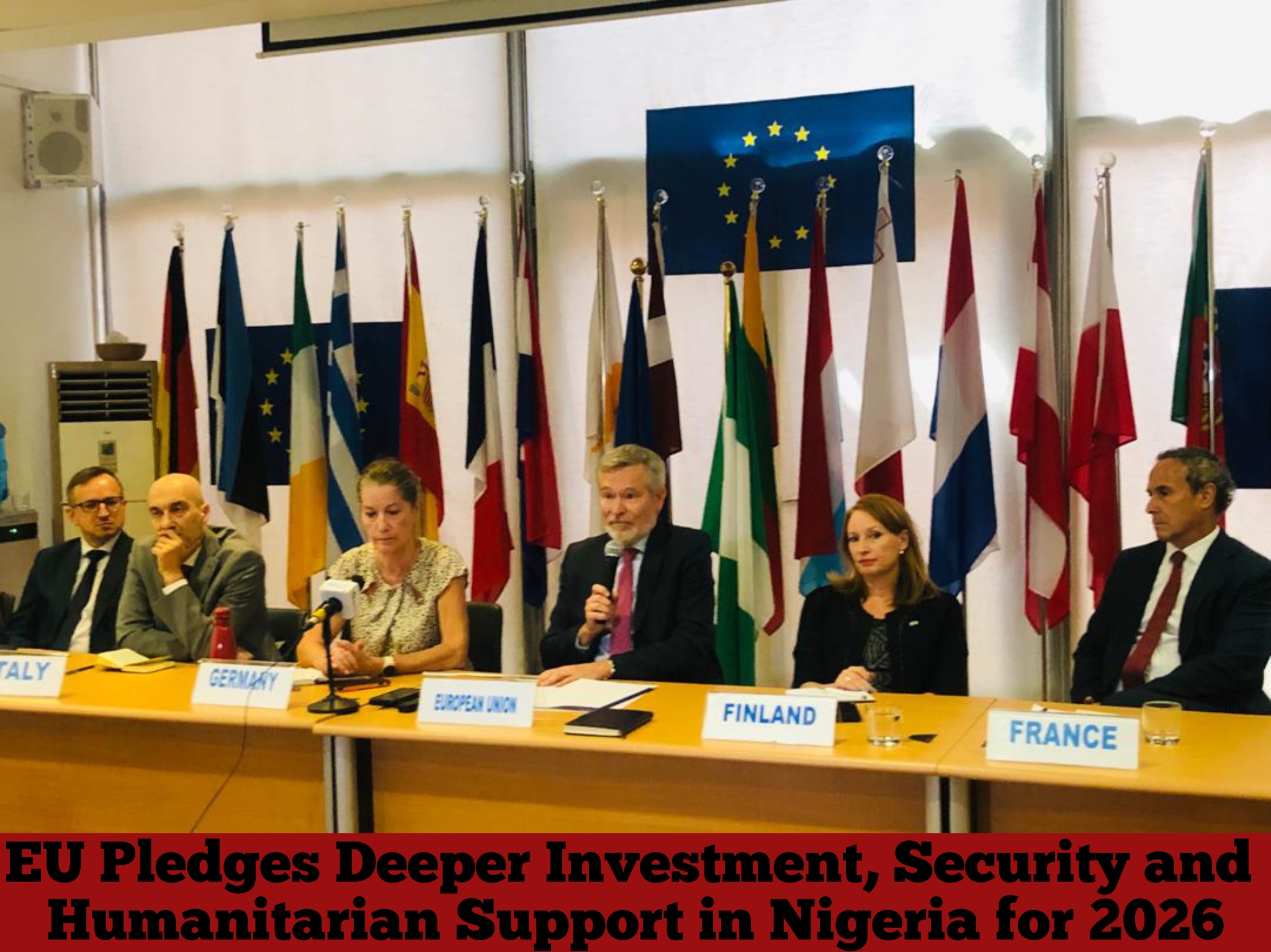
Speaking at the EU End-of-Year Media Parley in Abuja, the EU Ambassador to Nigeria and ECOWAS, Gautier MIGNOT said the gathering was an opportunity to appreciate journalists, review progress made, and “look ahead at what 2026 holds for the EU-Nigeria partnership.”
“I want to thank all of you, the heralds of press freedom, for keeping the public informed and helping us convey our messages throughout the year,” the Ambassador said. “We are grateful, and I wish you and your families joyful end-of-year celebrations.”
The envoy was joined by ambassadors from Czech Republic, Sweden, Poland, Italy, Germany, Finland, France, and Portugal, who he said represented the strength of Team Europe — the collective efforts of the EU and its 27 Member States.
“Even though the EU has its own institutions and programmes, our strength relies very much on our Member States. We team up in most initiatives, politically and in development cooperation,” he added.
The Ambassador highlighted the significance of the EU-AU Summit held in Luanda, calling it a milestone that reaffirmed the commitment of 80 countries to multilateralism and the UN Charter.
“Our partnership with the African Union is one that delivers, and must deliver even more through the Global Gateway Investment Strategy,” he said.
He noted that although President Bola Ahmed Tinubu could not attend the summit, Vice President Kashim Shettima represented Nigeria “ably and as a strong friend of the EU.”
The EU, he stressed, stands out for its development model:
“We do things differently. We fund long-term, sustainable projects and build capacity. We avoid debt traps, respect sovereignty, and help create local value chains. In short, Team Europe is a reliable and fair partner for Africa.”
The Ambassador described Nigeria as central to EU engagement in Africa due to its size, economic weight and regional influence.
“Our partnership with Nigeria is second to none and equal to none,” he said. “Nigeria is our first trading partner in Africa, and we are Nigeria’s number one trading partner. Nigeria also enjoys a USD 10 billion trade surplus with the EU.”
He revealed that EU investments account for one-third of Nigeria’s total Foreign Direct Investment, noting that most statistics understate this because they highlight individual EU Member States rather than the EU as a single economic bloc.
The first EU-Nigeria Trade and Investment Dialogue held this year produced working groups to tackle barriers and unlock opportunities for deeper economic cooperation.
The diplomat also highlighted the EU’s 2025 interventions:
* 410 million euros OMI-EKO electric water transport project in Lagos
* Health Investment Forum with 41 million euros in new health projects
* 30 million euros Africa-Europe culture and creative industries programme
* 100 million euros Team Europe package with ECOWAS on peace, security and governance
* Nigeria Jubilee Fellowship Programme, offering 25,000 young graduates a one-year placement
* Digital Transformation Centres supporting thousands of young tech entrepreneurs
* Over €50 million in humanitarian assistance targeting malnutrition in the North-West and North-East
“The impact of our partnership is felt on the ground, especially among young Nigerians. They are our main target,” he said.
He noted that Nigeria now ranks number one in Africa and number five globally for Erasmus scholarship awards.
The EU reiterated its support for Nigeria’s fight against insecurity, peace-building initiatives and the protection of vulnerable populations.
“We stand with communities affected by crisis, especially women and children in the North-East and North-West,” he said. “This year alone, we committed nearly €50 million for malnutrition response. Nigeria can count on the EU as a reliable partner.”
He added that democracy, rule of law and human rights would remain the backbone of EU-Nigeria relations, noting that the EU’s Election Observation Follow-up Mission has pushed key reforms currently before the National Assembly — including the proposed special seats for women.
The EU’s 2026 plans include:
* Holding the EU-Nigeria Ministerial Meeting
* Expanding the Global Gateway Strategy, including 90,000 km optic fibre rollout under the BRIDGE project
* Launching an 18 million euro project on technology-facilitated SGBV
* A new peace, security and defence dialogue that may unlock European Peace Facility funding
* Negotiating a Science, Technology and Innovation Agreement
* Advancing a comprehensive migration and mobility partnership
* Organising a major EU-Nigeria Business Forum to boost trade and investment
“Our interest is clear: to support Nigeria to thrive as a stable, democratic and prosperous partner of Europe,” he said. “At the same time, we want our companies to do business and make profit in a fair and predictable environment.”