
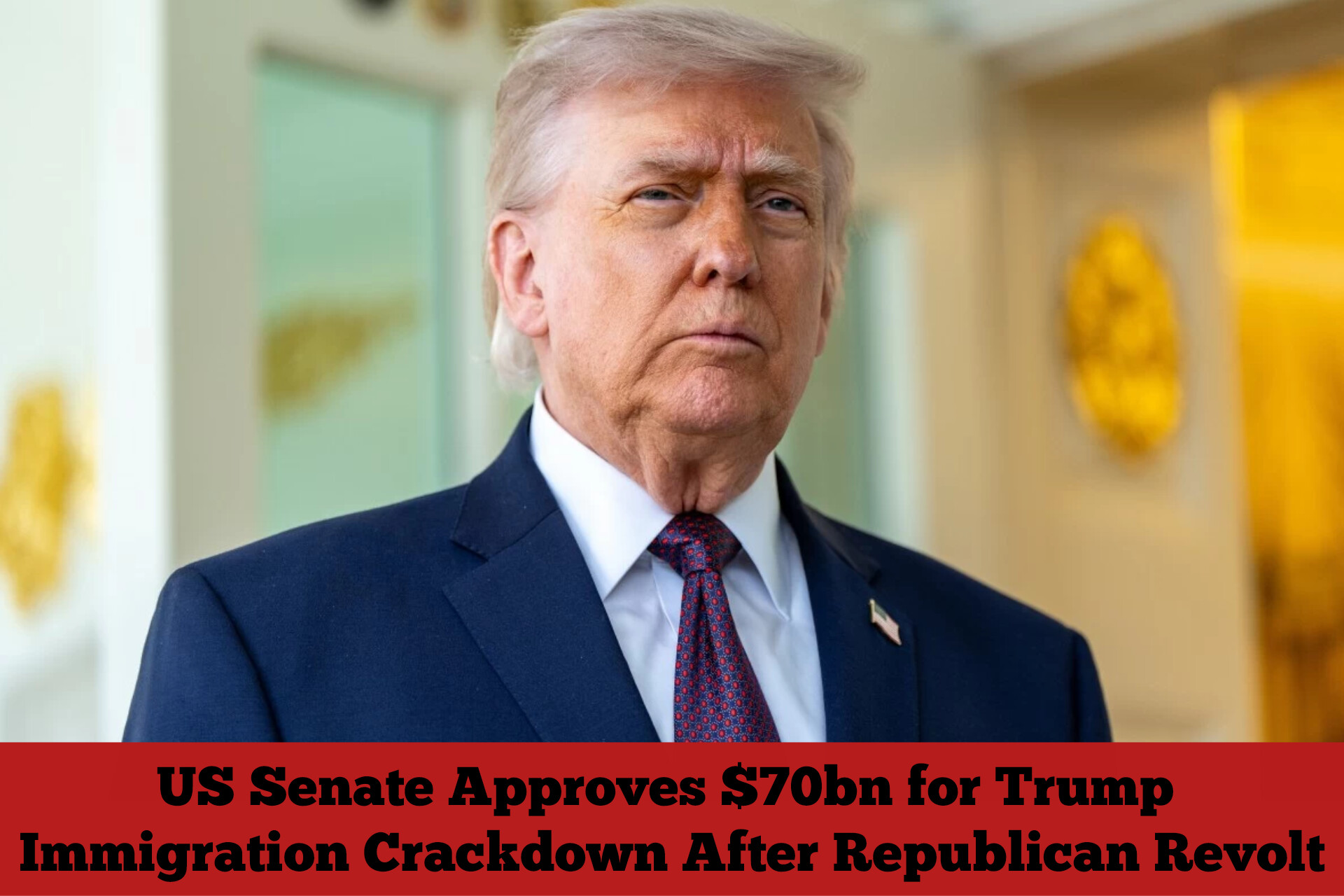
The US Senate has approved a $70bn funding package for President Donald Trump’s immigration enforcement agenda after a marathon voting session exposed divisions within the Republican Party over several of his controversial policy proposals.
The measure would provide funding for Immigration and Customs Enforcement (ICE) and the Border Patrol for the remainder of Mr Trump’s term in office, marking a significant legislative victory for the president on one of his flagship campaign promises.
The bill now moves to the House of Representatives, where Republican leaders are expected to seek swift approval before sending it to the White House for Mr Trump’s signature.
The vote comes months after a partial shutdown of the Department of Homeland Security (DHS), triggered by disagreements between Republicans and Democrats over immigration enforcement practices.
Democrats had demanded restrictions on immigration raids in sensitive locations and limits on the use of face coverings by federal officers before approving additional funding.
Republicans rejected those conditions and instead used the budget reconciliation process, allowing them to bypass Democratic opposition while relying on support from within their own ranks.
Although the immigration package ultimately passed, the debate highlighted growing tensions among Republicans over several Trump-backed initiatives.
The Senate vote followed an hours-long amendment session known in Washington as a “vote-a-rama”, during which lawmakers proposed and voted on politically sensitive measures.
Among the most contentious issues was a proposed $1.8bn Justice Department compensation fund for individuals who claim they were unfairly targeted by the government.
Critics argued the proposal could potentially allow people convicted in connection with the US Capitol riot to receive taxpayer-funded compensation.
The controversy forced the administration to distance itself from the plan.
Acting Attorney General Todd Blanche told lawmakers the administration would not proceed with the programme, but Mr Trump appeared less certain.
He reportedly described the proposal as “beautiful” and said he would need to “ask the lawyers” whether it had been abandoned or merely suspended.
The uncertainty prompted some Republican senators to seek legal guarantees that the fund would be permanently scrapped.
“When you’re explaining, you’re losing. There’s no way to explain the $1.776 billion fund. So the only way you can explain it is explain that you got rid of it,” Republican Senator Thom Tillis of North Carolina told reporters.
Democrats used the amendment process to argue that Congress should prioritise housing and affordability programmes rather than expanding immigration enforcement.
They accused Republicans of focusing on Mr Trump’s deportation agenda while many Americans remain concerned about rising living costs.
Several Republicans also joined Democrats in supporting efforts to impose additional sanctions on Russia over its invasion of Ukraine and provide $8bn in military financing loans to Kyiv, in what observers viewed as a separate challenge to White House policy.
Republicans defended the legislation, arguing it was necessary to restore funding for immigration agencies left out of an earlier stopgap spending measure.
While the temporary funding bill covered agencies such as the Coast Guard, Secret Service, Federal Emergency Management Agency and Transportation Security Administration through September, it excluded ICE and Border Patrol, setting the stage for the latest confrontation.
The vote delivers a major policy victory for Mr Trump and strengthens his immigration agenda ahead of the midterm election cycle.
However, the debate also underscored a continuing challenge for Republican leaders: managing internal opposition to some of the president’s more controversial priorities, despite controlling both chambers of Congress.