
“This conference is a call to action to confront the persistent challenges associated with Lassa fever by advancing research, diagnostics, and community-led solutions, while enhancing preparedness and response strategies against zoonotic diseases,” he said.
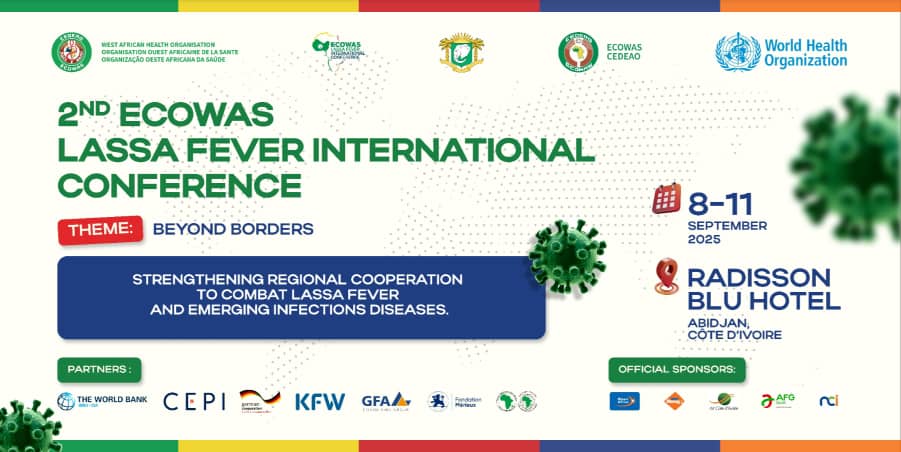
Leading health experts, policymakers, and scientists from across the world will gather in Abidjan from September 8 to 11, 2025, for the 2nd ECOWAS Lassa Fever International Conference (ELFIC 2025), a major platform to combat one of West Africa’s most pressing public health threats.
Organised by the West African Health Organisation (WAHO), in partnership with regional and global institutions, the conference is themed “Beyond Borders: Strengthening Regional Cooperation to Combat Lassa and Emerging Infectious Diseases.”
The event will be formally opened by the Prime Minister of Côte d’Ivoire, Robert Beugré Mambé, and will feature keynote addresses, technical workshops, and high-level panel discussions.
Speaking ahead of the conference, WAHO Director General, Dr. Melchior Athanase Aïssi, described the gathering as a crucial step in advancing solutions for Lassa fever.
“This conference is a call to action to confront the persistent challenges associated with Lassa fever by advancing research, diagnostics, and community-led solutions, while enhancing preparedness and response strategies against zoonotic diseases,” he said.
Sessions at ELFIC 2025 will cover advances in vaccine and diagnostic development, strategies for community engagement, cross-border surveillance, and policy frameworks for long-term control and elimination.
The conference will also feature a ministerial roundtable, co-chaired by Dr. Aïssi, Nigeria’s Minister of Health and Social Welfare, Professor Muhammad Ali Pate, and Côte d’Ivoire’s Minister of Health, Pierre N’Gou Dimba.
Lassa fever, a viral haemorrhagic illness with high mortality rates, continues to devastate rural and underserved communities. One in five infections results in severe disease, often affecting organs such as the liver, spleen, and kidneys.
Without a vaccine or approved antiviral drug, the disease also creates serious socio-economic consequences, disproportionately affecting vulnerable populations. ELFIC 2025 aims to bridge the gap between scientific research and policy action to ensure communities benefit directly from innovations.
Delegates are expected from ECOWAS member states, the World Health Organization (WHO), the World Bank, African Development Bank (AfDB), the Coalition for Epidemic Preparedness Innovations (CEPI), and KfW, among other partners. Exhibitions will showcase new innovations from research institutions, NGOs, and private sector organisations.
WAHO says ELFIC 2025 will not only strengthen scientific collaboration but also boost regional and international partnerships in epidemic preparedness and response.

