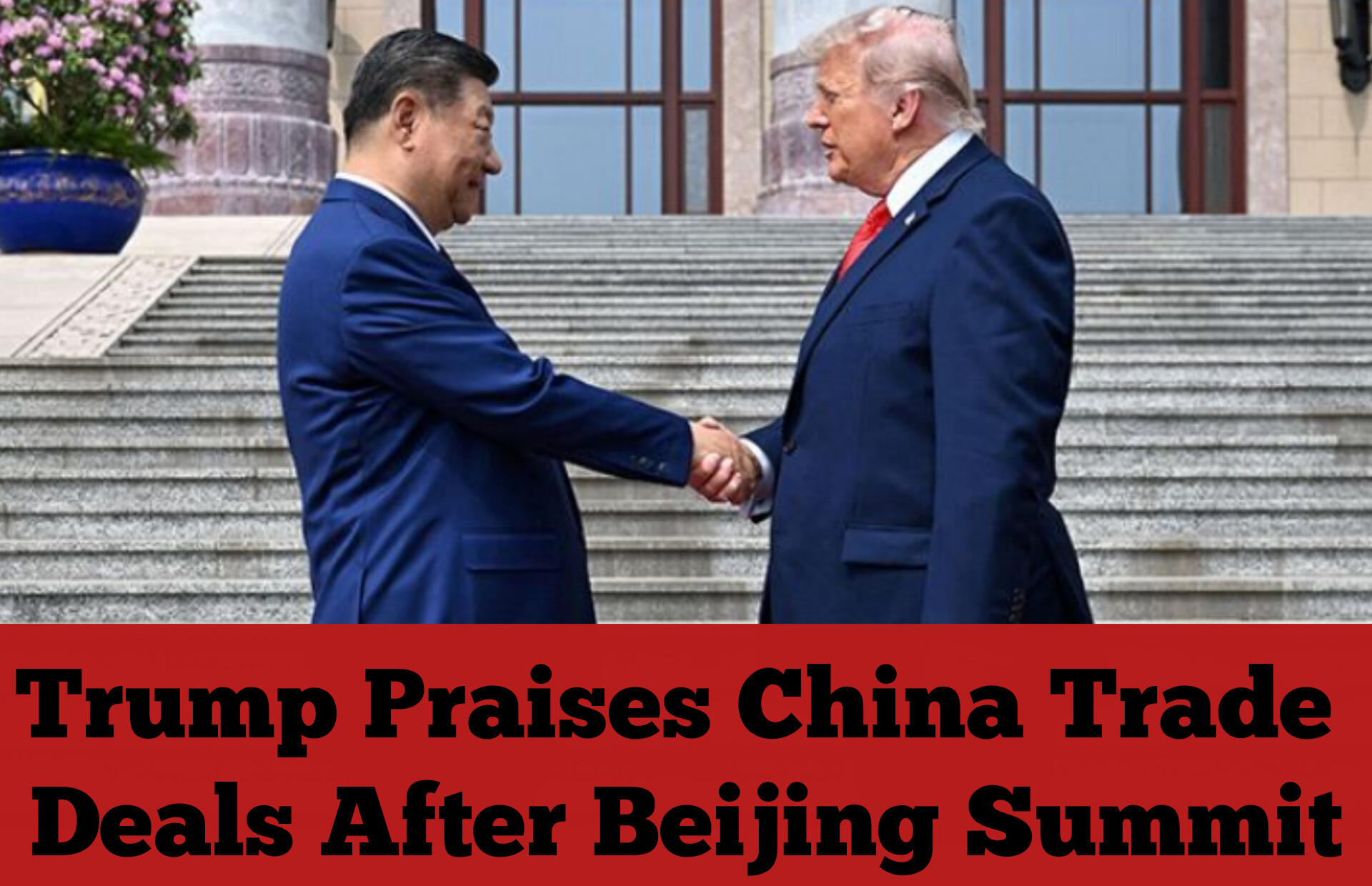
US President Donald Trump has hailed what he described as “fantastic trade deals” with Chinese President Xi Jinping after a high-stakes summit in Beijing that also touched on the Middle East crisis and tensions over Taiwan.
Speaking after talks at Zhongnanhai, China’s central leadership compound beside the Forbidden City, Trump said the two global powers had resolved issues “other people wouldn’t have been able to solve”.
“We’ve made some fantastic trade deals, great for both countries,” Trump said following a walk with Xi through the compound’s gardens.
The US president, who travelled to Beijing seeking agreements in agriculture, aviation and artificial intelligence, said “a lot of good” had emerged from the visit, although he did not disclose full details of the agreements.
Xi described the trip as a “milestone visit” and said both nations had established “a new bilateral relationship” built on “constructive strategic stability”.
The Chinese leader also reportedly promised to send seeds for the White House Rose Garden to Trump.
The summit was overshadowed by growing concerns over the war involving Iran and the disruption of shipping routes through the Strait of Hormuz.
In an interview with Fox News after the first day of talks, Trump said Xi had assured him China would not provide military support to Tehran.
“He said he’s not going to give military equipment… he said that strongly,” Trump said.
Trump added that Xi expressed willingness to help reopen the Strait of Hormuz, one of the world’s most important oil shipping lanes.
“He’d like to see the Hormuz Strait open, and said ‘if I can be of any help whatsoever, I would like to help,’” Trump said.
China’s foreign ministry later called for “a comprehensive and lasting ceasefire” and urged that shipping routes be reopened “as soon as possible”.
Despite the cordial atmosphere, Taiwan remained a major point of friction between Washington and Beijing.
Chinese state media reported that Xi warned Trump that any missteps over Taiwan could push both countries into “conflict”.
Trump did not publicly address the issue during the visit, while US Secretary of State Marco Rubio insisted Washington’s position had not changed.
“US policy on the issue of Taiwan is unchanged,” Rubio told NBC, adding that the matter had been raised by Beijing but both sides moved on to other topics.
Taiwanese officials later thanked Washington for “repeatedly expressing its support”.
Trump also revealed that China had agreed to purchase “200 big” Boeing aircraft, although no formal announcement was made.
The comments failed to impress investors, with shares in Boeing falling after the remarks amid expectations of a larger deal.
The US president said Beijing had also shown interest in buying American oil and soybeans, sectors affected by previous tariff disputes between the two countries.
No official confirmation was issued by China regarding the reported purchases.
Artificial intelligence cooperation was also discussed during the summit, with Jensen Huang joining Trump’s business delegation.
However, there were no announcements on easing US restrictions preventing Chinese firms from accessing advanced AI chips made by Nvidia.
US Treasury Secretary Scott Bessent said Washington and Beijing had discussed creating “guardrails” for artificial intelligence as the world’s “two AI superpowers”.
Trump later departed Beijing aboard Air Force One, raising his fist twice before take-off.