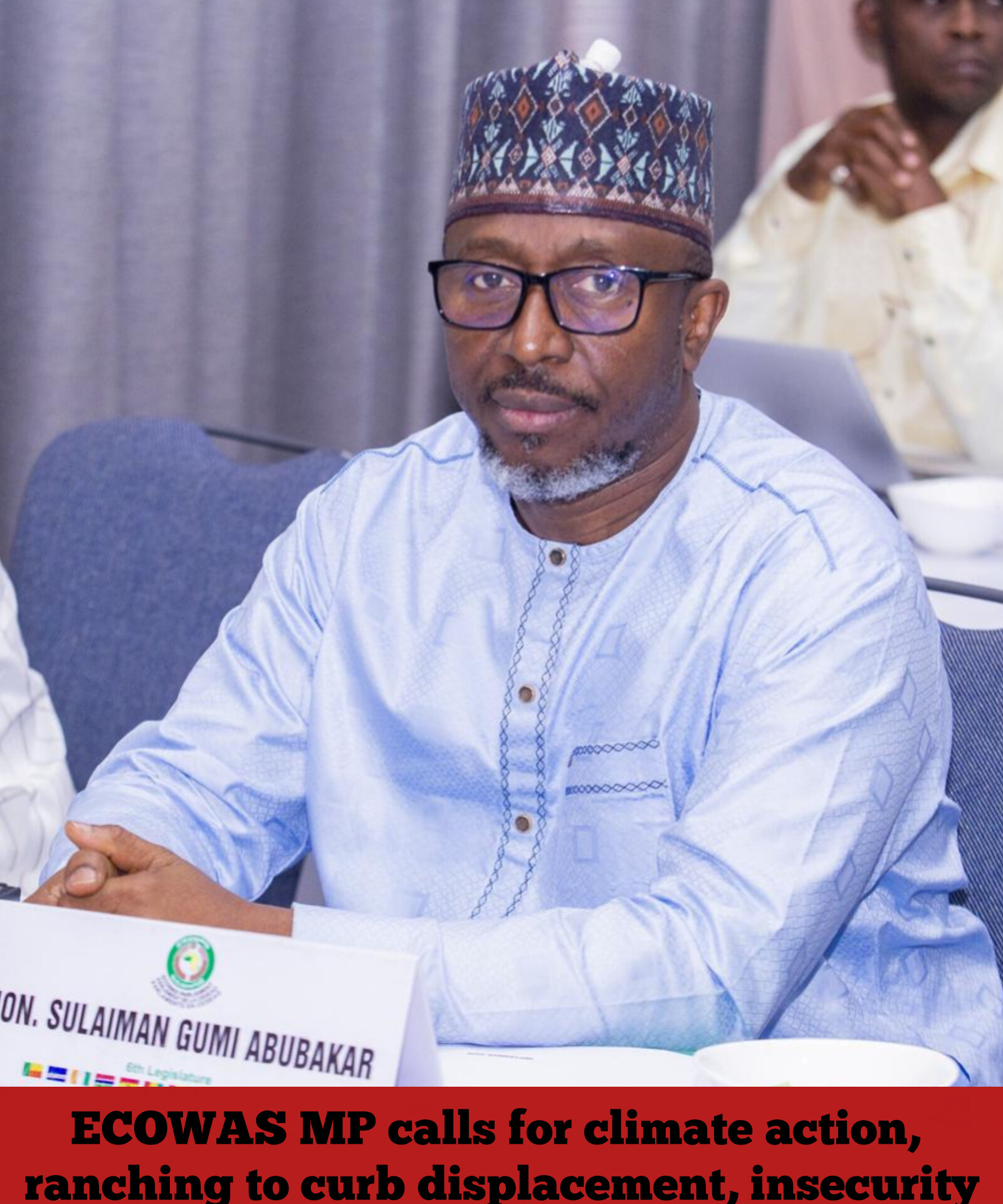
A member of the ECOWAS Parliament, Dr Suleiman Abubakar Gumi, has called for stronger climate adaptation measures, investment in ranching and alternative livelihoods to address the growing nexus between environmental degradation, population displacement and insecurity in the West African region.
Dr Gumi, who represents Gumi/Bukuyyum Federal Constituency of Zamfara State in Nigeria, made the call Friday in Accra, Ghana, on the sidelines of the 2026 Second Extraordinary Session and Parliamentary Seminar of the ECOWAS Parliament.
The seminar, which brought together lawmakers and regional stakeholders, deliberated on the devastating consequences of climate change under the theme, ‘Climate Change as a Factor of Environmental Degradation, Population Displacement and Growing Insecurity in the ECOWAS Region.’
Gumi stated although natural causes of climate change might not be controlled by humans, lots can be done to mitigate its spread while human activities that accelerate environmental degradation, including deforestation, charcoal production, mining and the burning of fossil fuels should be addressed.
He said: “The activities of man aggravate the situation. For instance, environmental degradation starts with reducing vegetation and putting additional pressure on communities, whose livelihoods depend on land and livestock.”
Dr Gumi further linked the expansion of desertification in the Sahel region to increasing pressure on pastoral communities, adding that the loss of grazing land has also forced livestock herders to move towards areas where vegetation and water remain available.
According to him, competition for land has contributed largely to tensions between farming and pastoral communities.
He therefore proposed that governments designate permanent grazing areas for affected communities while investing in modern ranching systems, including water facilities and improved pasture.
According to him, confined livestock production will reduce pressure on farmland and help prevent some of the disputes associated with the movement of cattle in search of pasture.
The concerns came as ECOWAS leaders and parliamentarians increasingly frame climate change as a development, humanitarian and security issue.
At the opening of the Accra meetings, ECOWAS Parliament Speaker, Hadja Mémounatou Ibrahima, called for legislation, financing and early-warning mechanisms to address the interconnected challenges.
Gumi, who expressed satisfaction with the meeting’s theme, said the loss of livestock through cattle rustling and the displacement of pastoral communities had contributed to unemployment and vulnerability among young people, which could create conditions for recruitment into armed groups.
In his opinion, a combination of security measures and non-kinetic interventions, including education, livelihood opportunities and rehabilitation programmes, should be adopted by government, especially in countries such as Nigeria, where the problem has escalated beyond the immediate northern part of the country.
“The government has two things to do; fight them because you don’t negotiate on the path of weakness but while you are doing that, you apply the non-kinetic measures, which include educating them, helping them to set up their business by proving cows and other assistance to them.”
He also suggested that individuals who abandon armed groups could be offered opportunities to rebuild their livelihoods through structured livestock programmes, stressing that some of them were cajoled into it without their consent.
At the regional level, Dr Gumi urged governments in the region to accelerate efforts to combat desertification, including through the Great Green Wall initiative.
He questioned the reason the initiative was not progressing quickly enough to meet its objectives, adding that restoring degraded land should be treated as a major regional priority.
“We have to put our acts together, itemise our problems one after the other, solve them one after the other and get security for people”, he said.
The lawmaker also called for greater investment in alternative cooking measures to combat tree felling and reduce pressure on forests. He said governments should make cleaner alternatives, including natural gas, affordable enough to compete with firewood and charcoal.
Another measure he suggested to combat climate change and its attendant crises is a stronger regulation of mining activities, particularly the rehabilitation of land after mineral extraction. He suggested that legislation should require mining companies to restore degraded land before leaving mining sites.
He proposed that where direct rehabilitation is not carried out, companies could be required to contribute through taxation to a dedicated environmental restoration fund.
Ghana’s Second Deputy Speaker, Andrew Amoako Asiamah, has similarly described environmental degradation and illegal small-scale mining as threats requiring stronger regional and national responses. Ghana News Agency
Reflecting on the parliamentary seminar, Dr Gumi noted that lawmakers should take the knowledge gained during the discussions back to their respective countries and translate it into legislation and budgetary priorities.
He said: “We as parliamentarians are to make laws and these laws would be the guiding principle in how we can mitigate these issues.”
He argued that climate change deserved significant attention in resource allocation alongside other major security threats.
“In as much as you are fighting insurgency, there is another big threat. You lose land to insurgents the same way you are losing land to desertification. So, both should be given adequate budgetary attention”, he said.
Dr Gumi said the seminar had provided parliamentarians with an opportunity to better understand the relationship between environmental change and insecurity.
“I believe a majority of parliamentarians have an understanding of the effects of climate change.”
He therefore urged lawmakers to examine the specific environmental pressures affecting their constituencies and develop policies suited to local conditions as environment has a different climate change effect, and parliamentarians should look for ways to resolve those