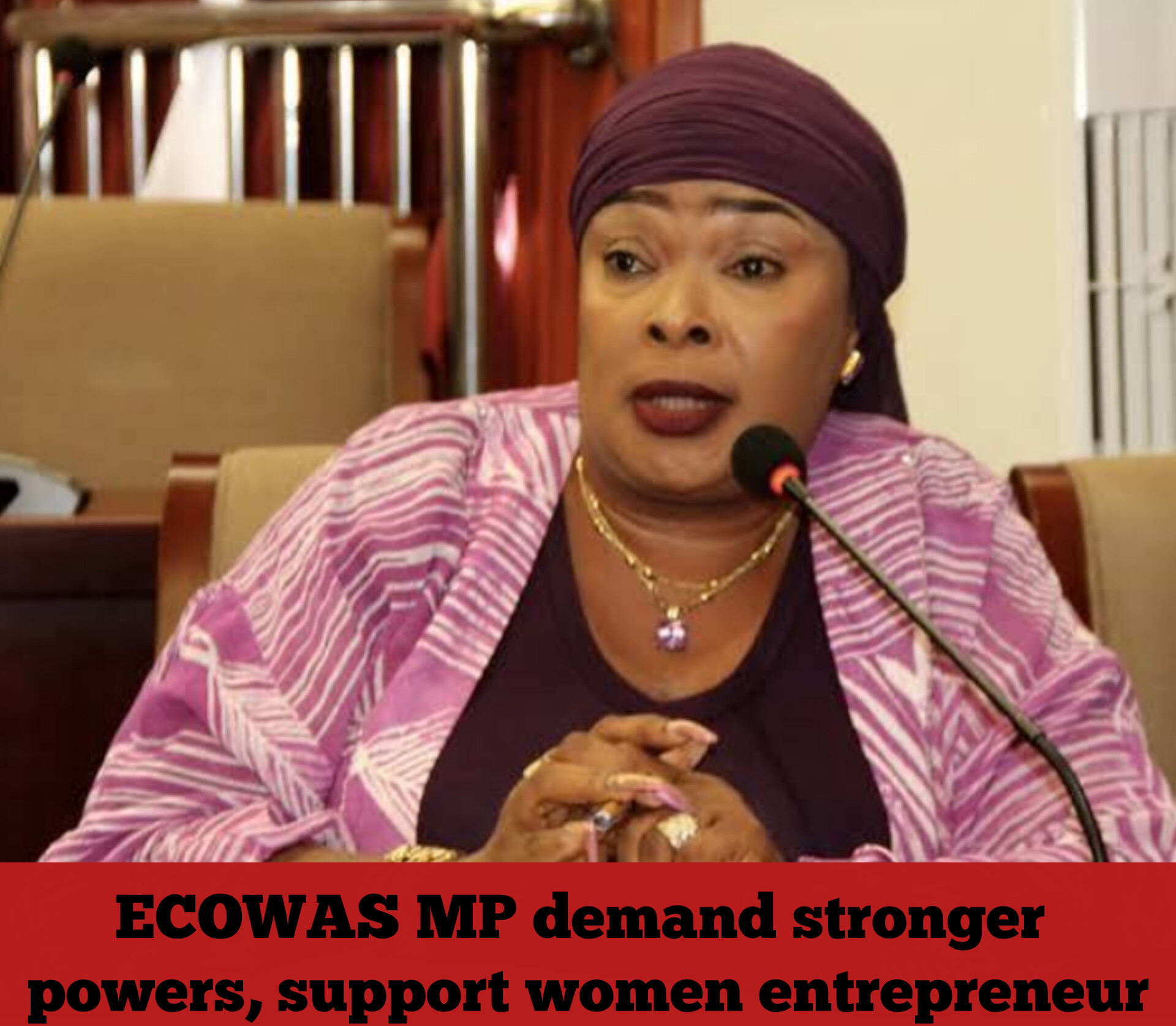
A Liberian member of the ECOWAS Parliament, Ms. Moima Briggs-Mensah, has called for reforms that will give the regional legislature greater authority to turn its decisions and recommendations into enforceable policies.
Ms Briggs-Menza gave the indication during the 2026 Second Extraordinary Session Of The ECOWAS Parliament and Second 2026 Seminar holiday in Accra Ghana.
She said the current advisory nature of the legislature was frustrating and could undermine efforts to address challenges facing citizens across West Africa.
She argued that parliamentarians, as elected representatives, should have a stronger role in determining regional policies and approving budgets.
“I don’t think you can have parliament members that are elected by the country and their constituents come and sit there and just be advisable to a few people that are just appointed by one president,” she said.
Ms Briggs-Mensah called for a review of the institutional framework governing the ECOWAS Parliament.
She said the Parliament should have powers to adopt legislation, approve its budget and influence the implementation of its decisions.
“For me, I think we should have a reform in the ECOWAS Parliament, that whatever we adopt here, that even the budget should come from us also to know how it’s been done, and we should pass it also,” she said.
She said it was frustrating for lawmakers to deliberate on issues affecting citizens only for their recommendations to depend on decisions by other regional institutions.
“We should have outstanding rules that ECOWAS Parliament, that we can adopt issues, that we can even pass the budget. We also can approve the budget.”
She said stronger parliamentary authority would improve accountability and give lawmakers greater ownership of regional policies.
Ms Briggs-Mensah also called for the development of common ECOWAS laws and policies to address climate change, environmental degradation and the effects of climate-related displacement.
She said the parliamentary seminar had provided valuable insights into the challenges facing the region, but warned that implementation remained the critical issue.
“The learning curve was good. I prayed that the implementation aspect by ECOWAS… ECOWAS should have a generic laws that are going to govern the region.”
She said ECOWAS should develop regional plans that complement international frameworks, including those addressing climate change and land degradation.
According to her, regional governments should also develop mechanisms to mobilise funding for countries and communities affected by climate-related disasters.
“The seminar is good, but the implementation is what matters,” she said.
Ms Briggs-Mensah said women and children were particularly vulnerable to the effects of climate change, especially during floods, migration and disruptions to farming and cross-border trade.
She said women whose businesses depend on transporting goods could lose their products when floods make roads and crossing points impassable.
“When you look at migration, when you look at flood issues… at the end of the day, you end up losing, because maybe it’s spoiled, or you have to throw it away.”
She also said changing weather patterns could affect farmers who invest in fertiliser and other agricultural inputs but subsequently experience poor yields.
The parliamentarian called for preventive policies rather than waiting for disasters before governments respond.
“We shouldn’t wait for it to happen, then we start to do quick impacts, or start to do a disaster origin needs. But we should come up with a full plan on how we are going to protect these people.”
She said women should be given greater protection and support within regional climate and development policies.
Ms Briggs-Mensah, who is involved with the ECOWAS Female Parliamentarians Association (ECO-FEPA), also highlighted the potential of women-led businesses to contribute to regional trade.
She said discussions during an ECO-FEPA masterclass had demonstrated that women entrepreneurs were already producing goods with potential for wider regional and international markets.
She cited products such as shea butter and agricultural commodities as examples of businesses that could benefit from greater access to finance and regional markets.
“The first thing, we should start with ourselves. Try to export within the region.”
She argued that ECOWAS countries should prioritise intra-regional trade before looking beyond Africa.
“If you are selling something, and you are not a consumer, people do not really buy into it,” she said.
She suggested that products made in one member state should be promoted and consumed across the region before being targeted at international markets.
Ms Briggs-Mensah said access to affordable finance remained a major obstacle for women entrepreneurs.
She said high commercial bank interest rates could make it difficult for small businesses to survive, particularly when entrepreneurs fail to meet repayment timelines.
She proposed dedicated ECOWAS funding, grants or concessional loans for women-led cooperatives and businesses seeking to expand their operations.
“If you have a grant from ECOWAS, to improve your business as a cooperative, as a body, it helps.”
She also proposed a dedicated funding mechanism through regional gender programmes to support women involved in production and exports.
According to her, such support would allow women entrepreneurs to improve production, packaging and market access.
Ms Briggs-Mensah said the strength of the ECOWAS Parliament lay in its direct connection to citizens.
She argued that parliamentarians were better positioned to understand the challenges faced by communities because they interacted directly with constituents.
“We are the direct representation of the people. We know the people’s problem.”
She questioned whether regional policymakers outside Parliament had sufficient direct engagement with women involved in cross-border trade.
“When was the last time the minister of council or the head of state sat and listened to women? How they are striving to do the export.”
She said the Parliament should serve as a channel through which such concerns could be converted into regional policies.
Ms Briggs-Mensah also cautioned against simply copying policies from other countries or regions without adapting them to West African circumstances.
She said experiences from countries such as China and the United States demonstrated that governments adopted policies based on their own circumstances.
“We need to adopt what we want for Africa,” she said, stressing that not every policy used elsewhere would necessarily be appropriate for the ECOWAS region.
She said regional lawmakers should identify useful practices and adapt them to local realities rather than simply reproducing foreign models.
The Liberian parliamentarian said her priority was to see concrete outcomes from parliamentary deliberations.
“For me, I like to see an outcome.”
She said ECOWAS had previously held training sessions where recommendations and proposed measures were developed, but expressed concern that some had yet to result in concrete action.
She therefore called for stronger parliamentary rules that would make implementation of agreed regional policies more effective.
“Whatever we do here is compelling to the commission, to the body to be made sure it passes.”
Ms Briggs-Mensah said giving the ECOWAS Parliament greater institutional powers would help ensure that its work produced tangible benefits for citizens across the region.