
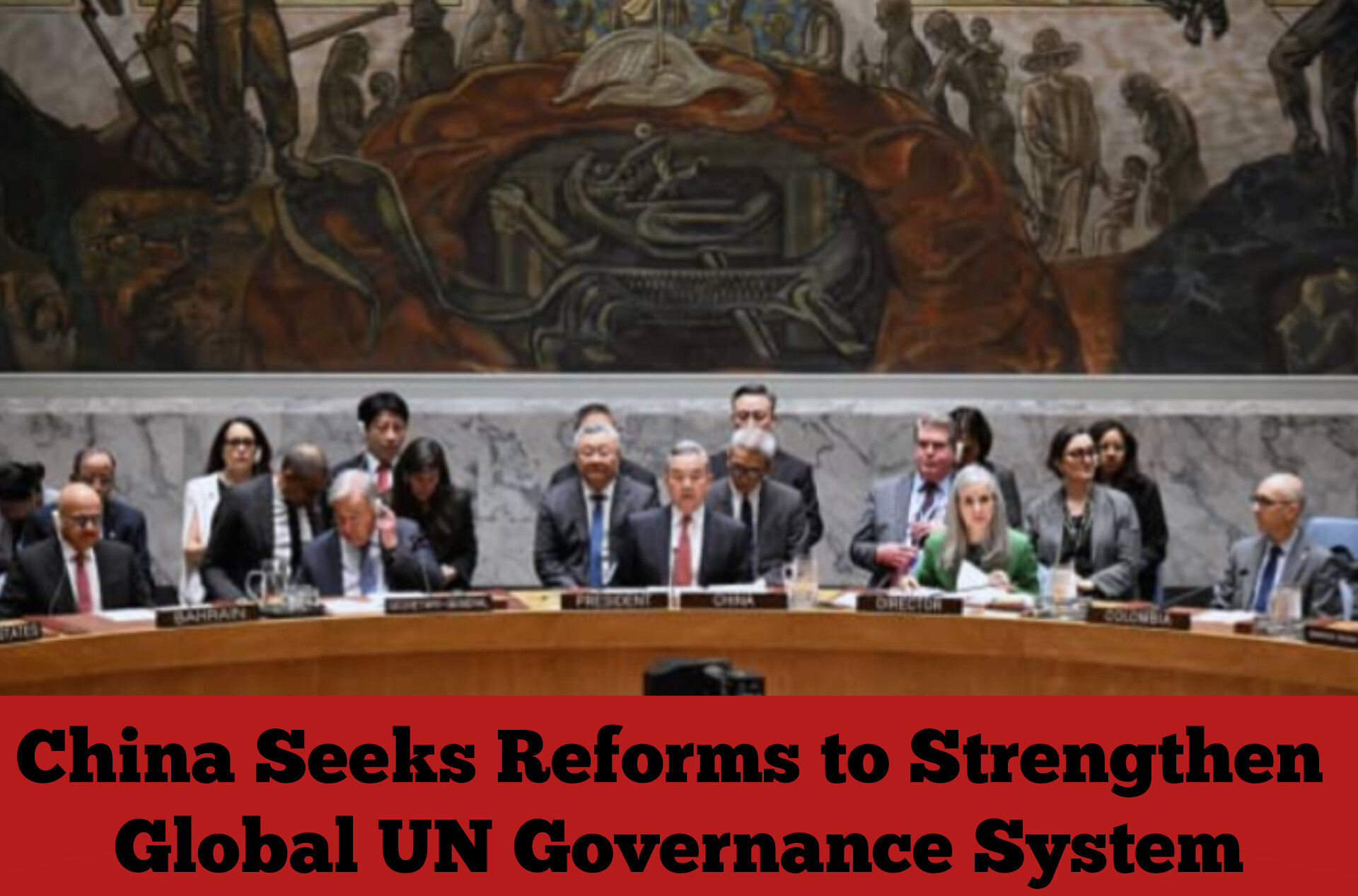
China has called for sweeping reforms to strengthen the United Nations and safeguard the international order, warning that rising conflicts, protectionism and unilateral actions are pushing the world towards greater instability.
Speaking at a high-level meeting of the UN Security Council Chinese Foreign Minister Wang Yi said the international community faces its most profound challenges since the end of the Second World War and urged nations to unite in defence of the UN Charter.
“The dark clouds of war keep gathering and the law of the jungle is resurging,” Wang told delegates. “World peace and development is at a crossroads.”
Addressing a session titled “Upholding the Purposes and Principles of the U.N. Charter and Strengthening the U.N.-centered International System,” Wang argued that global instability stems not from flaws in the UN Charter itself but from failures by states to fully respect and implement its principles.
He urged countries to uphold sovereignty, reject interference in internal affairs, settle disputes peacefully and resist what he described as “double standards, exceptionalism and selective application” of international law.
A key focus of Wang’s speech was the authority of the UN Security Council. He said member states, particularly the five permanent members, should prioritise cooperation over confrontation and act in the broader interests of the international community.
“What comes with Security Council membership is not privileges, but responsibilities,” he said.
Wang also criticised military interventions and sanctions imposed without UN approval, declaring that “any unilateral military action that circumvents the Council’s mandate is unacceptable” and that sanctions beyond Security Council resolutions “lack legitimacy”.
He further called for reforms to UN peacekeeping missions, saying their effectiveness should be reviewed and strengthened to better protect global peace.
The Chinese foreign minister stressed that economic development remains central to solving global challenges, warning that progress towards the UN Sustainable Development Goals is falling behind schedule.
He called on developed nations to honour development-financing commitments and urged greater support for poorer countries through funding, technology transfers and capacity-building programmes.
Wang also opposed trade protectionism, economic decoupling and technology restrictions, while advocating stronger representation for developing nations within international financial institutions such as the International Monetary Fund and the World Bank.
“It is imperative to increase the representation and say of developing countries,” he said.
Wang highlighted emerging global challenges, including artificial intelligence, cybersecurity, climate change and governance of outer space.
He urged the international community to establish “institutional guardrails” for artificial intelligence under UN leadership, warning that rapid technological advances present significant ethical and security risks.
He also called for stronger climate action and accountability mechanisms to ensure countries fulfil commitments on financial and technological support for climate-related programmes.
Marking the 55th anniversary of the restoration of the People’s Republic of China’s seat at the United Nations, Wang defended Beijing’s role in multilateral diplomacy and international development.
He said China had contributed more than $23bn to development initiatives, supported over 1,800 cooperation projects and trained more than 200,000 professionals from developing countries.
Wang also cited China’s involvement in peace efforts, including initiatives linked to the war in Ukraine, and its support for countries responding to Ebola outbreaks in Africa.
“As a permanent member of the Security Council, China has taken an active part in the U.N. cause,” he said.
He added that China would continue promoting multilateral cooperation and a “more just and equitable global governance system” while pursuing the vision of building what Beijing describes as a “community with a shared future for humanity”.