

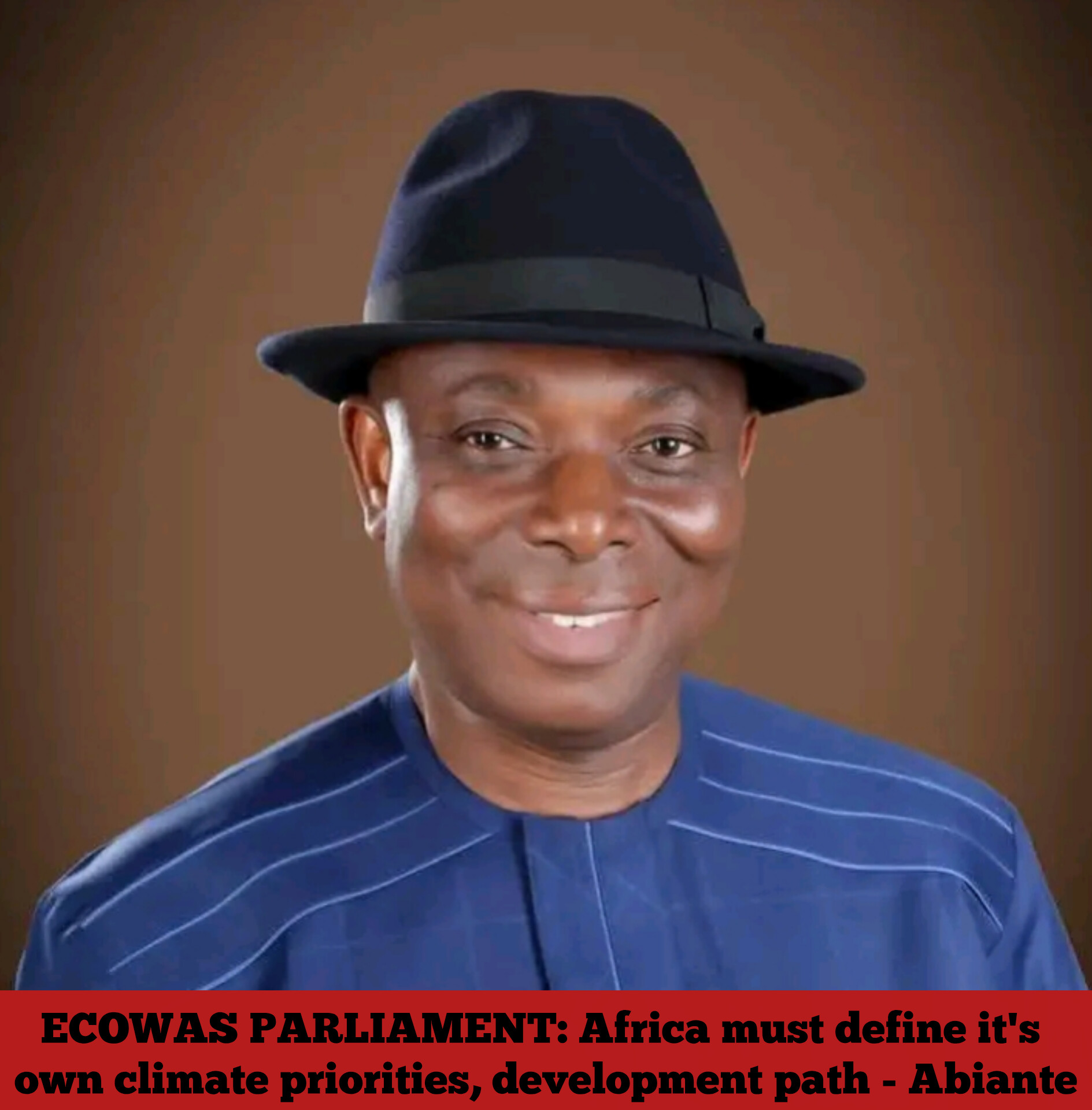
A member of the ECOWAS Parliament and Nigeria’s National Assembly representing Andoni-Opobo/Nkoro Federal Constituency of Rivers State, Mr. Awaji Nombek Dagomye Abiante says Africa must take greater control of its development agenda and determine its own priorities on climate change, energy and economic development.
Mr Abiante made the comments in an interview during the 2026 Second Extraordinary Session and Parliamentary Seminar of the regional parliament in Accra Ghana.
He questioned whether African countries had sufficient influence in shaping international climate agreements and policies that affect their development choices.
“Africa should be able to define who they are, define what they are, and define what they have,” he said.
He argued that Africa should not simply adopt decisions made elsewhere without considering the continent’s economic circumstances, resources and development needs.
Mr Abiante questioned the fairness of climate policies that encourage African countries to reduce their reliance on fossil fuels when some developed economies had historically relied heavily on coal and other fossil fuels during their industrialisation.
“They use coal to get to where they are today. They’re telling you, you cannot burn coal. You can’t use coal to generate energy. But we have a lot of coal in Nigeria, for instance, in Africa actually.”
He said the debate should also consider the different contributions countries make to global emissions and the economic capacity of nations to transition to cleaner energy.
“You can’t be contributing 90% of the challenges of this world and me that is contributing only one or 2% of it. You want me to suffocate while you are still there and tell me I’ll give you money.”
He called for climate responsibilities and sacrifices to be distributed equitably, taking into account historical emissions and the development needs of poorer countries.
The Nigerian lawmaker also questioned the extent to which Africa has benefited from international climate finance commitments.
He referred to the long-standing pledge by developed countries to mobilise $100bn annually for climate action in developing countries and asked where the resources had gone.
“How much has Africa benefited from? Where is the money? Where is the resource?” he asked.
He also questioned the consistency of calls for forest conservation and carbon credits while African countries continue to export raw materials.
“Are they not the same people who are coming to buy the logs from you to go and do furniture and import from them?” he said.
Mr Abiante said African countries needed to examine the terms of international agreements more carefully before committing themselves.
“African leaders don’t read… through some of these agreements within the international corridor, but they are very ready to go and sign.”
Mr Abiante said Africa had sufficient natural resources to support development but had failed to adequately process and add value to those resources domestically.
He cited Nigeria’s crude oil, Ghana’s gold, the Democratic Republic of Congo’s minerals and the continent’s diamond resources as examples.
“Africa has everything to develop,” he said.
He argued that African countries should move beyond exporting raw materials and instead build industries capable of processing resources locally.
According to him, the continent’s development challenge was not simply a lack of resources but also questions of political leadership, policy choices and public accountability.
Mr Abiante said Africans needed to examine their own institutions and leadership rather than attributing every development challenge to external actors.
“We are our problem. We are not ready. When Africa is ready, Africa would wake up.”
He said stronger institutions and accountable leadership were necessary if African countries were to translate their natural wealth into broad-based development.
He also used a management analogy to stress what he described as the importance of leadership.
“Everything revolves around leadership,” he said.
He cited historical African leaders, including Ghana’s first president Kwame Nkrumah and Congolese independence leader Patrice Lumumba, as examples in a discussion about leadership and the continent’s development trajectory.
Asked about the role of the ECOWAS Parliament in implementing regional climate and disaster-risk frameworks, Mr Abiante questioned the extent of the legislature’s powers.
“Do we have powers outside of advisory? And how many of the pieces of advice rendered have honestly been considered?” he asked.
He said the parliament’s ability to influence implementation was constrained if its recommendations remained advisory.
“Until you give a man responsibilities, you cannot question him, what have you done?” he said.
He suggested that strengthening the institution’s responsibilities and accountability mechanisms would be important if parliamentarians were expected to play a more direct role in regional policy implementation.
Mr Abiante said his approach as a parliamentarian was centred on representation, advocacy and accountability.
He said parliamentarians had a responsibility to raise questions, represent constituents and scrutinise government institutions.
“That is the essence of being a member of parliament, is to represent your people, to advocate, to speak to issues. And if it is possible, hold the institutions to account.”
He also criticised what he described as a tendency among some constituents to measure MPs primarily by the distribution of cash or material benefits rather than legislative performance.
“Some members of parliament believe that it’s sharing rights, sharing 5,000 Naira to constituents. That is what parliament means.”
He said constituents should pay greater attention to the legislative work of their representatives, including bills proposed, debates and oversight activities.
“Do you even know if your member of parliament had proposed a bill? They don’t know.”
Mr Abiante said greater public understanding of the role of parliament could strengthen democratic accountability.
“If members of our various constituencies understand the importance of parliament, the role of parliament as the gatekeepers… things will change.”
He said effective representation required both accountable lawmakers and informed constituents capable of demanding meaningful legislative performance.
The parliamentarian said he would continue to advocate for what he believes should be done in both Nigeria’s National Assembly and the ECOWAS Parliament.
“This man stands by his conviction. This man speaks for what is right and should be done,” he said, describing the feedback he receives from colleagues about his parliamentary work.
The interview was conducted during the ECOWAS Parliament’s 2026 parliamentary proceedings, where lawmakers have been examining climate change, environmental degradation, displacement, insecurity and the broader development challenges facing West Africa.


