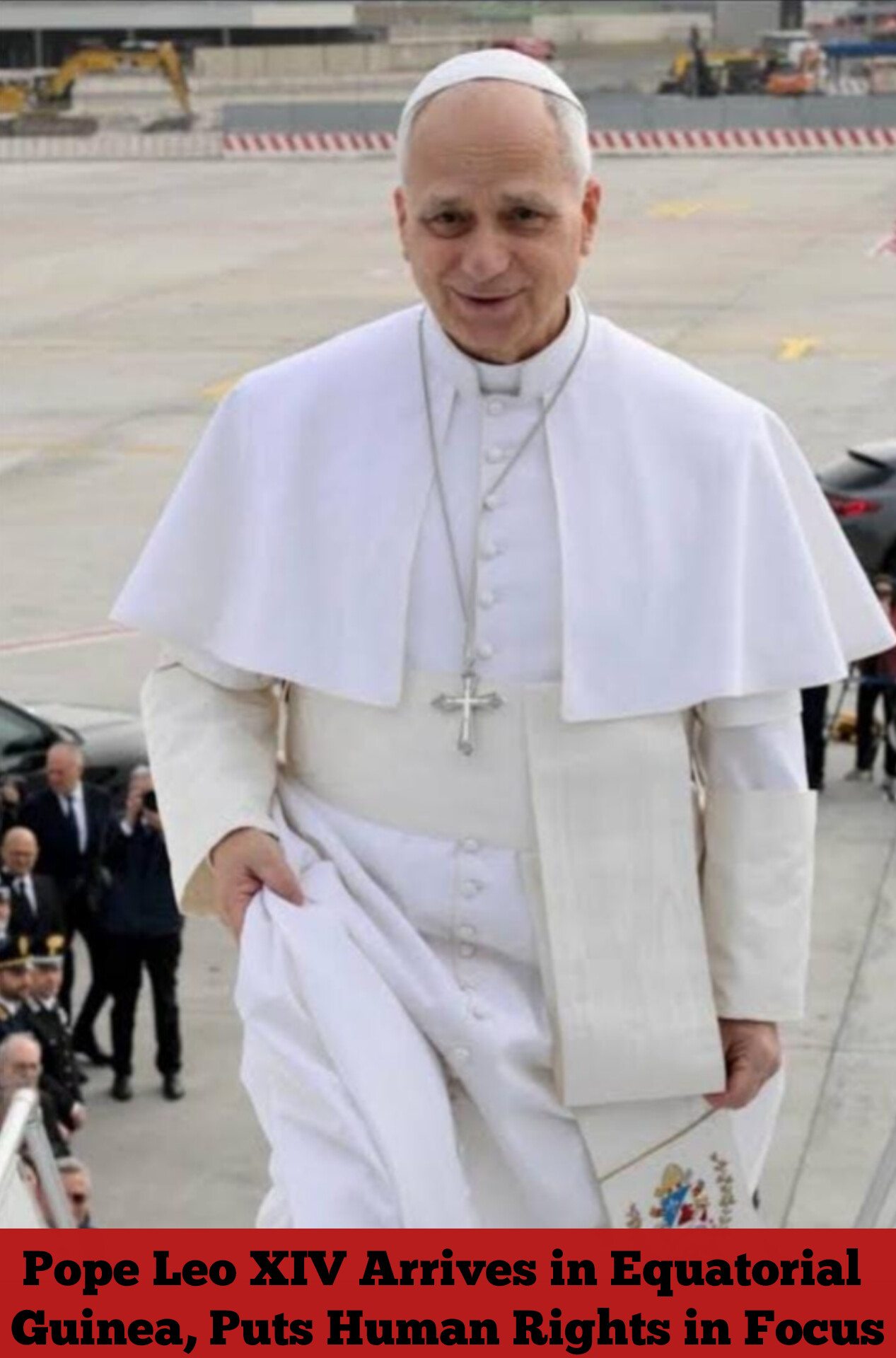
Pope Leo XIV begins the final leg of his African tour with a high-profile visit to Equatorial Guinea, where his increasingly outspoken stance on human rights is expected to draw global attention in one of the continent’s most tightly controlled states.
The US-born pontiff is scheduled to arrive in the Central African nation around noon (1100 GMT), following a three-day visit to Angola. His trip places him in a country ruled since 1979 by President Teodoro Obiang Nguema Mbasogo, 83, widely regarded as the world’s longest-serving non-monarchical head of state.
Pope Leo XIV’s visit follows in the footsteps of Pope John Paul II, who became the first pope to visit Equatorial Guinea four decades ago. The oil-rich nation of about two million people remains predominantly Catholic, a legacy of its Spanish colonial past.
Throughout his African tour, the pope has taken a firmer tone than in the past, openly criticising tyranny and exploitation while advocating peace and social justice. Observers say attention will now turn to whether he maintains that message during his stay in Equatorial Guinea.
The country has long faced criticism from international organisations over alleged authoritarian governance, human rights abuses, and restrictions on political opposition and media freedom. Many opposition figures and independent journalists are reported to be living in exile in Spain.
Despite the political backdrop, preparations for the papal visit have transformed the capital, Malabo. Streets are adorned with Vatican and national flags, alongside large portraits of the pope and welcome banners.
Local resident Juan Raul described the visit as a moment of hope for national unity.
“This will bring spiritual change and motivate many people to go to mass,” he said.
During his visit, Pope Leo XIV is expected to address government officials, members of the diplomatic corps, civil society groups, and representatives of the cultural sector.
His itinerary also includes a trip to Mongomo, the president’s political stronghold, where he will celebrate mass and visit a technology school named after Pope Francis. In Bata, the country’s economic hub, the pope will honour victims of a deadly military camp explosion that claimed more than 100 lives and is also scheduled to visit inmates at a local prison.
The visit will conclude with a large open-air mass at Malabo Stadium, bringing to a close the pope’s 11-day, 18,000-kilometre tour across Africa.