
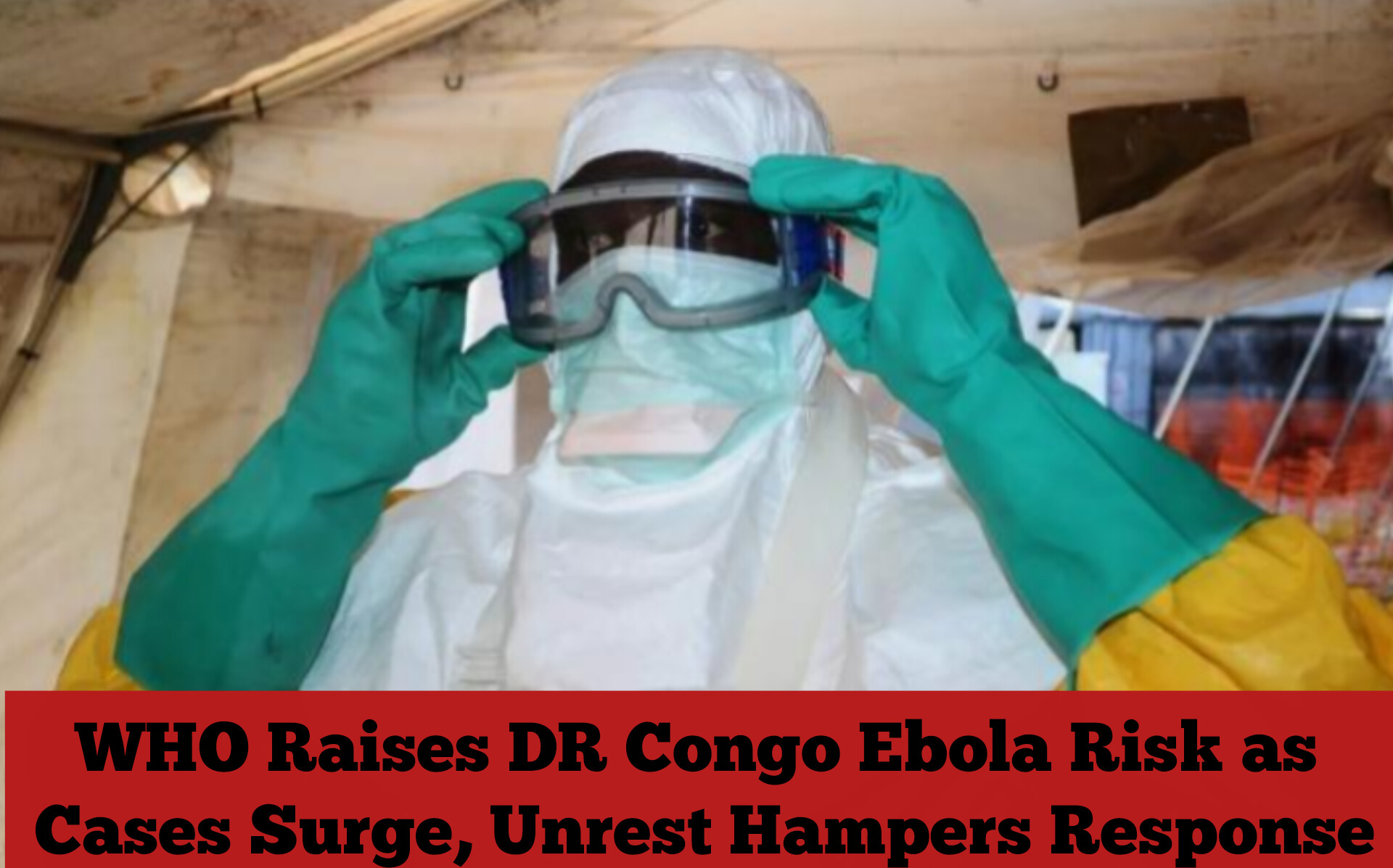
The World Health Organization (WHO) has raised its Ebola outbreak risk assessment for the Democratic Republic of Congo (DRC) to its highest level, warning that the epidemic is spreading rapidly as suspected infections and deaths continue to climb.
WHO Director-General Tedros Adhanom Ghebreyesus described the situation as “deeply worrisome”, revealing that health authorities are grappling with nearly 750 suspected cases and 177 suspected deaths across the country.
Speaking at a press briefing, Tedros said the UN health agency had upgraded the national risk level from “high” to “very high”, while maintaining the regional threat level at high and the global assessment at low.
“The Ebola outbreak in the Democratic Republic of the Congo is spreading rapidly,” he said.
According to WHO figures, 82 Ebola cases have so far been laboratory-confirmed in the DRC, resulting in seven confirmed deaths. However, the agency believes the true scale of the outbreak is significantly larger based on hundreds of suspected infections under investigation.
Health workers are racing to identify and monitor contacts of infected persons in a bid to contain the spread of the disease, which is caused by the Bundibugyo strain of Ebola.
The outbreak has already crossed borders, with Uganda confirming two Ebola cases linked to travellers from the DRC, including one death.
Tedros said Ugandan authorities had successfully limited further transmission through aggressive contact tracing and public health measures, including the cancellation of major Martyrs’ Day celebrations.
“The situation in Uganda is stable,” he said, adding that containment efforts appear to have prevented wider community spread.
The WHO chief also disclosed that two United States nationals linked to the outbreak had been evacuated from Africa for medical observation and treatment, with one transferred to Germany after testing positive and another moved to the Czech Republic as a high-risk contact.
To strengthen the response, WHO has deployed 22 international experts alongside national teams already operating in affected areas.
The outbreak response is facing major challenges from insecurity and public mistrust in parts of eastern Congo.
Authorities confirmed that rioters attacked and burned isolation tents at Rwampara Hospital in Ituri Province, one of the outbreak’s hotspots, after a dispute over the burial of a 24-year-old patient suspected to have died from Ebola.
Hospital officials said relatives demanded the release of the body for traditional burial rites, but health protocols required a controlled burial to prevent transmission.
“The family wanted us to hand over his body so that they can bury him, but given the circumstances, that’s impossible,” a hospital official said.
The unrest ended after soldiers fired warning shots to disperse crowds. A nurse was reportedly injured by stones thrown during the disturbance.
Military escorts later accompanied the burial of three suspected Ebola victims under strict safety procedures.
Despite mounting fatalities, some residents remain sceptical about the disease and government containment measures.
“My brother is not dead from Ebola, it’s an imaginary disease,” said 22-year-old Jeremie Arwampara outside the hospital.
Another relative, Ezekiel Shambuyi, protested authorities’ refusal to release the body of his brother.
“He’s my big brother, I cannot be afraid of him,” he said.
Public health experts warn that such attitudes are increasing transmission risks, particularly in rural communities where traditional mourning practices often involve direct contact with the deceased.
Civil society leader Jean Marie Ezadri said many families continue to touch bodies and gather in large numbers for funerals despite repeated warnings.
“Unfortunately, this is going on even during this epidemic, which explains the many instances of contamination,” he said.
The current outbreak is being driven by the Bundibugyo strain of Ebola, for which there is currently no approved vaccine or treatment.
WHO Chief Scientist Sylvie Briand said researchers are urgently evaluating existing medical tools that could help combat the disease.
The agency has prioritised two monoclonal antibody treatments for clinical trials and is also assessing the antiviral drug obeldesivir as a possible preventive treatment for people exposed to the virus.
Briand said early indications suggest the drug could help stop infected contacts from developing severe illness.
WHO is also working with international partners to accelerate the development of vaccines specifically targeting the Bundibugyo strain.
Ebola is transmitted through direct contact with infected bodily fluids and can cause severe bleeding, organ failure and death. Previous outbreaks of the Bundibugyo strain have been recorded only in Uganda and the DRC.