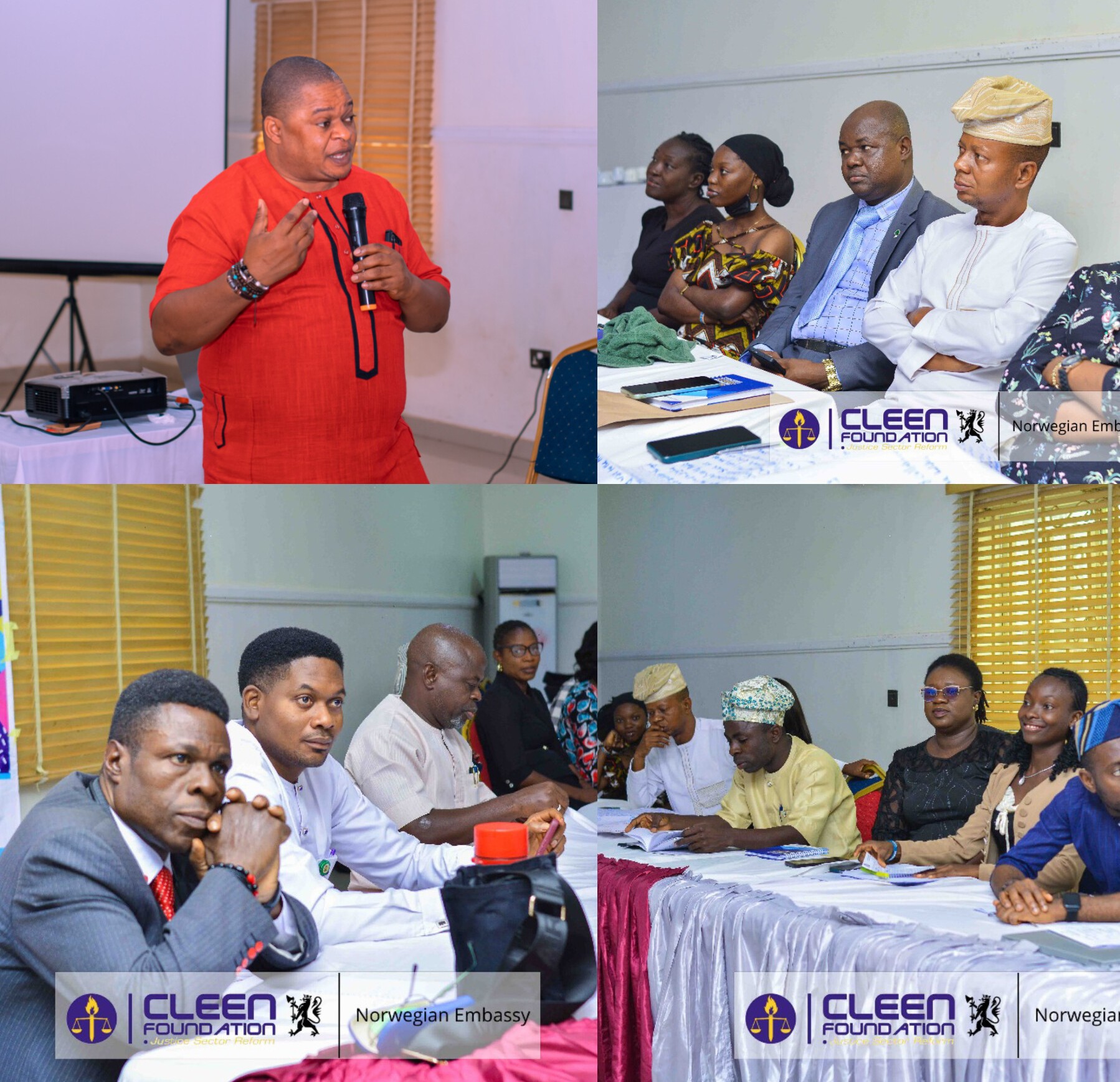
The workshop, held in Ado-Ekiti brought together key justice institutions including the Judiciary, Nigeria Police Force, Nigerian Correctional Service, Ministry of Justice, and the Nigeria Security and Civil Defence Corps (NSCDC).
Stakeholders in the Ekiti State justice sector have reaffirmed their commitment to improving the state’s criminal justice system through the effective implementation of the Administration of Criminal Justice Law (ACJL).
This renewed drive came during a two-day capacity-building workshop organized by the CLEEN Foundation, with support from the Royal Norwegian Embassy in Nigeria.
The workshop, held in Ado-Ekiti brought together key justice institutions including the Judiciary, Nigeria Police Force, Nigerian Correctional Service, Ministry of Justice, and the Nigeria Security and Civil Defence Corps (NSCDC).
Leading the training, Dr. Salaudeen Hashim of the CLEEN Foundation explained that the ACJL is a pivotal reform law designed to protect human rights, ensure fair hearing, and promote accountability in Nigeria’s criminal justice system.

“The ACJL rests on three strategic pillars — protection of rights, timely delivery of justice, and effective inter-agency coordination,” Hashim said. “Our goal is to help justice actors understand not just the letter of the law, but its spirit — which is fairness and efficiency.”
In a remark, Justice Lekan Ogunmoye, Chief Judge of Ekiti State, commended the collaborative effort, noting that the state has made significant progress in operationalizing the law.
“We are fortunate to have the key anchors of ACJL implementation gathered here today,” he said. “Ekiti is ahead of many states in enforcing the Criminal Justice Law, and we are determined to keep improving.”

Echoing this commitment, Commissioner of Police Joseph Eribo highlighted the importance of effective implementation for crime reduction.
“If properly implemented, the ACJL will reduce crime to the barest minimum,” Eribo said, adding that “sexual and gender-based crimes remain a concern that the police are determined to tackle more decisively.”
Other key participants included Comptroller Okuseinde Oluremi Christy of the Nigeria Correctional Service, representatives of the Attorney General and Commissioner for Justice, and the NSCDC.

Participants engaged in group discussions to identify bottlenecks in justice delivery and developed a State Action Plan to address them. The document outlines strategies to improve arrest and detention procedures, expedite case processing, strengthen inter-agency collaboration, and ensure better protection for both victims and defendants.
The CLEEN Foundation noted that the workshop forms part of its wider effort to enhance justice sector accountability, promote rule of law, and align Nigeria’s criminal justice processes with democratic and human rights principles.
“At CLEEN, we believe justice should be timely, fair, and transparent. Strengthening the ACJL implementation at state level is critical to achieving that vision,” Dr. Hashim concluded.